


Page 9 - ebook
P. 9
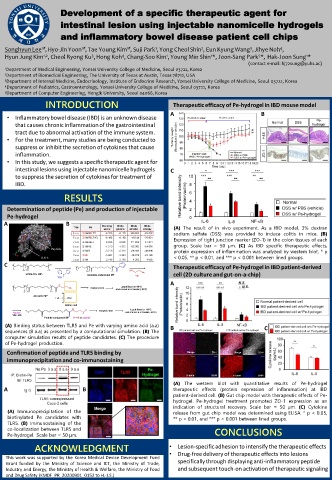
Development of a specific therapeutic agent for

                     intestinal lesion using injectable nanomicelle hydrogels
                     and inflammatory bowel disease patient cell chips


                                                    1
                                                                   2
                                                                                  3
               1#
                            1#
                                          1#
                                                                                            4
   Songhyun Lee , Hyo-Jin Yoon , Tae Young Kim , Suji Park , Yong Cheol Shin , Eun Kyung Wang , Jihye Noh ,
                                         4
   Hyun Jung Kim , Cheol Ryong Ku , Hong Koh , Chang-Soo Kim , Young Min Shin *, Joon-Sang Park *,  Hak-Joon Sung *
                               3
                                                                                                     1
               1,2
                                                                                     5
                                                       1
                                                                      1
                                                                                  (contact e-mail: hj72sung@yuhs.ac)
   1 Department of Medical Engineering, Yonsei University College of Medicine, Seoul 03722, Korea
   2 Department of Biomedical Engineering, The University of Texas at Austin, Texas 78712, USA
   3 Department of Internal Medicine, Endocrinology, Institute of Endocrine Research, Yonsei University College of Medicine, Seoul 03722, Korea
   4 Department of Pediatrics, Gastroenterology, Yonsei University College of Medicine, Seoul 03722, Korea
   5 Department of Computer Engineering, Hongik University, Seoul 04066, Korea
                INTRODUCTION                             Therapeutic efficacy of Pe-hydrogel in IBD mouse model
                                                        A                             B
   • Inflammatory bowel disease (IBD) is an unknown disease
      that causes chronic inflammation of the gastrointestinal
      tract due to abnormal activation of the immune system.
   • For the treatment, many studies are being conducted to
      suppress or inhibit the secretion of cytokines that cause
      inflammation.
   • In this study, we suggests a specific therapeutic agent for
      intestinal lesions using injectable nanomicelle hydrogels   C
      to suppress the secretion of cytokines for treatment of
      IBD.
                      RESULTS
   Determination of peptide (Pe) and production of injectable
   Pe-hydrogel
  A                    B
                                                         (A) The result of in vivo experiment. As a IBD model, 3% dextran
                                                         sodium sulfate (DSS) was provided to induce colitis in mice. (B)
                                                         Expression of tight junction marker (ZO-1) in the colon tissues of each
                                                         group. Scale bar = 50 µm. (C) As IBD specific therapeutic effects,
                                                         protein expression of inflammation was analyzed by western blot. * p
                                                         < 0.05, ** p < 0.01, and *** p < 0.001 between lined groups.
  C                                                      Therapeutic efficacy of Pe-hydrogel in IBD patient-derived
                                                         cell (2D culture and gut-on-a-chip)
                                                        A


   (A) Binding status between TLR5 and Pe with varying amino acid (a.a)
   sequences (8 a.a) as presented by a computational simulation. (B) The  B            C
   computer simulation results of peptide candidates. (C) The procedure
   of Pe-hydrogel production.
   Confirmation of peptide and TLR5 binding by
   immunoprecipitation and co-immunostaining


                                                         (A) The western blot with quantitative results of Pe-hydrogel
  A                         B                            therapeutic effects (protein expression of inflammation) at IBD
                                                         patient-derived cell. (B) Gut chip model with therapeutic effects of Pe-
                                                         hydrogel. Pe-hydrogel treatment promoted ZO-1 expression as an
                                                         indication of structural recovery. Scale bar = 50 µm. (C) Cytokine
   (A) Immunoprecipitation of the                        release from gut chip model was determined using ELISA. * p < 0.05,
   biotinylated Pe candidates with                       ** p < 0.01, and *** p < 0.001 between lined groups.
   TLR5. (B) Immunostaining of the
   co-localization between TLR5 and                                    CONCLUSIONS
   Pe-hydrogel. Scale bar = 50 µm.
            ACKNOWLEDGMENT                              • Lesion-specific adhesion to intensify the therapeutic effects
                                                        • Drug-free delivery of therapeutic effects into lesions
   This work was supported by the Korea Medical Device Development Fund
   Grant funded by the Ministry of Science and ICT, the Ministry of Trade,  specifically through displaying anti-inflammatory peptide
   Industry and Energy, the Ministry of Health & Welfare, the Ministry of Food  and subsequent touch-on activation of therapeutic signaling
   and Drug Safety (KMDF_PR_20200901_0152 to H.-J.S.)

