


Page 37 - ebook
P. 37
Aicardi-Goutières syndrome-associated gene SAMHD1 preserves genome integrity by
preventing R-loop formation at transcription–replication conflict regions
3
4
1
2
1
1
, , , , , ,
. ⁴, ¹ ∗
1 School of Biological Sciences , Seoul National University, Seoul 08826, Korea
2 Biomedical Research Institute, Seoul National University Hospital, Seoul 03080, Korea
3 Transdisciplinary Department of Medicine & Advanced Technology, Seoul National University Hospital,
Seoul 03080, Korea
4 Department of Physics and Astronomy, Seoul National University, Seoul 08826, Korea
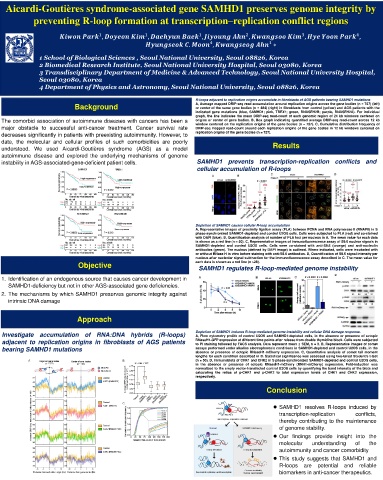
R-loops adjacent to replication origins accumulate in fibroblasts of AGS patients bearing SAMHD1 mutations
Background A, Average mapped DRIP-seq read accumulation around replication origins across the gene bodies (n = 727) (left)
or center of the same gene bodies (n = 484) (right) in fibroblasts from control (yellow) and AGS patients with the
indicated gene mutations (blue, SAMHD1; pink, TREX1; green, RNASEH2B; purple, RNASEH2A). For individual
graph, the line indicates the mean DRIP-seq read-count of each genomic region of 24 kb windows centered on
The comorbid association of autoimmune diseases with cancers has been a origins or center of gene bodies. B, Box graph indicating quantified average DRIP-seq read-count across 12 kb
major obstacle to successful anti-cancer treatment. Cancer survival rate window centered on the replication origins of the gene bodies (n = 727). C, Cumulative distribution frequency of
DRIP-seq mapped read-count around each replication origins of the gene bodies in 12 kb windows centered on
decreases significantly in patients with preexisting autoimmunity. However, to replication origins of the gene bodies (n = 727).
date, the molecular and cellular profiles of such comorbidities are poorly
understood. We used Aicardi-Goutières syndrome (AGS) as a model Results
autoimmune disease and explored the underlying mechanisms of genome
instability in AGS-associated-gene-deficient patient cells. SAMHD1 prevents transcription-replication conflicts and
cellular accumulation of R-loops
Depletion of SAMHD1 causes cellular R-loop accumulation
A, Representative images of proximity ligation assay (PLA) between PCNA and RNA polymerase II (RNAPII) in S
phase-synchronized SAMHD1-depleted and control U2OS cells. Cells were subjected to PLA (red) and co-stained
with DAPI (blue). B, Quantification analysis of number of PLA foci per nucleus in A. The mean value for each data
is shown as a red line (n = 50). C, Representative images of immunofluorescence assay of S9.6 nuclear signals in
SAMHD1-depleted and control U2OS cells. Cells were co-stained with anti-S9.6 (orange) and anti-nucleolin
antibodies (green). The nucleus (defined by DAPI image) is outlined. Where indicated, cells were incubated with
or without RNase H in vitro before staining with anti-S9.6 antibodies. D, Quantification of S9.6 signal intensity per
nucleus after nucleolar signal subtraction for the immunofluorescence assay described in C. The mean value for
Objective each data is shown as a red line (n >28).
SAMHD1 regulates R-loop-mediated genome instability
1. Identification of an endogenous source that causes cancer development in
SAMHD1-deficiency but not in other AGS-associated gene deficiencies.
2. The mechanisms by which SAMHD1 preserves genomic integrity against
intrinsic DNA damage
Approach
Investigate accumulation of RNA:DNA hybrids (R-loops) Depletion of SAMHD1 induces R-loop-mediated genome instability and cellular DNA damage response.
A, Flow cytometry prolife of control U2OS and SAMHD1-depleted cells, in the absence or presence of ectopic
adjacent to replication origins in fibroblasts of AGS patients RNaseH1-GFP expression at different time points after release from double thymidine block. Cells were subjected
to PI staining followed by FACS analysis. Data represent mean ± SEM, n = 3. B, Representative images of comet
bearing SAMHD1 mutations assays performed under alkaline electrophoresis conditions in SAMHD1-depleted and control U2OS cells, in the
absence or presence of ectopic RNaseH1-mCherry expression. C, Quantitative analysis of comet tail moment
lengths for each condition described in B. Statistical significance was assessed using two-tailed Student’s t-test
(n = 50). D, Immunoblots of CHK1 and CHK2 in S phase-synchronized SAMHD1-depleted and control U2OS cells,
in the absence or presence of ectopic RNaseH1-mCherry (RNH1-mCherry) expression. Fold-induction was
normalized to the empty vector-transfected control U2OS cells by quantifying the band intensity of the blots and
calculating the ratios of p-CHK1 and p-CHK2 to total expression levels of CHK1 and CHK2 expression,
respectively.
Conclusion
SAMHD1 resolves R-loops induced by
transcription-replication conflicts,
thereby contributing to the maintenance
of genome stability.
Our findings provide insight into the
molecular understanding of the
autoimmunity and cancer comorbidity
This study suggests that SAMHD1 and
R-loops are potential and reliable
biomarkers in anti-cancer therapeutics.

