


Page 31 - ebook
P. 31
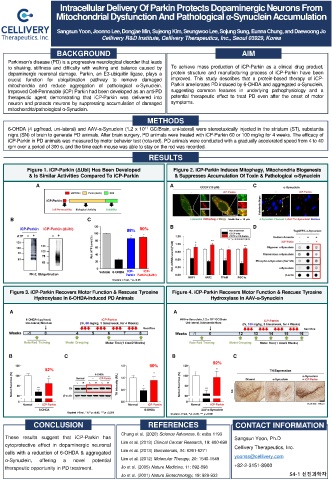
Intracellular Delivery Of Parkin Protects Dopaminergic Neurons From
Mitochondrial Dysfunction And Pathological α-Synuclein Accumulation
SangsunYoon, JoonnoLee, DongjaeMin, SujeongKim, SeungwooLee, SojungSung, EunnaChung, and DaewoongJo
Cellivery R&D Institute, Cellivery Therapeutics, Inc., Seoul 03929, Korea
BACKGROUND AIM
Parkinson’s disease (PD) is a progressive neurological disorder that leads
to shaking, stiffness and difficulty with walking and balance caused by To achieve mass production of iCP-Parkin as a clinical drug product,
dopaminergic neuronal damage. Parkin, an E3-ubiquitin ligase, plays a protein structure and manufacturing process of iCP-Parkin have been
crucial function for ubiquitination pathway to remove damaged improved. This study describes that a protein-based therapy of iCP-
mitochondria and reduce aggregation of pathological α-Synuclein. Parkin ameliorates PD induced by 6-OHDA and aggregated α-Synuclein,
Improved Cell-Permeable (iCP) Parkin had been developed as an anti-PD suggesting common features in underlying pathophysiology and a
therapeutic agent demonstrating that iCP-Parkin was delivered into potential therapeutic effect to treat PD even after the onset of motor
neuron and protects neurons by suppressing accumulation of damaged symptoms.
mitochondria/pathological α-Synuclein.
METHODS
6-OHDA (4 μg/head, uni-lateral) and AAV-α-Synuclein (1.2 x 10 11 GC/Brain, uni-lateral) were stereotaxically injected in the striatum (ST), substantia
nigra (SN) of brain to generate PD animals. After brain surgery, PD animals were treated with iCP-Parkin 60 or 100 mg/kg for 4 weeks. The efficacy of
iCP-Parkin in PD animals was measured by motor behavior test (rota-rod). PD animals were conducted with a gradually accelerated speed from 4 to 40
rpm over a period of 300 s, and the time each mouse was able to stay on the rod was recorded.
RESULTS
Figure 1. iCP-Parkin (ΔUbl) Has Been Developed Figure 2. iCP-Parkin Induces Mitophagy, Mitochondria Biogenesis
& Is Similar Activities Compared To iCP-Parkin & Suppresses Accumulation Of Toxin & Pathological α-Synuclein
A A C
B C Scale Bar = 10 m
89% 90% B D
Vehicle 6-OHDA iCP- iCP-
FK-2, Ubiquitination Parkin Parkin (ΔUbl)
Student t-Test, * p <0.05
Figure 3. iCP-Parkin Recovers Motor Function & Rescues Tyrosine Figure 4. iCP-Parkin Recovers Motor Function & Rescues Tyrosine
Hydroxylase In 6-OHDA-Induced PD Animals Hydroxylase In AAV-α-Synuclein
A A
B C B C
92%
90%
52%
Student t-Test, * & # p <0.05, *** p <0.001 Student t-Test, # p <0.05, *** p <0.001
CONCLUSION REFERENCES CONTACT INFORMATION
Chung et al. (2020) Science Advances, 6: eaba 1193
These results suggest that iCP-Parkin has Sangsun Yoon, Ph.D
Lim et al. (2013) Clinical Cancer Research, 19: 680-690
cytoprotective effect in dopaminergic neuronal Cellivery Therapeutics, Inc.
cells with a reduction of 6-OHDA & aggregated Lim et al. (2013) Biomaterials, 34: 6261-6271 yoonss@cellivery.com
α-Synuclein, offering a novel potential Lim et al. (2012) Molecular Therapy, 20: 1540-1549
therapeutic opportunity in PD treatment. Jo et al. (2005) Nature Medicine, 11: 892-898 +82-2-3151-8900
Jo et al. (2001) Nature Biotechnology, 19: 929-933 S4-1 신진과학자

