Page 27 - ebook
P. 27

The API5-FGF2 complex functions in mRNA export and is a potential target for cancer therapeutics


                                                                                                                                                                                       SeonJeong Baek, Seoungmin Bong and Byung Il Lee


                                                                                                                                                              1 Research Institute, National Cancer center, Goyang, Gyeonggi 10408, Korea,


                                                                    2 Department of Cancer Biomedical Science, National Cancer Center Graduate School of Cancer Science and Policy, Goyang-si, Gyeonggi 10408, Republic of Korea


                            ABSTRACT


             API5 (APoptosis Inhibitor 5) and nuclear FGF2 (Fibroblast Growth Factor 2) are upregulated in various human cancers and are correlated with poor prognosis. Although their physical interaction has been identified,


             the function of the resulting complex in cancer is unknown. Here, we determined the crystal structure of the API5–FGF2 complex and identified critical residues driving the protein interaction. This provided


             structural basis of nuclear localization of the FGF2 isoform lacking canonical nuclear localization signal and identified cryptic nuclear localization sequence in FGF2. The interaction between API5 and FGF2 was


             important for mRNA export through both the TREX and eIF4E/LRPPRC mRNA export complexes, regulating the export of bulk mRNA and specific mRNAs containing eIF4E sensitivity elements, such as c-MYC


             and cyclin D1. Interestingly, API5–FGF2 complex directly interacted with UAP56, a common factor of these two mRNA export complexes. Disruption of the API5–FGF2 interaction reduced cell proliferation and


             increased drug sensitivity. These data reveal a previously unknown function for API5 and nuclear FGF2 and suggest a new therapeutic target for regulating the expression of oncogenes at the mRNA export level.


             And in further studies, to discover chemicals that bind to the API5-FGF2 complex, we use thermal shift assay to prioritize Fragment-Based Drug Discovery (FBDD) library screening and select hits.


                  INTRODUCTION                                                                                                                                                                                                                                                                                                                                                                                           METHOD


                                                                                                                                                                                                                                                                                   - low-molecular weight (LMW) FGF2                                                                                 CLONING & OVEREXPRESSION


                                                                                                                                                                                                                                                                                     isoform lacking the N-terminal extensions is                                                                   ESCHERICHIA COLI EXPRESSION
                                                                                                                                                                                                                                                                                                                                                                                                    SYSTEM (pET28b/pHis VECTOR)
                                                                                                                                                                                                                                                                                     usually secreted to function in autocrine


                                                                                                                                                                                                                                                                                     or paracrine FGF2 signaling by association


                                                                                                                                                                                                                                                                                     with heparan sulfate proteoglycans (HSPGs)


                                                                                                                                                                                                                                                                                     and FGF receptors (FGFRs).

                                                                                                                                                                                                                                                                                                                                                                                                                     PURIFICATION


                                                                                                                                                                                                                                                                                   - High-molecular-weight (HMW) FGF2


                                                                                                                                                                                                                                                                                     isoforms that possess N-terminal NLS

                                                                                                                                                                                                                                                                                     sequences are localized to the nucleus to


                                                                                                                                                                                                                                                                                     perform various FGFR-independent function.


                                                                                                                                                                                               Atlas of Genetics and Cytogenetics in Oncology and Haematology


                                                                                                                                         Yang et al., 2009, Trends Mol Med


                                                                                                              - Apoptosis inhibitor 5 (API5) is a nuclear


                                                                                                                protein that inhibits apoptosis in human cells.


                                                                                                              - API5 is important for cell cycle progression,


                                                                                                                immune escape, metastasis, and the stem-


                                                                                                                cell-like properties of cancer cells and that it                                                                                                                                                                                                                                               CRYSTALLIZATION


                                                                                                                promotes drug resistance in cancer.


                                                                                                              - Interaction partners : Fibroblast growth


                                                                        (Han et al 2012, J. Biol. Chem.)        factor 2 (FGF2), Acinus, Influenza A virus
                                                                                                                nucleoprotein, Estrogen receptor.


                        RESULTS                                                                                                                                                                                                                                                                     Terai et al., 2013, Mol cancer Res.


                                                                                                                                                                                                                                                                                                                                                                                                STRUCTURE DETERMINATION,


                                                                                                                                                                                                                                                                                                                                                                                                  REFINEMENT, AND ANALYSIS


                                                                                                                                                                                                                                                                                                                                                                                                                                                        HKL2000


                                                                                                                                                                                                                                                                                                                                                                                                                                                        Coot


                                                                                                                                                                                                                                                                                                                                                                                                                                                        Refmac


                                                                                                                                                                                                                                                                                                                                                                                                                                                        Phenix


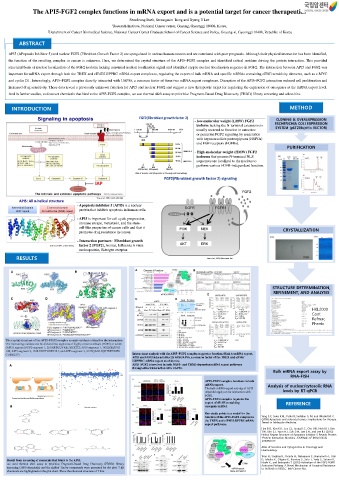
         The crystal structure of the API5–FGF2 complex reveals residues critical for the interaction

         The interacting residues can be divided into segments of highly conserved basic (FGF2) or acidic


         (API5) regions (FGF2-segment 1, 261KRTGQYKLGSKT272; API5-segment 1, 142QGEDIVR

         148; API5-segment 2, 183LEDVTGEEF191; and API5-segment 3, 219EQADLEQTFNPSDPD

         CVDR237)                                                                                                                                                                          Interactome analysis with the API5–FGF2 complex suggests a functional link to mRNA export.
                                                                                                                                                                                           API5 and FGF2 interact directly withUAP56, a common factor of the TREX and eIF4E/

                                                                                                                                                                                           LRPPRC mRNA export machineries.


                                                                                    4                                                                                                      API5–FGF2 is involved in both NXF1- and CRM1-dependent mRNA export pathways

                                                                                                                                                                                           through direct interaction with UAP56.
                                                                                    2
                                                                                                                                                                                                                                                                                                                                                                                                 Bulk mRNA export assay by

                                                                                    0
                                                                                      0         200        400       600        800       1000       1200      1400       1600                                                                                                                                                                                                                                            RNA-FISH
                                                                                   -2

                                                                                                                                                                                                                                                                                                 API5–FGF2 complex functions in bulk
                                                                                   -4
                                                                                  ΔTm(°C)  -6                                                                                                                                                                                                    mRNA export.                                                                             Analysis of nuclear/cytosolic RNA


                                                                                   -8                                                                                                                                                                                                            The bulk mRNA export activity of API5                                                                         levels by RT-qPCR
                                                                                                                                                                                                                                                                                                 depends largely on its interaction with
                                                                                  -10
                                                                                                                                                                                                                                                                                                 FGF2.

                  Fragment-Based Drug Discovery (FBDD) conceptual diagram         -12                                                                                                                                                                                                            API5–FGF2 complex regulates the


                                                                                  -14                                                                                                                                                                                                            export of 4E-SE containing                                                                                        REFERENCE
                                                                                                                                                                                                                                                                                                 oncogenic mRNA
                                                                                  -16                                  Chemical numbers


                                                                                                                                                                                                                                                                                                 Our study points to a model for the

                                                                                                                                                                                                                                                                                                 function of the API5-FGF2 complex in                                            Yang S.Y., Sales K.M., Fuller B, Seifalian A. M. and Winslet M. C.


                                                                                                                                                                                                                                                                                                 the TREX and eIF4E/LRPPRCmRNA                                                   (2009) Apoptosis and colorectal cancer: implications for therapy.
                                                                                                                                                                                                                                                                                                                                                                                 Trends in Molecular Medicine
                                                                                                                                                                                                                                                                                                                                                                                                                                 .
                                                                                                                                                                                                                                                                                                 export pathways.

                                                                                                                                                                                                                                                                                                                                                                                 Han B.G., Kim K.H., Lee S.J., Jeong K.C., Cho J.W., Noh K.H., Kim

                                                                                                                                                                                                                                                                                                                                                                                 T.W., Kim S.J., Yoon H.J., Suh S.W., Lee S.H., and Lee B.I. (2012)

                                                                                                                                                                                                                                                                                                                                                                                 Helical Repeat Structure of Apoptosis Inhibitor 5 Reveals Protein
                                                                                                                                                                                                                                                                                                                                                                                 -Protein Interaction Modules. JOURNAL OF BIOLOGICAL

                                                                                                                                                                                                                                                                                                                                                                                 CHEMISTRY.


                                                                                                                                                                                                                                                                                                                                                                                 Atlas of Genetics and Cytogenetics in Oncology and
                                                                                                                                                                                                                                                                                                                                                                                 Haematology.


                                                                                                                                                                                                                                                                                                                                                                                 Terai H., Soejima K., Yasuda H., Nakayama S., Hamamoto J., Arai

           Result from screening of chemicals that binds to the API5.                                                                                                                                                                                                                                                                                                            D., Ishioka K., Ohgino K., Ikemura S., Sato T., Yoda S., Satomi R.,


           we used thermal shift assay to prioritize Fragment-Based Drug Discovery (FBDD) library                                                                                                                                                                                                                                                                                Naoki K., and Betsuyaku T. (2013) Activation of the FGF2-FGFR1
                                                                                                                                                                                                                                                                                                                                                                                 Autocrine Pathway: A Novel Mechanism of Acquired Resistance
           screening (1600 chemicals) and the shifted Tm by compounds were presented by dot-plot. 7 hit                                                                                                                                                                                                                                                                          to Gefitinib in NSCLC. Mol Cancer Res.

           chemicals are highlighted on the plot chart. Show the chemical structure of 7 hits.
   22   23   24   25   26   27   28   29   30   31   32