


Page 21 - ebook
P. 21
Membrane-Free Stem Cell Extract Enhances Blood–Brain Barrier Integrity by
       Suppressing NF-κB-Mediated Activation of NLRP3 Inflammasome in Mice
                                         with Ischemic Stroke
  Ji Hyeon Ryu¹, Jisu Park¹, Ji Won Kim¹, Min Jae Kim², Hye Sook Park³, Young  Sil Kim³, Hwa Kyoung Shin², Yong-Il Shin¹,⁴*
        1  Research Institute for Convergence of Biomedical Science and Technology, Pusan National University Yangsan Hospital, Yangsan
        2  Department of Korean Medical Science, School of Korean Medicine, Pusan National University, Yangsan
        3  T-Stem Co., Ltd., Changwon; 4   Department of Rehabilitation Medicine, Pusan National University School of Medicine, Yangsan
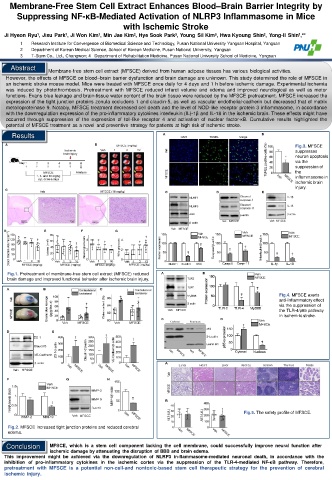
     Abstract    Membrane-free stem cell extract (MFSCE) derived from human adipose tissues has various biological activities.
   However, the effects of MFSCE on blood–brain barrier dysfunction and brain damage are unknown. This study determined the role of MFSCE in
   an ischemic stroke mouse model. Mice were treated with MFSCE once daily for 4 days and 1 h before ischemic damage. Experimental ischemia
   was induced by photothrombosis. Pretreatment with MFSCE reduced infarct volume and edema and improved neurological as well as motor
   functions. Evans blue leakage and brain-tissue water content of the brain tissue were reduced by the MFSCE pretreatment. MFSCE increased the
   expression of the tight junction proteins zonula occludens 1 and claudin-5, as well as vascular endothelial-cadherin but decreased that of matrix
   metalloproteinase 9. Notably, MFSCE treatment decreased cell death and the level of NOD-like receptor protein 3 inflammasome, in accordance
   with the downregulation expression of the pro-inflammatory cytokines interleukin (IL)-1β and IL-18 in the ischemic brain. These effects might have
   occurred through suppression of the expression of toll-like receptor 4 and activation of nuclear factor-κB. Cumulative results highlighted the
   potential of MFSCE treatment as a novel and preventive strategy for patients at high risk of ischemic stroke.
     Results
                                                                                                 Fig.3. MFSCE
                                                                                                 suppresses
                                                                                                 neuron apoptosis
                                                                                                 via the
                                                                                                 suppression of
                                                                                                 the
                                                                                                 inflammasome in
                                                                                                 ischemic brain
                                                                                                 injury.


   Fig.1. Pretreatment of membrane-free stem cell extract (MFSCE) reduced
   brain damage and improved functional behavior after ischemic brain injury.

                                                                                            Fig.4. MFSCE exerts
                                                                                            anti-inflammatory effect
                                                                                            via the suppression of
                                                                                            the TLR-4/p65 pathway
                                                                                            in ischem-ic stroke.


                                                                                Fig.5. The safety profile of MFSCE.

    Fig.2. MFSCE increased tight junction proteins and reduced cerebral
    edema.

   Conclusion    MFSCE, which is a stem cell component lacking the cell membrane, could successfully improve neural function after
                 ischemic damage by attenuating the disruption of BBB and brain edema.
  This improvement might be achieved via the downregulation of NLRP3 in-flammasome-mediated neuronal death, in accordance with the
  inhibition of pro-inflammatory cytokines in the ischemic cortex via the suppression of the TLR-4-mediated NF-κB pathway. Therefore,
  pretreatment with MFSCE is a potential non-cell-and nontoxic-based stem cell therapeutic strategy for the prevention of cerebral
  ischemic injury.

