


Page 17 - Y. Vascular biology
P. 17
NF-κB-responsive microRNA-155 induces functional impairment of
                             VSMCs by downregulating soluble guanylyl cyclase.

                       Minsik Park , Wonjin Park , Suji Kim , Taesam Kim , Young-Guen Kwon and Young-Myeong Kim a
                                               a
                                                        a
                                                                      b
                               a
                                        a
       a Departments of Molecular and Cellular Biochemistry, Kangwon National University School of Medicine, Chuncheon, Gangwon-do, South Korea
                  b Department of Biochemistry, College of Life Science and Biotechnology, Yonsei University, Seoul, South Korea
                   BACKGROUND                                                  AIM
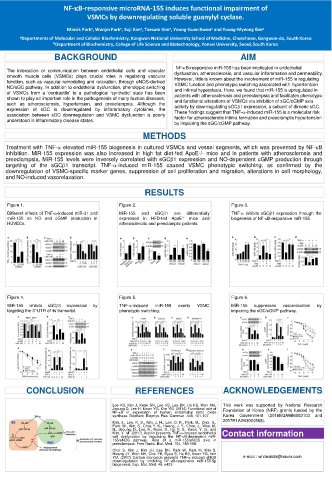
                                                          NF-κB-responsive miR-155 has been implicated in endothelial
   The interaction or communication between endothelial cells and vascular  dysfunction, atherosclerosis, and vascular inflammation and permeability.
   smooth muscle cells (VSMCs) plays crucial roles in regulating vascular  However, little is known about the involvement of miR-155 in regulating
   function, such as vascular remodeling and relaxation, through eNOS-derived  VSMC function and phenotypic switching associated with hypertension
   NO/sGC pathway. In addition to endothelial dysfunction, phenotypic switching  and intimal hyperplasia. Here, we found that miR-155 is upregulated in
   of VSMCs from a ‘contractile’ to a pathological ‘synthetic’ state has been  patients with atherosclerosis and preeclampsia and facilitates phenotypic
   shown to play an important role in the pathogenesis of many human diseases,  and functional alterations of VSMCs via inhibition of sGC/cGMP axis
   such as atherosclerosis, hypertension, and preeclampsia. Although the  activity by downregulating sGCβ1 expression, a subunit of dimeric sGC.
   expression of sGC is downregulated by inflammatory cytokines, the
   association between sGC downregulation and VSMC dysfunction is poorly  These findings suggest that TNF-α-induced miR-155 is a molecular risk
   understood in inflammatory disease states.             factor for atherosclerotic intima formation and preeclamptic hypertension
                                                          by impairing the sGC/cGMP pathway.
                                                METHODS

   Treatment with TNF-α elevated miR-155 biogenesis in cultured VSMCs and vessel segments, which was prevented by NF-κB
   inhibition. MiR-155 expression was also increased in high fat diet-fed ApoE-/- mice and in patients with atherosclerosis and
   preeclampsia. MiR-155 levels were inversely correlated with sGCβ1 expression and NO-dependent cGMP production through
   targeting of the sGCβ1 transcript. TNF-α-induced miR-155 caused VSMC phenotypic switching, as confirmed by the
   downregulation of VSMC-specific marker genes, suppression of cell proliferation and migration, alterations in cell morphology,
   and NO-induced vasorelaxation.

                                                RESULTS

   Figure 1.                            Figure 2.                           Figure 3.
   Different effects of TNF-α-induced miR-31 and  MiR-155  and  sGCβ1  are  differentially  TNF-α inhibits sGCβ1 expression through the
   miR-155 on NO and cGMP production in  expressed in  HFD-fed  ApoE -/-  mice and  biogenesis of NF-κB-responsive miR-155.
   HUVECs.                              atherosclerotic and preeclamptic patients.


   Figure 4.                            Figure 5.                           Figure 6.
   MiR-155  inhibits  sGCβ1  expression  by  TNF-α-induced  miR-155  exerts  VSMC  MiR-155  suppresses  vasorelaxation  by
   targeting the 3’-UTR of its transcript.  phenotypic switching.           impairing the sGC/cGMP pathway.


          CONCLUSION                         REFERENCES                   ACKNOWLEDGEMENTS


                                      Lee KS, Kim J, Kwak SN, Lee KS, Lee DK, Ha KS, Won MH,  This work was supported by National Research
                                      Jeoung D, Lee H, Kwon YG, Kim YM. (2014) Functional role of  Foundation of Korea (NRF) grants funded by the
                                      NF-κB in expression of human endothelial nitric oxide
                                      synthase. Biochem. Biophys. Res. Commun. 448, 101-107.  Korea  Government  (2016M3A9B6903103  and
                                      Kim, J., Lee, K. S., Kim, J. H., Lee, D. K., Park, M., Choi, S.,  2017R1A2B3004565).
                                      Park, W., Kim, S., Choi, Y. K., Hwang, J. Y., Choe, J., Won, M.
                                      H., Jeoung, D., Lee, H., Ryoo, S., Ha, K. S., Kwon, Y. G., and
                                      Kim, Y. M. (2017) Aspirin prevents TNF-α-induced endothelial  Contact information
                                      cell dysfunction by regulating the NF-κB-dependent miR-
                                      155/eNOS pathway: Role of a miR-155/eNOS axis in
                                      preeclampsia. Free Radic. Biol. Med. 104, 185-198.
                                      Choi S, Kim J, Kim JH, Lee DK, Park W, Park M, Kim S,
                                      Hwang JY, Won MH, Choi YK, Ryoo S, Ha KS, Kwon YG, Kim
                                      YM. (2017) Carbon monoxide prevents TNF-α-induced eNOS  e-mail : whitealstlr@naver.com
                                      downregulation by inhibiting NF-κB-responsive miR-155-5p
                                      biogenesis. Exp. Mol. Med. 49, e403

