


Page 19 - Y. Vascular biology
P. 19
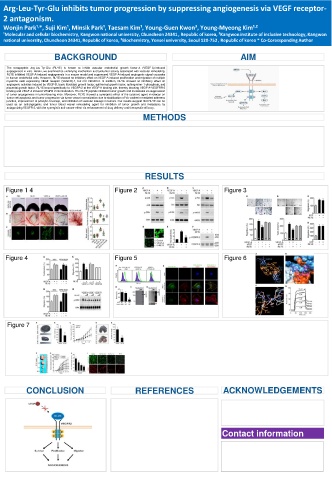
Arg-Leu-Tyr-Glu inhibits tumor progression by suppressing angiogenesis via VEGF receptor-
  2 antagonism.

  Wonjin Park¹ *, Suji Kim¹, Minsik Park¹, Taesam Kim¹, Young-Guen Kwon³, Young-Myeong Kim¹ ²
                                                                                    ,
             ,
  ¹Molecular and cellular biochemistry, Kangwon national university, Chuncheon 24341 , Republic of korea, ²Kangwon institute of inclusive technology, Kangwon
  national university, Chuncheon 24341, Republic of korea, ³Biochemistry, Yonsei university, Seoul 120-752 , Republic of korea * Co-Coressponding Author
                   BACKGROUND                                                  AIM

   The tetrapeptide Arg-Leu-Tyr-Glu (RLYE) is known to inhibit vascular endothelial growth factor-A (VEGF-A)-induced
   angiogenesis in vitro. Herein, we examined its underlying mechanism and antitumor activity associated with vascular remodeling.
   RLYE inhibited VEGF-A-induced angiogenesis in a mouse model and suppressed VEGF-A-induced angiogenic signal cascades
   in human endothelial cells. However, RLYE showed no inhibitory effect on VEGF-A-induced proliferation and migration of multiple
   myeloma cells expressing VEGF receptor (VEGFR)-1, but not VEGFR-2. In addition, RLYE showed no inhibitory effect on
   angiogenic activities induced by VEGF-B, basic fibroblast growth factor, epithermal growth factor, sphingosine- 1-phosphate, and
   placental growth factor. RLYE bound specifically to VEGFR-2 at the VEGF-A binding site, thereby blocking VEGF-A-VEGFRR-2
   binding and VEGF-A-induced VEGFR-2 internalization. The RLYE peptide inhibited tumor growth and metastasis via suppression
   of tumor angiogenesis in tumor-bearing mice. Moreover, RLYE showed a synergistic effect of the cytotoxic agent irinotecan on
   tumor cell apoptosis and tumor progression via tumor vessel normalization due to stabilization of VE-cadherin-mediated adherens
   junction, improvement of pericyte coverage, and inhibition of vascular leakage in tumors. Our results suggest that RLYE can be
   used as an antiangiogenic and tumor blood vessel remodeling agent for inhibition of tumor growth and metastasis by
   antagonizing VEGFR-2, with the synergistic anti-cancer effect via enhancement of drug delivery and therapeutic efficacy.
                                                METHODS


                                                RESULTS

   Figure 1 4                         Figure 2                            Figure 3


   Figure 4                           Figure 5                            Figure 6


   Figure 7


          CONCLUSION                         REFERENCES                   ACKNOWLEDGEMENTS


                                                                         Contact information

