


Page 5 - V. Proteomics
P. 5
Proteome discovery of ASFV infected PAM cell
GaSeul Lee¹, MinJu Ahn², DaeGwin Jeong², JeongHee Moon¹,*
¹Disease Target Structure Research Center, KRIBB, Daejeon 34141, Korea,
²Infectious Disease Research Center, KRIBB, Daejeon 34141, Korea
BACKGROUND RESULTS
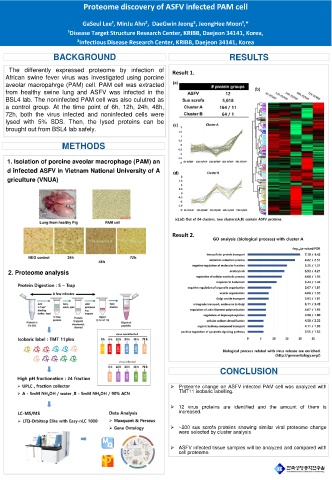
The differently expressed proteome by infection of Result 1.
African swine fever virus was investigated using porcine
aveolar macropahrge (PAM) cell. PAM cell was extracted
from healthy swine lung and ASFV was infected in the
BSL4 lab. The noninfected PAM cell was also culutred as
a control group. At the time point of 6h, 12h, 24h, 48h,
72h, both the virus infected and noninfected cells were
lysed with 5% SDS. Then, the lysed proteins can be
brought out from BSL4 lab safely.
METHODS
1. Isolation of porcine aveolar macrophage (PAM) an
d infected ASFV in Vietnam National University of A
griculture (VNUA)
Result 2.
2. Proteome analysis
CONCLUSION
Proteome change on ASFV infected PAM cell was analyzed with
TMT11 isobaric labelling.
12 virus proteins are identified and the amount of them is
increased.
~200 sus scrofa proteins showing similar viral proteome change
were selected by cluster analysis
ASFV infected tissue samples will be analyzed and compared with
cell proteome.

