


Page 7 - V. Proteomics
P. 7
Identification of rice caleosin gene OsPXG9 with peroxygenase activity
  involved in oxylipin pathways

  Duc Tran Anh , Kyoungwon Cho , Oksoo Han*
                               *
               *
  *Department of Molecular Biotechnology and Kumho Life Science Laboratory, College of Agriculture and Life Sciences, Chonnam National
  University, Gwangju, South Korea
                                            BACKGROUND

   Caleosin is group of genes that are specialized by several structural features, including Calcium binding EF hand motif, Proline-rich knot region and heme-binding residues. Caleosins are
   generally involved in variety of biological functions. Rice, among cereals, is a key crop plant that plays significant roles among human population. Oxylipin pathways in rice has been researched
   for a long time, especially octadecanoid pathways that is responsible for producing jasmonic acid under various stresses (1). However, there are many other oxylipin pathways are remain
   enigmatical. In some plants, caleosins that are reported to have peroxygenase activity are generally play roles in responding to either biotic or abiotic stresses by involving in oxylipin pathways.
   In this study, we investigated to study about one protein in rice, OsPXG9 (Accession number AK104598.1), turned out to be a caleosin with peroxygenase activity and create several enzymatic
   products which are related to plant defense.
                                                RESULTS

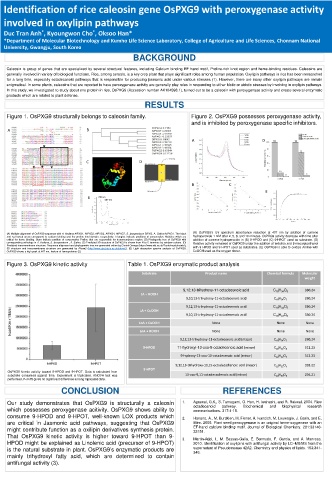
   Figure 1. OsPXG9 structurally belongs to caleosin family.   Figure 2. OsPXG9 possesses peroxygenase activity,
                                                               and is inhibited by peroxygenase specific inhibitors.
    A                        B
                                                               A                      D


                             C                D


                                                               B            C
                                                                                       E
                              E  280 nm
                                   407 nm


                                                                (A) OsPXG9’s UV spectrum absorbance reduction at 407 nm by addition of cumene
   (A) Multiple alignment of OsPXG9 sequence with A. thaliana AtPXG1, AtPXG2, AtPXG3, AtPXG4, AtPXG7, S. lycopersicum SlPXG, A. Sativa AsPXG1. The black
   and red boxed areas correspond to calcium binding and the proline knot domain, respectively. Triangles indicate positions of conservative Histidine which are  hydroperoxide 1 mM after 2, 5, 8, and 10 minutes. OsPXG9 activity decrease with time after
   critical for heme binding. Stars indicate position of conservative Proline that are responsible for transmembrane region. (B) Phylogentic tree of OsPXG9 with  addition of cumene hydroperoxide in (B) 9-HPOD and (C) 9-HPOT used as substrate. (D)
   corresponding orthologs in A. thaliana, S. lycopersicum , A. Sativa. (C) Predicted 3D structure of OsPXG9 is shown from N to C terminus by rainbow colours. (D)  Relative activity remained of OsPXG9 under the addition of terbufos and β-mecarptoethanol
   Predicted transmembrane structure. Sequence alignment and phylogenetic tree are generated online by Clustal Omega (https://www.ebi.ac.uk/Tools/msa/clustalo/);  with 9 HPOD and 9 HPOT used as substrates. (E) OsPXG9 is able to oxidize Aniline with
   3D structure and transmembrane structure are generated by Phyre2 (http://www.sbg.bio.ic.ac.uk/phyre2). (E) Light absorption spectra analysis of OsPXG9,
   OsPXG9 shows a high peak at 407 nm, feature of hemoproteins (2).  CuOOH used as the oxygen donor.
   Figure 3. OsPXG9 kinetic activity       Table 1. OsPXG9 enzymatic product analysis
                                               Substrate            Product name        Chemical formula  Molecular
                                                                                                    weight
                                                             9,12,13-trihydroxy-11-octadecenoic acid  C 18 H 34 O 5  330.24
                                               LA + HOOH
                                                              9,10,13-trihydroxy-11-octadecenoic acid  C 18 H 34 O 5  330.24
                                                              9,12,13-trihydroxy-11-octadecenoic acid  C 18 H 34 O 5  330.24
                                               LA + CuOOH
                                                              9,10,13-trihydroxy-11-octadecenoic acid  C 18 H 34 O 5  330.24
                                              LnA + CuOOH             None                 None      None
                                              LnA + HOOH              None                 None      None
                                                            9,12,13-trihydroxy-11-octadecenoic acid (major)  C 18 H 34 O 5  330.24
                                                9-HPOD     11-hydroxyl-13-oxo-9-octadecenoic acid (minor)  C 18 H 32 O 4  312.23
                                                            9-hydroxy-13-oxo-10-octadecenoic acid (minor)  C 18 H 32 O 4  312.23
                                                          9,12,13-trihydroxy-10,15-octadecadienoic acid (major)  C 18 H 32 O 5  328.22
                                                9 HPOT
    OsPXG9 kinetic activity toward 9-HPOD and 9-HPOT. Data is calculated from
    substrate consumed against time. Experiment is triplicated. ANOVA test was  13-oxo-9,11-octadecadienoic acid (minor)  C 18 H 30 O 3  294.21
    performed, P<0.05 gives no significant difference among triplicated data.
                     CONCLUSION                                          REFERENCES
   Our study demonstrates that OsPXG9 is structurally a caleosin  1.  Agrawal, G.K., S. Tamogami, O. Han, H. Iwahashi, and R. Rakwal. 2004. Rice
   which possesses peroxygenase acitivity. OsPXG9 shows ability to  octadecanoid  pathway.  Biochemical  and  biophysical  research
                                                                communications. 317:1-15.
   consume 9-HPOD and 9-HPOT, well-known LOX products which  2.  Hanano, A., M. Burcklen, M. Flenet, A. Ivancich, M. Louwagie, J. Garin, and E.
   are critical in Jasmonic acid pathways, suggesting that OsPXG9  Blée. 2006. Plant seed peroxygenase is an original heme-oxygenase with an
   might contribute function as a oxilipin derivatives synthesis protein.  EF-hand calcium binding motif. Journal of Biological Chemistry. 281:33140-
                                                                33151.
   That OsPXG9 kinetic activity is higher toward 9-HPOT than 9-  3.  Martin-Arjol, I., M. Bassas-Galia, E. Bermudo, F. Garcia, and A. Manresa.
   HPOD might be explained as Linolenic acid (precursor of 9-HPOT)  2010. Identification of oxylipins with antifungal activity by LC–MS/MS from the
   is the natural substrate in plant. OsPXG9’s enzymatic products are  supernatant of Pseudomonas 42A2. Chemistry and physics of lipids. 163:341-
                                                                346.
   mainly trihydroxyl fatty acid, which are determined to contain
   antifungal activity (3).

