


Page 1 - T. Protein modification and regulation
P. 1
Improved Tol2 transposon-based system for efficient protein production
Su Young Hwang and Joon Tae Park*
Division of Life Sciences, College of Life Sciences and Bioengineering, Incheon National University, Incheon, Korea
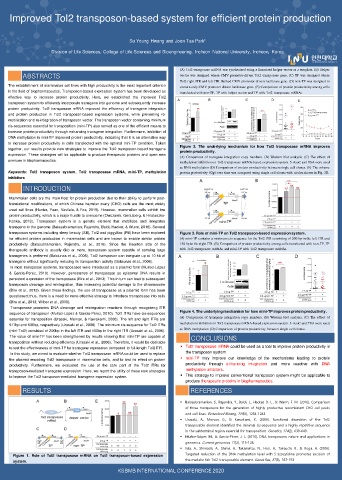
(A) Tol2 transposase mRNA was synthesized using a linearized helper vector as a template. (B) Helper
vector was designed where CMV promoter-driven Tol2 transposase gene. (C) TP was designed where
Tol2 right ITR and left ITR flanked CMV promoter-driven luciferase gene. (D) non-TP was designed to
The establishment of mammalian cell lines with high productivity is the most important criterion contain only CMV promoter-driven luciferase gene. (E) Comparison of protein productivity among cells
in the field of biopharmaceutics. Transposon-based expression system has been developed as transfected with non-TP, TP with helper vector and TP with Tol2 transposase mRNAs.
effective way to increase protein productivity. Here, we established the improved Tol2
transposon system to efficiently incorporate transgene into genome and subsequently increase
protein productivity. Tol2 transposase mRNA improved the efficiency of transgene integration
and protein production in Tol2 transposon-based expression systems, while preventing re-
mobilization and re-integration of transposon vector. The transposon vector containing minimum
cis-sequences essential for transposition (mini-TP) also served as one of the efficient means to
increase protein productivity through enhancing transgene integration. Furthermore, inhibition of
DNA methylation in mini-TP improved protein productivity, indicating that it is an alternative way
to increase protein productivity in cells transfected with the optimal mini-TP condition. Taken
Figure 2. The underlying mechanism for how Tol2 transposase mRNA improves
together, our results provide new strategies to improve the Tol2 transposon-based transgene protein productivity.
expression. These strategies will be applicable to produce therapeutic proteins and open new
(A) Comparison of transgene integration copy numbers. (B) Western blot analysis. (C) The effect of
avenues in biopharmaceutics. methylation inhibition on Tol2 transposase mRNA-based expression system. 5-AzaC and TSA were used
as DNA methylation (D) Comparison of protein productivity between single cell clones. (E) The volume
Keywords: Tol2 transposon system, Tol2 transposase mRNA, mini-TP, methylation protein productivity (Qp) over time was compared using single cell clones with circles shown in Fig. 2E.
inhibitors
Mammalian cells are the main host for protein production due to their ability to perform post-
translational modifications, of which Chinese hamster ovary (CHO) cells are the most widely
used cell lines (Hunter, Yuan, Vavilala, & Fox, 2019). However, mammalian cells exhibit low
protein productivity, which is a major hurdle to overcome (Owczarek, Gerszberg, & Hnatuszko-
Konka, 2019). Transposon system is a genetic element that mobilizes and integrates
transgene in the genome (Balasubramanian, Rajendra, Baldi, Hacker, & Wurm, 2016). Several
transposon systems including sleep beauty (SB), Tol2 and piggyBac (PB) have been explored Figure 3. Role of mini-TP on Tol2 transposon-based expression system.
for efficient protein production in mammalian cells and are known to enable similar protein (A) mini-TP contains a minimum cis-sequence for the Tol2 ITR consisting of 200 bp in the left ITR and
productivity (Balasubramanian, Rajendra, et al., 2016). Since the insertion size of the 150 bp in the right ITR. (B) Comparison of protein productivity among cells transfected with non-TP, TP
therapeutic antibody is usually 6kb or more, transposon system capable of carrying large with Tol2 transposase mRNAs and mini-TP with Tol2 transposase mRNAs.
transgenes is preferred (Balciunas et al., 2006). Tol2 transposon can integrate up to 10 kb of
transgene without significantly reducing its transposition activity (Balciunas et al., 2006).
In most transposon systems, transposases were introduced as a plasmid form (Muñoz-López
& García-Pérez, 2010). However, persistence of transposase as episomal DNA results in
persistent expression of the transposase (Bire et al., 2013). This in turn can lead to subsequent
transposon cleavage and reintegration, thus increasing potential damage to the chromosome
(Bire et al., 2013). Given these findings, the use of transposase as a plasmid form has been
questioned; thus, there is a need for more effective strategy to introduce transposase into cells
(Bire et al., 2013; Wilber et al., 2006).
Transposase promotes DNA cleavage and reintegration reactions through recognizing ITR
sequence of transposon (Muñoz-López & García-Pérez, 2010). Tol2 ITRs have cis-sequences Figure 4. The underlying mechanism for how mini-TP improves protein productivity.
essential for transposition (Urasaki, Morvan, & Kawakami, 2006). The left and right ITRs are (A) Comparison of transgene integration copy numbers. (B) Western blot analysis. (C) The effect of
517bp and 536bp, respectively (Urasaki et al., 2006). The minimum cis-sequence for Tol2 ITRs methylation inhibition on Tol2 transposase mRNA-based expression system. 5-AzaC and TSA were used
as DNA methylation (D) Comparison of protein productivity between single cell clones.
(mini-Tol2) consisted of 200bp in the left ITR and 150bp in the right ITR (Urasaki et al., 2006).
The value of mini-TP has been strengthened by results showing that mini-TP are capable of
transposition without reducing efficiency (Urasaki et al., 2006). Therefore, it would be desirable
to test the effectiveness of mini-TP for transgene expression compared to full-length Tol2 ITR. Tol2 transposase mRNA could be used as a tool to improve protein productivity in
In this study, we aimed to evaluate whether Tol2 transposase mRNA could be used to replace the transposon system
the plasmid encoding Tol2 transposase in mammalian cells, and to test its effect on protein mini-TP may improve our knowledge of the mechanisms leading to protein
productivity. Furthermore, we evaluated the use of the core part of the Tol2 ITRs for productivity through enhancing integration and more reactive with DNA
transposon-mediated transgene expression. Here, we report the utility of these new strategies methylation inhibitors.
to improve the Tol2 transposon-mediated transgene expression system. This strategy to improve conventional transposon system might be applicable to
produce therapeutic proteins in biopharmaceutics.
Balasubramanian, S., Rajendra, Y., Baldi, L., Hacker, D. L., & Wurm, F. M. (2016). Comparison
of three transposons for the generation of highly productive recombinant CHO cell pools
and cell lines. Biotechnol Bioeng, 113 (6), 1234-1243.
Urasaki, A., Morvan, G., & Kawakami, K. (2006). Functional dissection of the Tol2
transposable element identified the minimal cis-sequence and a highly repetitive sequence
in the subterminal region essential for transposition. Genetics, 174 (2), 639-649.
Muñoz-López, M., & García-Pérez, J. L. (2010). DNA transposons: nature and applications in
genomics. Current genomics, 11 (2), 115-128.
Iida, A., Shimada, A., Shima, A., Takamatsu, N., Hori, H., Takeuchi, K., & Koga, A. (2006).
Figure 1. Role of Tol2 transposase mRNA on Tol2 transposon-based expression Targeted reduction of the DNA methylation level with 5-azacytidine promotes excision of
system. the medaka fish Tol2 transposable element. Genet Res, 87 (3), 187-193.

