


Page 9 - T. Protein modification and regulation
P. 9
Identification and Characterization of p300-mediated Acetylated Lysine
                                        Residues in SERCA2a
                                Przemek A. Gorski , Kiyotake Ishikawa , Changwon Kho *
                                               2
                                                                           1,2
                                                              2
                                                             2
   1  School of Korean Medicine, Pusan National University, Republic of Korea;  Cardiovascular Research Center, Icahn School of Medicine
                                  at Mount Sinai, USA, *Corresponding author; Presenter
                   BACKGROUND                                                  AIM
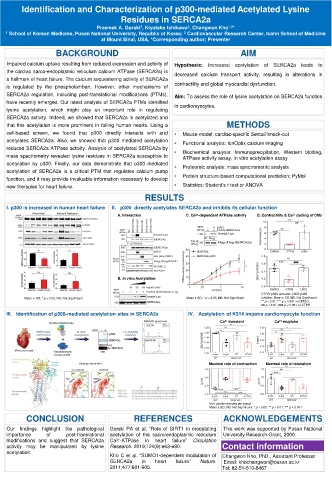
   Impaired calcium uptake resulting from reduced expression and activity of  Hypothesis:  Increased  acetylation  of  SERCA2a  leads  to
   the cardiac sarco-endoplasmic reticulum calcium ATPase (SERCA2a) is
                                                          decreased calcium transport activity, resulting in alterations in
   a hallmark of heart failure. The calcium sequestering activity of SERCA2a
                                                          contractility and global myocardial dysfunction.
   is regulated by the phospholamban. However, other mechanisms of
   SERCA2a regulation, including post-translational modifications (PTMs),  Aim: To assess the role of lysine acetylation on SERCA2a function
   have recently emerged. Our latest analysis of SERCA2a PTMs identified
                                                          in cardiomyocytes.
   lysine acetylation, which might play an important role in regulating
   SERCA2a activity. Indeed, we showed that SERCA2a is acetylated and
   that this acetylation is more prominent in failing human hearts. Using a  METHODS
   cell-based screen, we found that p300 directly interacts with and  •  Mouse model: cardiac-specific Serca2 knock-out
   acetylates SERCA2a. Also, we showed that p300 mediated acetylation
                                                          •  Functional analysis: IonOptix calcium imaging
   reduced SERCA2a ATPase activity. Analysis of acetylated SERCA2a by
                                                          •  Biochemical analysis: Immunoprecipitation, Western blotting,
   mass spectrometry revealed lysine residues in SERCA2a susceptible to  ATPase activity assay, in vitro acetylation assay
   acetylation by p300. Finally, our data demonstrate that p300 mediated
                                                          •  Proteomic analysis: mass spectrometric analysis
   acetylation of SERCA2a is a critical PTM that regulates calcium pump
                                                          •  Protein structure-based computational prediction: PyMol
   function, and it may provide invaluable information necessary to develop
   new therapies for heart failure.                       •  Statistics: Student’s t-test or ANOVA
                                                RESULTS

   I. p300 is increased in human heart failure  II. p300 directly acetylates SERCA2a and inhibits its cellular function
                                       A. Interaction         C. Ca 2+ -dependent ATPase activity  D. Contractility & Ca 2+  cycling of CMs


                                       B. in vitro Acetylation

                                                                                      CTPB: p300 activator; L002: p300
         Mean ± SD, * p < 0.05, NS: Not Significant           Mean ± SD, * p < 0.05, NS: Not Significant  inhibitor. Mean ± SD, NS: Not Significant
                                                                                      ** p < 0.01; *** p < 0.001 vs DMSO;
                                                                                      ## p < 0.01; ### p < 0.001 vs CTPB
   III. Identification of p300-mediated acetylation sites in SERCA2a  IV. Acetylation of K514 impairs cardiomyocyte function
                                                                         Ca 2+  transient  Ca 2+  reuptake


                                                                     Maximal rate of contraction  Maximal rate of relaxation


                                                                     N=4 cardiomyocytes per group
                                                                     Mean ± SD; NS: Not Significant; * p < 0.05; ** p < 0.01; *** p < 0.001
          CONCLUSION                         REFERENCES                   ACKNOWLEDGEMENTS
   Our  findings  highlight  the  pathological  Gorski PA et al. “Role of SIRT1 in modulating  This work was supported by Pusan National
   importance   of     post-translational  acetylation of the sacro/endoplasmic reticulum  University Research Grant, 2000.
                                       2+
   modifications and suggest that SERCA2a  Ca -ATPase  in  heart  failure”  Circulation
   activity may be manipulated by lysine  Research. 2019;124(9):e63-e80.  Contact information
   acetylation.
                                     Kho C et al. “SUMO1-dependent modulation of  Changwon Kho, PhD., Assistant Professor
                                     SERCA2a   in  heart  failure”  Nature.  Email: khochangwon@pusan.ac.kr
                                     2011;477:601-605.                   Tel: 82-51-510-8467

