


Page 11 - T. Protein modification and regulation
P. 11
.
  Misfolded human Z-type α -antitrypsin makes the
                                                       1
  host vulnerable to the oxidative stress

  Jaeyeon Lim, Hana Im  *
  Department of Integrative Bioscience and Biotechnology, Sejong University

                  BACKGROUND                                                   AIM
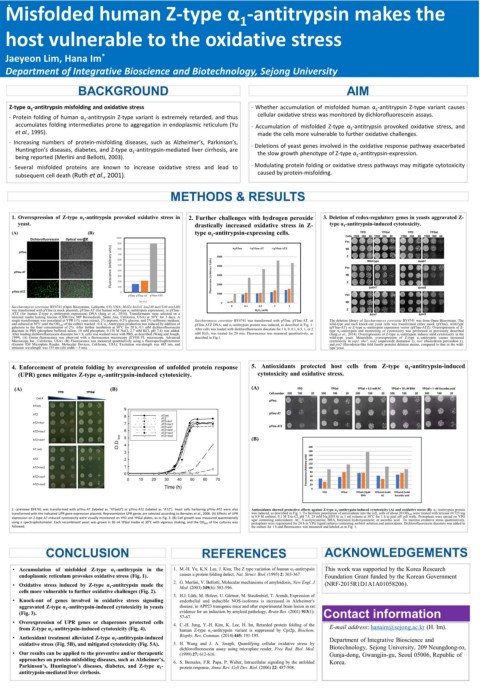
   Z-type α 1 -antitrypsin misfolding and oxidative stress  · Whether accumulation of misfolded human α 1 -antitrypsin Z-type variant causes
   · Protein folding of human α 1 -antitrypsin Z-type variant is extremely retarded, and thus  cellular oxidative stress was monitored by dichlorofluorescein assays.
    accumulates folding intermediates prone to aggregation in endoplasmic reticulum (Yu  · Accumulation of misfolded Z-type α 1 -antitrypsin provoked oxidative stress, and
    et al., 1995).                                         made the cells more vulnerable to further oxidative challenges.
   · Increasing numbers of protein-misfolding diseases, such as Alzheimer’s, Parkinson’s,  · Deletions of yeast genes involved in the oxidative response pathway exacerbated
    Huntington’s diseases, diabetes, and Z-type α 1 -antitrypsin-mediated liver cirrhosis, are  the slow growth phenotype of Z-type α 1 -antitrypsin-expression.
    being reported (Merlini and Bellotti, 2003).
   · Several misfolded proteins are known to increase oxidative stress and lead to  · Modulating protein folding or oxidative stress pathways may mitigate cytotoxicity
    subsequent cell death (Ruth et al., 2001).             caused by protein-misfolding.

                                       METHODS & RESULTS

    1. Overexpression of Z-type α 1 -antitrypsin provoked oxidative stress in  2. Further challenges with hydrogen peroxide  3. Deletion of redox-regulatory genes in yeasts aggravated Z-
     yeast.                                  drastically increased oxidative stress in Z-  type α 1 -antitrypsin-induced cytotoxicity.
    (A)              (B)                     type α 1 -antitrypsin-expressing cells.  YPD  YPGal  YPD  YPGal
        Dichlorofluorescein  Optical merge  1000                               Cells  1500   300   60   1500   300  60  1500    300     60    1500   300    60
                           900                                                 Vec
                          Fluorescence (Arbitrary units)  500  4000            Vec  Wild-type  ∆yap1
     pYInu                 800                    5000  pYInu  pYInu-AT  pYInu-ATZ  Wt Z
                           700
                           600
    pYInu-AT               400                  Fluorescence (Arbitrary Units)  3000  Wt
                           300
                           200
    pYInu-ATZ              100 0                  2000                         Z    ∆skn7      ∆sod2
                                                  1000
                              pYInu  pYInu-AT pYInu-ATZ                        Vec
                                Strains            0                           Wt
    Saccharomyces cerevisiae BY4741 (Open Biosystems, Lafayette, CO, USA; MATa his3Δ1 leu2Δ0 met15Δ0 ura3Δ0)  0  0.1  0.5  1  2
    was transformed with pYInu (a mock plasmid), pYInu-AT (for human wild-type α 1 -antitrypsin expression), or pYInu-  H 2 O 2 (mM)  Z
    ATZ (for human Z-type α 1 -antitrypsin expression) DNA (Jung et al., 2014). Transformants were selected on a  ∆tsa1  ∆pst2
    minimal media lacking leucine (CSM-Ura; MP Biomedicals, Santa Ana, California, USA) at 30°C for 3 days. A
    single transformant was inoculated in YPR (1% yeast extract, 2% peptone, 0.2% glucose, and 2% raffinose) medium,  Saccharomyces cerevisiae BY4741 was transformed with pYInu, pYInu-AT, or  The deletion library of Saccharomyces cerevisiae BY4741 was from Open Biosystems. The
    and cultured at 30°C until the OD 600 of the culture reached ~0.4. α 1 -Antitrypsin production was induced by addition of  pYInu-ATZ DNA, and α 1 -antitrypsin protein was induced, as described in Fig. 1.  wild-type and each knock-out yeast cells was transformed either mock (pYInu), wild-type
    galactose to the final concentration of 2%. After further incubation at 30°C for 20 h, 0.1 mM dichlorofluorescein  After cells was loaded with dichlorofluorescein diacetate for 1 h, 0, 0.1, 0.5, 1, or 2  (pYInu-AT) or Z-type α 1 -antitrypsin expression vector (pYInu-ATZ). Overexpression of Z-
    diacetate in PBS (phosphate buffered saline; 10 mM phosphate, 0.138 M NaCl, 2.7 mM KCl, pH 7.4) was added.  type α 1 -antitrypsin and monitoring of cytotoxicity was performed as previously described
    After loading dichlorofluorescein diacetate for 1 h, cells was washed twice with PBS, as described (Wang and Joseph,  mM H 2 O 2 was treated for 20 min. Fluorescence was measured quantitatively, as  (Jung et al., 2014). Overexpression of Z-type α 1 -antitrypsin induces mild cytotoxicity in the
    1999). (A) Green fluorescence was observed with a fluorescence microscopy (EVOS FL microscope, Advanced  described in Fig.1.  wild-type yeast. Meanwhile, overexpression of Z-type α 1 -antitrypsin causes increased
    Microscopy Inc., California, USA). (B) Fluorescence was measured quantitatively using a fluorespectrophotometer  cytotoxicity in yap1, skn7, sod2 (superoxide dismutase 2), tsa1 (thioredoxin peroxidase 1),
    (Gemini EM Microplate Reader, Molecular Devices, California, USA). Excitation wavelength was 485 nm, and  and pst2 (flavodoxin-like fold family protein) deletion strains, compared to that in the wild-
    emission wavelength was 535 nm (slit width = 5 nm).                    type yeast.
    4. Enforcement of protein folding by overexpression of unfolded protein response  5. Antioxidants protected host cells from Z-type α 1 -antitrypsin-induced
     (UPR) genes mitigates Z-type α 1 -antitrypsin-induced cytotoxicity.  cytotoxicity and oxidative stress.
    (A)                   (B)                             (A)       YPD                                         YPGal  YPGal + 0.5 mM AC           YPGal + 10 µM BHA        YPGal + 1 mM Ascorbic acid
              YPD   YPGal
                                                              Cell number  500          100          20           500            100               20            500           100                20   500           100               20  500           100          20
         Cell #
                                                              pYInu
        AT(wt)
                             9
                                                              pYInu-AT
        ATZ                  8       AT(wt)
                                     ATZ
        ATZ+lhs1             7       ATZ+lhs1
                                     ATZ+hac1
                                     ATZ+ent1                 pYInu-ATZ
        ATZ+hac1             6       ATZ+kar2
                                     ATZ+ssa1
                           O.D. 600  4
        ATZ+ent1             5       ATZ+ssa2             (B)
        AT (wt)                                                       200
                             3                                        180
                                                                      160
        ATZ                  2                                        140
        ATZ+kar2             1                                        Fluorescence (Arbitrary units)  120
                                                                      100
                             0                                         80
        ATZ+ssa1                                                       60
                              0  10  20  30  40  50  60  70            40
        ATZ+ssa2                                                       20
                                      Time (h)                         0
                                                                          YPD  YPGal  YPGal+10μM   YPGal+0.5mM  YPGal+0.5mM
                                                                                  BHA  AC  Ascorbic acid
    S. cerevisiae BY4741 was transformed with pYInu-AT [labeled as “AT(wt)”] or pYInu-ATZ (labeled as “ATZ”). Yeast cells harboring pYInu-ATZ were also  Antioxidants showed protective effects against Z-type α 1 -antitrypsin-induced cytotoxicity (A) and oxidative stress (B). α 1 -Antitrypsin protein
    transformed with the indicated UPR gene expression plasmid. Representative UPR genes are selected according to Bernales et al., 2006. (A) Effects of UPR  was induced, as described in Fig. 1. To facilitate penetration of antioxidants into the cell, cells of about 20 OD 600 were treated with lyticase (0.725 mg
    expression on Z-type AT-induced cytotoxicity were visually monitored on YPD and YPGal plates, as in Fig. 3. (B) Cell growth was measured quantitatively  in 0.9 M sorbitol, 0.1 M Tris-Cl, pH 7.5, 25 mM Na 2 EDTA) in 1 ml volume at 30°C for 1 h to peel off cell walls. Protoplasts were spread on YPG
    using a spectrophotometer. Each recombinant yeast was grown in 30 ml YPGal media at 30°C with vigorous shaking, and the OD 600 of the cultures was  agar containing antioxidants: AC, N-acetylcysteine; BHA, butylated hydroxyaninole; or ascorbic acid. Το monitor oxidative stress quantitatively,
                                                          protoplasts were regenerated for 24 h in YPG liquid cultures containing sorbitol solution and antioxidants. Dichlorofluorescein diacetate was added to
    followed.                                             the culture for 1 h and fluorescence was measured and labeled as in Fig. 1.
           CONCLUSION                         REFERENCES                  ACKNOWLEDGEMENTS
    • Accumulation of misfolded Z-type α 1 -antitrypsin in the  1. M.-H. Yu, K.N. Lee, J. Kim, The Z type variation of human α 1 -antitrypsin  This work was supported by the Korea Research
     endoplasmic reticulum provokes oxidative stress (Fig. 1).  causes a protein folding defect, Nat. Struct. Biol. (1995) 2: 363-367.  Foundation Grant funded by the Korean Government
    • Oxidative stress induced by Z-type α 1 -antitrypsin made the  2. G. Merlini, V. Bellotti, Molecular mechanisms of amyloidosis, New Engl. J.  (NRF-2015R1D1A1A01058206).
                                         Med. (2003) 349(6): 583-596.
     cells more vulnerable to further oxidative challenges (Fig. 2).
                                        3. H.J. Lüth, M. Holzer, U. Gärtner, M. Staufenbiel, T. Arendt, Expression of
    • Knock-out of genes involved in oxidative stress signaling  endothelial and inducible NOS-isoforms is increased in Alzheimer's
     aggravated Z-type α 1 -antitrypsin-induced cytotoxicity in yeasts  disease, in APP23 transgenic mice and after experimental brain lesion in rat:
     (Fig. 3).                           evidence for an induction by amyloid pathology, Brain Res. (2001) 913(1):  Contact information
                                         57-67.
    • Overexpression of UPR genes or chaperones protected cells  4. C.-H. Jung, Y.-H. Kim, K. Lee, H. Im, Retarded protein folding of the
     from Z-type α 1 -antitrypsin-induced cytotoxicity (Fig. 4).  human Z-type α 1 -antitrypsin variant is suppressed by Cpr2p, Biochem.  E-mail address: hanaim@sejong.ac.kr (H. Im).
    • Antioxidant treatment alleviated Z-type α 1 -antitrypsin-induced  Biophy. Res. Commun. (2014) 445: 191-195.  Department of Integrative Bioscience and
     oxidative stress (Fig. 5B), and mitigated cytotoxicity (Fig. 5A).  5. H. Wang and J. A. Joseph, Quantifying cellular oxidative stress by
                                         dichlorofluorescein assay using microplate reader, Free Rad. Biol. Med.  Biotechnology, Sejong University, 209 Neungdong-ro,
    • Our results can be applied to the preventive and/or therapeutic  (1999) 27: 612-616.  Gunja-dong, Gwangjin-gu, Seoul 05006, Republic of
     approaches on protein-misfolding diseases, such as Alzheimer’s,  6. S. Bernales, F.R. Papa, P. Walter, Intracellular signaling by the unfolded  Korea.
     Parkinson’s, Huntington’s diseases, diabetes, and Z-type α 1 -  protein response, Annu. Rev. Cell Dev. Biol. (2006) 22: 487-508.
     antitrypsin-mediated liver cirrhosis.

