


Page 7 - R. Organoid
P. 7
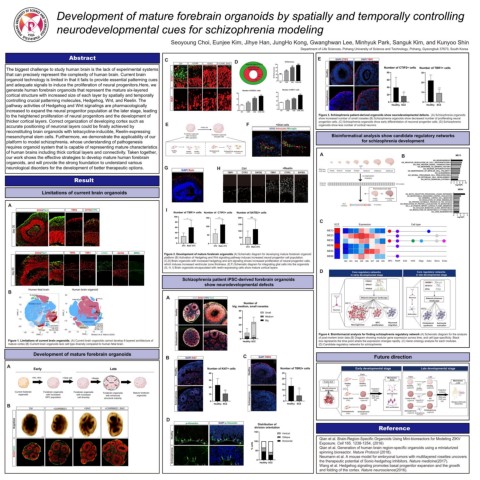
Development of mature forebrain organoids by spatially and temporally controlling
neurodevelopmental cues for schizophrenia modeling
Seoyoung Choi, Eunjee Kim, Jihye Han, JungHo Kong, Gwanghwan Lee, Minhyuk Park, Sanguk Kim, and Kunyoo Shin
Department of Life Sciences, Pohang University of Science and Technology, Pohang, Gyeongbuk 37673, South Korea
Abstract
Abstract C E DAPI CTIP2 DAPI TBR1
Ctrl +CHIR +SAG +CHIR, SAG D neuronal layer(TUJ1+) 100 VZ thickness ***
***
The biggest challenge to study human brain is the lack of experimental systems progenitor cell 80 * Number of CTIP2+ cells Number of TBR1+ cells
layer(SOX2+)
60
that can precisely represent the complexity of human brain. Current brain SOX2/TUJ1 45° VZ thickness(um) 40 Healthy 80 30
organoid technology is limited in that it fails to provide essential patterning cues 45° 20 0 60
and adequate signals to induce the proliferation of neural progenitors.Here, we Ctrl CHIR SAG CHIR,SAG 40 20
generate human forebrain organoids that represent the mature six-layered Number of SOX2+ cells Number of Ki67+ cells ** 10 ***
cortical structure with increased size of each layer by spatially and temporally 60 ** *** 40 *** SCZ #2 20
30
controlling crucial patterning molecules, Hedgehog, Wnt, and Reelin. The Ki67 40 * 20 * *** Schizophrenia 0 0
pathway activities of Hedgehog and Wnt signalings are pharmacologically 20 10 Healthy SCZ Healthy SCZ
increased to expand the neural progenitor population at the later stage, leading 0 Ctrl CHIR SAG CHIR, SAG 0 Ctrl CHIR SAG CHIR, SAG
to the heightened proliferation of neural progenitors and the development of Figure 3. Schizophrenia patient-derived organoids show neurodevelopmental defects. (A) Schizophrenia organoids
thicker cortical layers. Correct organization of developing cortex such as show increased number of small rossetes (B) Schizophrenia organoids show decreased number of proliferating neural
progenitor cells. (C) Schizophrenia organoids show early differentiation of neuronal progenitor cells. (D) Schizophrenia
accurate positioning of neuronal layers could be finally achieved by E +Glial cell F +Glial cells organoids show less number of cortical neurons
reconstituting brain organoids with tetracycline-inducible, Reelin-expressing SOX2 Astrocytes Microglia
mesenchymal stem cells. Furthermore, we demonstrate the applicability of our Forebrain organoids Forebrain organoids Bioinformatical analysis show candidate regulatory networks
with increased
with glial cells
NPC population
platform to model schizophrenia, whose understanding of pathogenesis for schizophrenia development
requires organoid system that is capable of representing mature characteristics
of human brains including thick cortical layers and connectivity. Taken together, Healthy astroctyes Healthy Schizophrenia Schizophrenia Schizophrenia A
Healthy
iPSC
iPSC
astroctyes
microglia
microglia
our work shows the effective strategies to develop mature human forebrain B ME13
GO_NEUROGENESIS
organoids, and will provide the strong foundation to understand various GO_NEGATIVE_REGULATION_OF_CELL_DIFFERENTIATION
GO_RAS_PROTEIN_SIGNAL_TRANSDUCTION
neurological disorders for the development of better therapeutic options. G H Ctrl +Reelin birth GO_RESPONSE_TO_GROWTH_FACTOR
GO_NEURON_DIFFERENTIATION
DAPI Reln RNA-seq, PCW5 PCW10 PCW20 PCW27 Newborn Childhood Adulthood GO_MAINTENANCE_OF_BIPOLAR_CELL_POLARITY
ChIP-seq
TBR1 CTIP2 SATB2 TBR1 CTIP2 SATB2 GO_GLIOGENESIS
co-expression GO_NEURAL_PRECURSOR_CELL_PROLIFERATION
GO_EPITHELIAL_CELL_DEVELOPMENT
Result modules GO_NOTCH_SIGNALING_PATHWAY
Temporal 55 modules 0 2 4 6 8 10
modules -log10(P)
Post-mortem brain data ME64
Limitations of current brain organoids vs. GO_NOTCH_RECEPTOR_PROCESSING_LIGAND_DEPENDENT
GO_MICROTUBULE_ORGANIZING_CENTER_LOCALIZATION
Healthy Schizophrenia GO_CEREBRAL_CORTEX_CELL_MIGRATION
(n=936) (n=559) GO_REGULATION_OF_BONE_REMODELING
GO_PROTEIN_CATABOLIC_PROCESS_IN_THE_VACUOLE
A modules 6 modules GO_REGULATION_OF_PROTEIN_LOCALIZATION_TO_MICROTUBULE
SCZ
GO_L_GLUTAMATE_IMPORT_ACROSS_PLASMA_MEMBRANE
GO_NUCLEAR_MIGRATION_ALONG_MICROTUBULE
SOX2/TUJ1 TBR2 SATB2/CTIP2 I GO_MODULATION_OF_MICROTUBULE_CYTOSKELETON
Number of TBR1+ cells Number of CTIP2+ cells Number of SATB2+ cells GO_AXON_REGENERATION
0 1 2 3 4
100 200 ns -log10(P)
* 150 **
80 C
150 SCZ Expression Cell type
day 30 60 100 ME13
100
40
50 ME23
20 50
ME33
0 0 0
3T3 Reln 3T3 3T3 Reln 3T3 3T3 Reln 3T3 ME58
ME64
SOX2/TUJ1 TBR2 TBR1 CTIP2 SATB2 BRN2 Figure 2. Development of mature forebrain organoids (A) Schematic diagram for developing mature forebrain organoid
platform (B) Activation of Hedgehog and Wnt signaling pathway induces increased neural progenitor cell population. ME68
(C,D) Brain organoids with increased hedgehog and wnt signaling shows increased proliferation of neural progenitor cells, W2 W3 W4 W5 W6 W7 W8 W9 NPC NasN ExN InhN Oligo Astro Micro Endo
which induces increased ventricular zone thickness. (E,F) Schematic diagram for integrating glial cells into the organoids
(G, H, I) Brain organoids encapsulated with reelin-expressing cells show mature cortical layers
day 60 D in early developmental stage in late developmental stage
Core regulatory networks
Core regulatory networks
Schizophrenia patient iPSC-derived forebrain organoids FOXO1
show neurodevelopmental defects NPAS3 SREBF1
NFATC3
B Human fetal brain Human brain organoid PPARA NFIA
A DAPI SOX2 CTIP2 TUJ1 Altered enhancer landscape Neurons Altered enhancer
landscape
Number of ME13
big, medium, small rossetes ME22 ME64 ME55
Healthy 40 Small Neurons Astrocytes
30 Medium
Big
NPC Neuronal Cholesterol Astrocyte
20 *** Neurogenesis proliferation migration synthesis activation
Bhaduri et al. Nature (2020) 10 Figure 4. Bioinformacial analysis for finding schizophrenia regulatory network (A) Schematic diagram for the analysis
Figure 1. Limitations of current brain organoids. (A) Current brain organoids cannot develop 6-layered architecture of Schizophrenia 0 Healthy SCZ of post-mortem brain data (B) Diagram showing modular gene expression across time, and cell type specificity. Black
box represents the time point where the expression changes rapidly. (C) Gene ontology analysis for each modules.
mature cortex (B) Current brain organoids lack cell type diversity compared to human fetal brain. (D) Candidate regulatory networks for schizophrenia
Development of mature forebrain organoids
B DAPI Ki67 C DAPI TBR2 Future direction
A
Early Late Number of Ki67+ cells Number of TBR2+ cells Early developmental stage Late developmental stage
Healthy 40 Healthy 25 Early
+Hh, Wnt +Glial cell +Reelin 20 Mechanism Early Late
30 _Early Mechanism
reelin Factor A,B _Late
15 Healthy Healthy Healthy
iPSC
organoid
20 ** Altered enhancer CRISPR organoid Healthy Healthy
organoid
*** 10 landscape Knockout Integrative astrocytes Integrative
analysis
Current forebrain Forebrain organoids Forebrain organoids Forebrain organoids Mature forebrain analysis Astrocyte
organoids with increased with increased with enhanced organoids 10 5 Neurogenesis
RNA-seq,
NPC population cell diversity structural maturity Schizophrenia Schizophrenia 0 Factor A KO Factor A KO ChIP-seq, Factor A KO Factor B KO organoid ChIP-seq,
RNA-seq,
KO
IHC
iPSC
organoid
organoid
B 0 Healthy SCZ Healthy SCZ astrocytes IHC Synapse-Astrocyte
interaction
Ctrl +CHIR99021 +SAG +CHIR99021, SAG NPC proliferation
Schizophrenia Schizophrenia Schizophrenia Schizophrenia
organoid
iPSC organoid organoid Schizophrenia
astrocytes
Brightfield D p-Vimentin DAPI p-Vimentin division orientation Reference
Distribution of
Healthy 150 Vertical
Oblique
100 Horizontal Qian et al. Brain-Region-Specific Organoids Using Mini-bioreactors for Modeling ZIKV
Exposure. Cell 165. 1238-1254, (2016)
% cells Qian et al. Generation of human brain region-specific organoids using a miniaturized
SOX2/TUJ1 Schizophrenia 50 spinning bioreactor. Nature Protocol (2018).
Neumann et al. A mouse model for embryonal tumors with multilayered rosettes uncovers
0
the therapeutic potential of Sonic-hedgehog inhibitors. Nature medicine(2017).
Healthy SCZ
Wang et al. Hedgehog signaling promotes basal progenitor expansion and the growth
and folding of the cortex. Nature neuroscience(2016).

