


Page 3 - R. Organoid
P. 3
Comparative Proteomic Analysis and Evaluation of Anticancer
Drug Responses Using Patient-Derived Tumor Organoids
Yeon-Jin Chu, Hyuna Kim, Hyeong Ho Cho, Ki Soon Kim, Donghyun Park, Woo Yong Oh, Yoonsook Lee*
Clinical Research Division, National Institute of Food and Drug Safety Evaluation, Ministry of Food and Drug Safety, Osong Health
Technology Administration Complex, 187 Osongsaengmyeong2-ro, Osong, Heungdeok, Cheongju, 28159, Korea
ABSTRACT
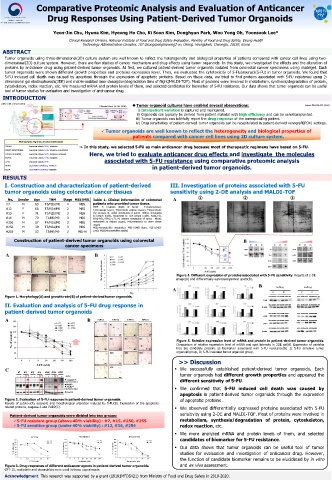
Tumor organoids using three-dimensional(3D) culture system are well known to reflect the heterogeneity and biological properties of patients compared with cancer cell lines using two-
dimensional(2D) culture system. However, there are few studies of cancer mechanism and drug effects using tumor organoids. In this study, we investigated the effects and the alteration of
proteins by anticancer drug using patient-derived tumor organoids. At first, we cultured patient-derived tumor organoids isolated from colorectal cancer specimens using matrigel. Each
tumor organoids were shown different growth properties and proteins expression level. Then, we evaluated the cytotoxicity of 5-Fluorouracil(5-FU) in tumor organoids. We found that
5-FU induced cell death was caused by apoptosis through the expression of apoptotic proteins. Based on these data, we tried to find proteins associated with 5-FU resistance using 2-
dimensional gel electrophoresis(2DE) and matrix-assisted laser desorption/degradation time of flight(MALDI-TOF). Most of proteins were involved in metabolism, synthesis/degradation of protein,
cytoskeleton, redox reaction, etc. We measured mRNA and protein levels of them, and selected candidates for biomarker of 5-FU resistance. Our data shows that tumor organoids can be useful
tool of tumor studies for evaluation and investigation of anti-cancer drug.
INTRODUCTION
EMBO J. 38: e101654 (2019) Tumor organoid cultures have enabled several observations: Science. 364:952-955. (2019)
J Hematol Oncol. 11:116. (2018)
iii) Interpatient variation is captured and maintained.
iii) Organoids can typically be derived from patient material with high efficiency and can be xenotransplanted.
iii) Tumor organoids can faithfully report the drug response of the corresponding patient.
iv) Drug sensitivities of patient-derived tumor organoids can be recapitulated in patient-derived xenograft(PDX) settings.
Tumor organoids are well known to reflect the heterogeneity and biological properties of
patients compared with cancer cell lines using 2D culture system.
Therapeutic regimen of colorectal cancer
FOLFIRI Leucovorin calcium, 5-FU, Irinotecan ⇒ In this study, we selected 5-FU as main anticancer drug because most of therapeutic regimens have based on 5-FU.
FOLFIRI-BEVACIZUMAB Leucovorin calcium, 5-FU, Irinotecan, bevacizumab
Here, we tried to evaluate anticancer drug effects and investigate the molecules
FOLFIRI-CETUXIMAB Leucovorin calcium, 5-FU, Irinotecan, Cetuximab
FOLFOX Leucovorin calcium, 5-FU, Oxaliplatin associated with 5-FU resistance using comparative proteomic analysis
FU-LV Leucovorin calcium, 5-FU
in patient-derived tumor organoids.
XELIRI Capecitabine(Xeloda), Irinotecan
XELOX Capecitabine(Xeloda), Oxaliplatin
RESULTS
I. Construction and characterization of patient-derived III. Investigation of proteins associated with 5-FU
tumor organoids using colorectal cancer tissues sensitivity using 2-DE analysis and MALDI-TOF
No. Gender Age TNM Stage MSS/MSI Table 1. Clinical information of colorectal A ① ② ③
#7 M 63 T3/N2b/M1 4 MSS patients who provided tumor tissue.
#12 F 66 T3/N1a/M0 2 MSS TNM: T; invasion depth of tumor T1(submucosa),
T2(muscular layer), T3(pericolic adipose tissue), T4(penetrate
#15 F 71 T3/N2b/M1 3 MSS the serosa), N; nodal metastasis of tumor N0(no metastasis
#16 M 70 T1/N0/M0 3 MSS to lymph node), N1a(meta to one lymph node), N1b(2-3),
N2a(4-6), N2b(>=7), M; distant metastasis of tumor M0(no
#250 M 57 T4/N1a/M0 3 MSS metastasis to distant organ), M1(metastasis to other disant
organ).
#254 M 39 T3/N2a/M0 3 MSS MSI(microsatellite instability): MSI-H(MSI-High), HSI-L(MSI-
#255 M 53 T3/N0/M0 2 MSI-H Low), MSS(microsatellite stable)
Construction of patient-derived tumor organoids using colorectal B
cancer specimens ① ② ③ ① ② ③ ① ② ③
③ 1001 17 5719
A B ② 7007 119 6014
#7 #12 #15 #16 ①
1012 6709
5007
40X 40X 40X 40X
#250 #254 #255 Figure 4. Different expression of proteins associated with 5-FU sensitivity. Results of 2-DE
image(A) and differentially expressed protein spots(B).
B
A 5-FU (-) 5-FU (+)
40X 40X 40X
S R S R
Figure 1. Morphology(A) and growth rate(B) of patient-derived tumor organoids. #12 #254 #15 #250 #255 #7 #12 #254 #15 #250 #255 #7
1001
II. Evaluation and analysis of 5-FU drug response in β-actin #12 #254 #15 #250 #255 #7 #12 #254 #15 #250 #255 #7
patient-derived tumor organoids #12 #254 #15 #250 #255 #12 #254 #15 #250 #255
6709
A B 5-FU (-) 5-FU (+) 5-FU (-) 5-FU (+) #12 #254 #15 #250 #255 #12 #254 #15 #250 #255
#7 5719
#7 #12 #12
#12 #254 #15 #250 #255 #12 #254 #15 #250 #255
β-actin
#15 40X 40X 40X 40X
#15 #16 #16
Figure 5. Relative expression level of mRNA and protein in patient-derived tumor organoids.
Comparison of relative expression level of mRNA and spot intensity in 2DE gel(A). Expression of proteins
that are candidate proteins as biomarker associated with 5-FU resistance(B). S; 5-FU sensitive tumor
40X 40X 40X 40X
#250 organoid group, R; 5-FU resistant tumor organoid group.
#250 #254 #254
>> Discussion
40X 40X 40X 40X
#255
#255
C We successfully established patient-derived tumor organoids. Each
#7 #12 #15 #16 #250 #254 #255 tumor organoids had different growth properties and appeared the
- + - + - + - + - + - + - + 5-FU 40X 40X
◀ Caspase-3 different sensitivity of 5-FU.
(cleaved form)
◀ PARP
◀ PARP*
(cleaved form) We confirmed that 5-FU induced cell death was caused by
◀ β-actin
apoptosis in patient-derived tumor organoids through the expression
Figure 2. Evaluation of 5-FU response in patient-derived tumor organoids. of apoptotic proteins .
Results of cytotoxicity assay(A) and morphological alteration induced by 5-FU(B). Expression of the apoptosis-
related proteins, caspase-3 and PARP(C). We observed differentially expressed proteins associated with 5-FU
sensitivity using 2-DE and MALDI-TOF. Most of proteins were involved in
Patient-derived tumor organoids were divided into two groups:
5-FU resistant group (above 40% viability) : #7, #15, #250, #255 metabolism, synthesis/degradation of protein, cytoskeleton,
5-FU sensitive group (under 40% viability) : #12, #16, #254 redox reaction, etc.
We more analyzed mRNA and protein levels of them, and selected
candidates of biomarker for 5-FU resistance.
Our data shows that tumor organoids can be useful tool of tumor
studies for evaluation and investigation of anticancer drug. However,
the function of candidate biomarker remains to be elucidated by in vitro
Figure 3. Drug responses of different anticancer agents in patient-derived tumor organoids. and ex vivo assessment.
CPT-11, oxaliplatin and doxorubicin were used in these experiments.
Acknowledgment This research was supported by a grant (19181MFDS421) from Ministry of Food and Drug Safety in 2019-2020.

