


Page 9 - R. Organoid
P. 9
Human pluripotent stem cell-derived hepatic organoids as a
  screening platform for toxicity prediction and drug evaluation

                                                            3
                                                                          1,2
                                                                                                       2,4
                                                                                         1,2
                          1
                                    1
                                                1,2
             1,2
  Seon Ju Mun , Jaeseo Lee , Mi-Ok Lee , Ye Seul Son , Soo Jin Oh , Hyun-Soo Cho , Mi-Young Son , Dae-Soo Kim ,
                                          1,2
             1
                           1,2
  Ho-Joon Lee , Janghwan Kim , Cho-Rok Jung , Kyung-Sook Chung 1,2,5,*  and Myung Jin Son 1,2, *
                   BACKGROUND                                                   AIM
   Human cell-based and personalized in vitro liver models  The development of hepatic models capable of long-
   are urgently needed for drug efficacy and toxicity tests in  term expansion with competent liver functionality in a
   pre-clinical drug development. Although the liver is a  personalized setting is technically challenging. Stem
   representative organ with a native regenerative potential  cell-based organoid technologies can provide an
   in vivo, primary human hepatocytes (PHHs), which are   alternative  source  of   patient-derived  primary
   considered the gold standard for evaluating hepatic    hepatocytes. However, self-renewing and functionally
   metabolism, are limited by their loss of proliferative  competent human pluripotent stem cell (PSC)-derived
   capacity and long-term functionality in vitro.         hepatic organoids are still lacking
                                                METHODS
   We developed a novel method to efficiently and reproducibly generate functionally mature human hepatic organoids
   derived from PSCs, including human embryonic stem cells and induced PSCs. The maturity of the organoids was
    validated by a detailed transcriptome analysis and functional performance assays. The organoids were applied to
    screening platforms for predicting toxicity and evaluating drugs that target hepatic steatosis through real-time
    monitoring of cellular bioenergetics and high-content analyses.
                                                 RESULTS

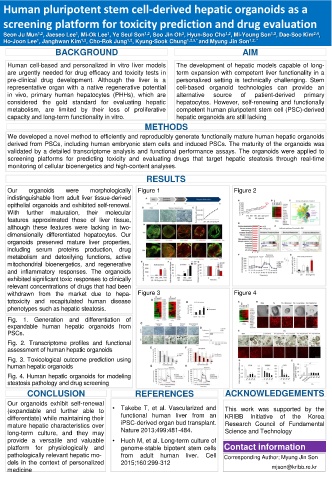
   Our    organoids   were    morphologically  Figure 1                      Figure 2
   indistinguishable from adult liver tissue-derived
   epithelial organoids and exhibited self-renewal.
   With   further  maturation,  their  molecular
   features approximated those of liver tissue,
   although these features were lacking in two-
   dimensionally differentiated hepatocytes. Our
   organoids preserved mature liver properties,
   including serum proteins production, drug
   metabolism and detoxifying functions, active
   mitochondrial bioenergetics, and regenerative
   and inflammatory responses. The organoids
   exhibited significant toxic responses to clinically
   relevant concentrations of drugs that had been
   withdrawn from the market due to hepa-     Figure 3                       Figure 4
   totoxicity and recapitulated human disease
   phenotypes such as hepatic steatosis.
   Fig. 1. Generation and differentiation of
   expandable human hepatic organoids from
   PSCs.
   Fig. 2. Transcriptome profiles and functional
   assessment of human hepatic organoids
   Fig. 3. Toxicological outcome prediction using
   human hepatic organoids
   Fig. 4. Human hepatic organoids for modeling
   steatosis pathology and drug screening
          CONCLUSION                         REFERENCES                   ACKNOWLEDGEMENTS
   Our organoids exhibit self-renewal
   (expandable and further able to    •  Takebe T, et al. Vascularized and  This work was supported by the
   differentiate) while maintaining their  functional human liver from an  KRIBB  Initiative  of  the  Korea
   mature hepatic characteristics over  iPSC-derived organ bud transplant.  Research Council of Fundamental
   long-term culture, and they may      Nature 2013;499:481-484.          Science and Technology
   provide a versatile and valuable   •  Huch M, et al. Long-term culture of
   platform for physiologically and     genome-stable bipotent stem cells Contact information
   pathologically relevant hepatic mo-  from   adult  human  liver.  Cell  Corresponding Author; Myung Jin Son
   dels in the context of personalized  2015;160:299-312
   medicine                                                                              mjson@kribb.re.kr

