


Page 79 - Q. Neuroscience
P. 79
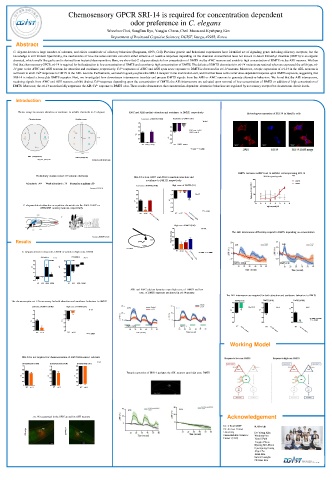
Chemosensory GPCR SRI-14 is required for concentration dependent
odor preference in C. elegans
Woochan Choi, SangEun Ryu, Yongjin Cheon, Cheil Moon and Kyuhyung Kim
Department of Brain and Cognitive Sciences, DGIST, Daegu, 42988, Korea
Abstract
C. elegans detects a large number of odorants, and elicits a multitude of olfactory behaviors (Bargmann, 1993, Cell). Previous genetic and behavioral experiments have identified set of signaling genes including olfactory receptors, but the
knowledge is still limited. Specifically, the mechanisms of how the same odorants can elicit either attractive or aversive responses depending on the chemical concentration have not known in detail. Dimethyl trisulfide (DMTS) is an organic
chemical, which smells like garlic and is derived from bacterial decomposition. Here, we show that C. elegans attracts to low concentration of DMTS via the AWC neurons and avoids to high concentration of DMTS via the ASH neurons. We then
find that chemosensory GPCR sri-14 is required for both attraction to low concentration of DMTS and aversion to high concentration of DMTS. The defects of DMTS chemotaxis in sri-14 mutants are restored when we expressed the wild-type sri-
14 gene to the AWC and ASH neurons for attraction and avoidance, respectively. Ca 2+ responses of AWC and ASH upon acute exposure to DMTS is decreased in sri-14 mutants. Moreover, ectopic expression of sri-14 in the ADL neurons is
sufficient to elicit Ca 2+ responses to DMTS in the ADL neurons. Furthermore, we heterologously express the SRI-14 receptor in the mammalian cell, and find that these cells confer dose-dependent response upon DMTS exposure, suggesting that
SRI-14 is indeed a bona fide DMTS receptor. Next, we investigated how downstream interneurons translate and process DMTS signals from the ASH or AWC neurons to generate alternative behaviors. We found that the AIB interneurons,
receiving signals from AWC and ASH neurons, exhibit distinct Ca 2+ responses depending upon the concentration of DMTS; the AIB interneurons are activated upon removal of low concentration of DMTS or addition of high concentration of
DMTS. Moreover, the sri-14 mutation fully suppresses the AIB Ca 2+ response to DMTS odor. These results demonstrate that concentration-dependent alternative behaviors are regulated by not sensory receptor but downstream circuit levels.
Introduction
Chemo assays to measure attraction or avoidance to volatile chemicals in C. elegans AWC and ASH mediate attraction and avoidance to DMTS, respectively Heterologous expression of SRI-14 in Hana3A cells
Chemotaxis assay Avoidance assay Low conc. of DMTS (1/100) High conc. of DMTS (1/1)
DMTS(1/100)
N=4-6
1.0 -0.0
0.8 -0.2 0 **
0.6 -0.4 ASH(-)= pqe-1; rtls11
AWC(-)= ceh-36
CI. 0.4 -0.6
AI.
0.2 -0.8
0.0 0 *** -1.0
WT AWC(-) ASH(-) WT AWC(-) ASH(-)
**P<0.001 *** P <0.0001
Index= (A-B)/(A+B+C)
Index= (A-B)/(A+B)
Bargmann, (1993) Cell Yoshida et al., (2012) Nat Comm
DMTS increases cAMP level in HANA3 cells expressing SRI-14
Preliminary studies tested 119 volatile chemicals SRI-14 acts in AWC and ASH to mediate attraction and SRI-14 expressing cells N=3
avoidance to DMTS, respectively 150 DMTS
Attractants : 49 Weak attractants : 11 Neutral or repellents : 59 DMSO
Low conc. of DMTS (1/100) High conc. of DMTS (1/1)
Bargmann, (1993) Cell 100
1 .0 -0.0 Response (% max), RLU
*** ***
0 .8 -0.2 N=6-7 50
0 .6 -0.4 NS
CI. AI. 0
0 .4 -0.6 -9 -8 -7 -6 -5 -4 -3 -2
C. elegans detects attractive or repulsive chemicals via the AWA /AWC or log[compound], M
AWB/ASH sensory neurons, respectively 0 .2 *** -0.8
0 .0 0 -1.0 *** P <0.0001
WT sri-14 WT sri-14
/
High conc. of DMTS (1/10)
1.0 N=4-8 The AIB interneurons differently respond to DMTS depending on concentration
A S Bargmann, (2006) Wormbook Fraction Reversing 0.8 0.6
Results DMTS 0.4 *** **
H
A worm 0.2
Drop assay
0.0 0
C. elegans attracts to low conc. DMTS or avoids to high conc. DMTS WT sri-14 **P<0.001 *** P <0.0001
Attraction N=5-6 Avoidance N=2-7
0.8 0.077M 0.2 7.77M
00
0.6 -0.0 0
C.I. A.I.
0.4 -0.2
0.2 -0.4
0.0 0 -0.6
-0.2 -0.8
1/1 1/10 1/100 1/1000 1/1 1/10 1/100 1/1000
ASH and AWC calcium dynamics upon high conc. of DMTS and low
conc. of DMTS exposure are altered in sri-14 mutants
The AIB interneuron are required for both attraction and avoidance behaviors to DMTS
The chemoreceptor sri-14 is necessary for both attraction and avoidance behaviors to DMTS DMTS (1/1) DMTS (1/10) DMTS (1/100)
-0.0 -0.0 0.8
**
Low conc. of DMTS (1/100) High conc. of DMTS (1/1) N=12-13 N=4 0.6 N=9
-0.2 -0.2
N=6-9 CI.
1.0 -0.0 AI. * AI.
-0.4 -0.4 0.4
0.8 -0.2 ***
-0.6 0.2
0.6 -0.4 -0.6 *P<0.005 **P<0.001
C.I. A.I. NS *** *** P <0.0001
0.4 -0.6 -0.8 -0.8 0.0
0.2 *** -0.8 WT WT WT
0.0 0 -1.0
WT WT sri-14 sri-14 WT sri-14 *** P <0.0001
Working Model
SRI-14 is not required for chemosensation of AWC/ASH-sensed odorants
N=6-7
Benzaldehyde (1/100) Isoamyl alcohol (1/100) Benzaldehyde (1/1)
1.0 1.0 -0.0
0.8 0.8 -0.2 0
Ectopic expression of SRI-14 activates the ADL neurons upon high conc. DMTS
0.6 0.6 -0.4
CI. CI. AI.
0.4 0.4 -0.6
ADLp::GCaMP3
0.2 0.2 -0.8
0.0 0 0.0 0 -1.0
WT sri-14 WT sri-14 WT sri-14
Acknowledgement
sri-14 is expressed in the AWC as well as ASH neurons
sri- sri-
14p::GFP 14p::
GFP
Dr. J. Koo DGIST K.Kim lab
DII red dye DII red dye AWC Dr. Jin Lee Yonsei Do-Young Kim
ASH
University
Caenorhabditis Genetics
Center (CGC) Woojung Heo
YeonJi Park
Yongjin Cheon
Kyeong Min Moon
Hyeonjeong Hwang
Jihye Cho
Jimin Kim
Semin Hwangbo
Ok Hwa Kim

