


Page 83 - Q. Neuroscience
P. 83
Repetitive head injury alters olfactory-associated
                       electroencephalographic, behavioral, and pathological sequelae in mice
                                                                       1,3
                              Younghyun Yoon 1,2* , YunHee Seol , Hyoenjoo Im , Hio-Been Han , Jeongeun Kum ,
                                                   3*
                                                             3*
                                                                                   1,4
                                               Jee Hyun Choi 1,4# & Hoon Ryu 1,5#
  1 Center for Neuroscience, Korea Institute of Science and Technology, Seoul 02792, ROK;  2 Department of Electrical Engineering and Computer Science, Vanderbilt University, Nashville, TN, 37235, USA;  3 Program of Brain and Cognitive
  Engineering, Korea Advanced Institute of Science and Technology, Daejeon 34141, ROK;  4 Department of Neuroscience, Division of Bio-Medical Science & Technology, KIST School, Korea University of Science and Technology, Seoul 027
  92, ROK;  5 Boston University Alzheimer’s Disease Center and Department of Neurology, Boston University School of Medicine, Boston, MA 02130, USA
                        Abstract                                            Introduction
   A series of repeated mild traumatic brain injury (TBI) by collision sports
   or accidents lead to long-term cognitive impairments with an increased   Olfactory Dysfunction is commonly reported in TBI patients and
   risk for neurodegenerative and psychiatric disorders. Olfactory   animal models.
   dysfunction has been observed as one of the most prominent symptoms   •  Olfaction is one of the primary sensory perceptions responsible
   in TBI patients, but the exact pathological mechanism is not fully
   understood. In this present study, we investigated the acute effects of   for memory and emotions
   repetitive mild TBI (r-mTBI) on olfactory functioning and its pathological   •  a-synuclein and tauopathy changes in the olfactory system are
   neuronal injuries using a TBI mouse model that mimics concussions in   indicators of dementia risk.
   humans. Electroencephalography (EEG) neural impairments observed
   in the olfactory bulb revealed significantly attenuated modulation index
   values for delta-phase fast oscillations. As well as significantly reduced   Aims of Study
   cross-frequency couplings between delta phase and beta/low gamma
   amplitudes in concussed mice. Then, through pathological examination,
   we found a significant increase in p-Tau (S202/T205) in olfactory bulb-  Hypothesis: Olfactory dysfunction may be an indicator
   associated areas. Furthermore, neuronal atrophy was correlated with p-  of cognitive decline in mice exposed to repetitive-mild
   Tau levels. Lastly, TBI mice showed for an abnormal loss of preference   TBI events.
   in home bedding under Y-maze conditions compared to controls.
   Together, p-Tau alterations may serve as important biomarkers of   Aim 1: To develop a new TBI mouse model that closely
   olfactory track-associated dysfunctions and behavioral impairments.   resembles human sub-concussion scenarios.
   KEY WORDS: Traumatic Brain Injury, Olfactory System, EEG, Tau,   Aim 2: To investigate the pathological detriments in the
   neuronal atrophy                                       olfactory system after r-mTBI events.

                                                 RESULTS

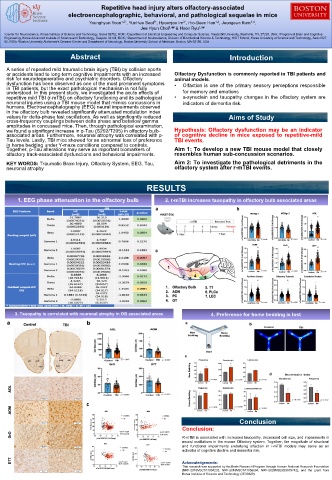
       1. EEG phase attenuation in the olfactory bulb  2. r-mTBI increases tauopathy in olfactory bulb associated areas


      3. Tauopathy is correlated with neuronal atrophy in OB associated areas  4. Preference for home bedding is lost


                                                                               Conclusion
                                                            Conclusion:
                                                            R-mTBI is associated with increased tauopathy, decreased cell size, and impairments in
                                                            neural oscillations in the mouse Olfactory system. Together, the magnitude of structural
                                                            and functional impairments underlying olfaction in r-mTBI models may serve as an
                                                            activator of cognitive decline and dementia risk.

                                                            Acknowledgements:
                                                            This research was supported by the Brain Research Program through Korean National Research Foundation
                                                            (NRF-2016M3C7A1904233, NRF-2018M3C7A1056894, NRF-2020M3E5D9079742), and the grant from
                                                            Korea Institute of Science and Technology (2E30320).

