


Page 57 - Q. Neuroscience
P. 57
Development of levodopa induced dyskinesia mouse model
            combining with mutant α-synuclein and MPTP

            Eunji Namgung, 1,2,3,# Soo Jeong Kim, 1,3,#  Min Jeong Ryu, 1  Yunseon Jang, 1,2,3  Min Joung Lee, 1,2,3  Xianshu Ju, 1,2 3 Jianchen Cui, 1,2,3  Yu Lim Lee, 1,2,3  Jiebo Zhu, 1,2,3 Dahyun Go,
            1,2,3 Chang Jun Seo, 1,2,3 Woosuk Chung 4  and Jun Young Heo 1, 2, 3, *
            1 Department of Biochemistry,  2 Department of Medical science,  3 Infection Control Convergence Research Center, Chungnam National University School of Medicine,
            Daejeon 35015, Republic of Korea.  4 Department of Anesthesiology and Pain Medicine, Chungnam National University Hospital, # Co-first Author, * Coressponding Author
  BACKGROUND   For pre-clinical trial, the development of animal model which recapitulates Levodopa-Induced dyskinesia(LID) patient symptoms
  should be preceded, at present the predominantly used model of LID is neurotoxin induced Parkinson’s disease(PD) animal model. MPTP and 6-
  OHDA neurotoxic models display robust nigro-striatal degeneration but, construct validity are limited as the formation of LB inclusions is not a
  common feature.
  AIM  To develop the recapitulate the LID patient symptoms, we generate the LID animal model combine with α-synuclein(α-syn) and MPTP.
  METHODS  Stereotactic surgery was performed with α-syn A53T virus in the SN area, and MPTP was administered by intraperitoneal injection.
  Abnormal involuntary movement scale(AIMs) test was perfomed to identify the level of dyskinesia. TH positive neuron was confimed the DAB stain.
  RESULTS
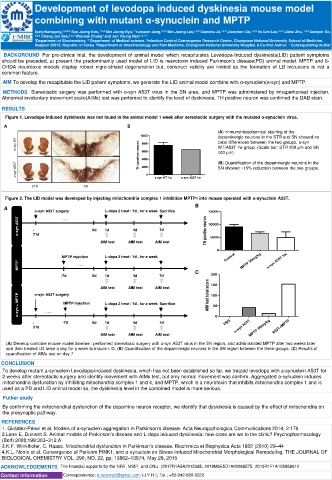
   Figure 1. Levodopa-induced dyskinesia was not found in the animal model 1 week after sereotactic surgery with the mutated α-synuclein virus.
  A                                       B
                                                                        (A) Immunohistochemical staining of the
                                               10000                    dopaminergic neurons in the STR and SN showed no
      α-syn WT                                TH positive neuron  8000  clear differences between the two groups, a-syn
                                                                        WT/A53T 1w group. (Scale bar: STR 200 μm and SN
                                                                        100 μm)
                                               6000
      α-syn A53T                               4000 0  a-syn WT 1w  a-syn A53T 1w  (B) Quantification of the dopaminergic neurons in the
                                               2000
                                                                        SN showed ~15% reduction between the two groups.
           STR              SN

   Figure 2. The LID model was developed by injecting mitochondria complex 1 inhibition MPTP1 into mouse operated with α-synuclein A53T.
  A                                                              B
            α-syn A53T surgery     L-dopa 2 treat / 1d , for a week Sacrifice  15000
       α-syn A53T  -  . . .    0d  1d       4d       7d             TH positive neuron  10000

            21d
                                  AIM test  AIM test  AIM test       5000
                                                                        0
                     MPTP injection  L-dopa 2 treat / 1d , for a week     Control
       MPTP               . . .                                                 MPTP 20mg/kg  α-syn A53T 3w

                     -7d       0d  1d       4d       7d          C    200
                                  AIM test  AIM test  AIM test       AIM test total score  150
            α-syn A53T surgery
       α-syn + MPTP  . . .  MPTP injection  L-dopa 2 treat / 1d , for a week Sacrifice  50
                                                                      100


            -        -7d       0d  1d       4d       7d                0  PBS
            21d                                                               α-syn A53T MPTP 20mg/kg  A53T+MPTP
                                  AIM test  AIM test  AIM test
   (A) Develop combine mouse model timeline : performed stereotaxic surgery with α-syn A53T virus in the SN region, and administrated MPTP after two weeks later
   and then treated LD twice a day for a week to induce LID. (B) Quantification of the dopaminergic neurons in the SN region between the three groups. (C) Results of
   quantification of AIMs test on day 7
  CONCLUSION
  To develop mutant a-synuclein Levodopa-induced dyskinesia, which has not been established so far, we treated levodopa with a-synuclein A53T for
  2 weeks after stereotactic surgery and identify movement with AIMs test, but only normal movement was confirm. Aggregated a-synuclein induces
  mitochondria dysfunction by inhibiting mitochondria complex 1 and 4, and MPTP, which is a neurotoxin that inhibits mitochondria complex 1 and is
  used as a PD and LID animal model so, the dyskinesia level in the combined model is more serious.
  Futher study
  By confirming the mitochondrial dysfunction of the dopamine neuron receptor, we identify that dyskinesia is caused by the effect of mitochondria on
  the presynaptic pathway.
  REFERENCES
  1. Giráldez-Pérez et al. Models of α-synuclein aggregation in Parkinson’s disease. Acta Neuropathologica Communications 2014, 2:176
  2.Lane E, Dunnett S. Animal models of Parkinson’s disease and L-dopa induced dyskinesia: how close are we to the clinic? Psychopharmacology
  (Berl) 2008;199:303–312.A
  3.K.F. Winklhofer, C. Haass. Mitochondrial dysfunction in Parkinson’s disease. Biochimica et Biophysica Acta 1802 (2010) 29–44
  4.K.L. Norris et al. Convergence of Parkinm PINK1, and α-synuclein on Stress-induced Mitochondrial Morphological Remodeling. THE JOURNAL OF
  BIOLOGICAL CHEMISTRY VOL. 290, NO. 22, pp. 13862–13874, May 29, 2015
  ACKNOWLEDGEMENTS   The financial supports by the NRF, MSIP, and CNU. (2017R1A5A2015385, 2019M3E5D1A02068575, 2019R1F1A105958612
  Contact information   Correspondence: junyoung3@gmail.com (J.Y.H.); Tel.: +82-042-580-8222

