


Page 55 - Q. Neuroscience
P. 55
Oral administration of Proteus mirabilis, a gut bacterium linked to Parkinson’s disease,
                             alters the expression of a neurotrophin in the intestine of mice


   Jun Heyok Kwak , Miran Jeong ,a,b,c , Jin Gyu Choi a,b,c , Eugene Huh , Jae-Won Lee , Im-Ho Lee , Dong-Hyun Kim a,b,c , Myung Sook Oh a,b,c , and
                                                                                b
                 a,b
                                                          d
                                                                      b
                                                     Jung-Hye Choi a,b,c,*
  a  Neurobiota Research Center (NRC), Kyung Hee University, Seoul, South Korea,  Department of Life and Nanopharmaceutical Sciences, Kyung Hee University, Seoul, South Korea ,  c
                                                      b
           College of Pharmacy, Kyung Hee University, Seoul, South Korea,  Medical Science of Meridian, Graduate School, Kyung Hee University, Seoul, South Korea
                                                    d
   Abstract                                 Results
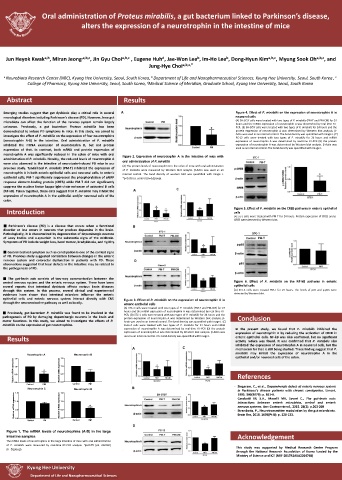
  Emerging studies suggest that gut dysbiosis play a critical role in several      Figure 4. Effect of P. mirabilis on the expression of neurotrophin A in
  neurological disorders including Parkinson’s disease (PD). However, how gut      neuronal cells
  microbiota can affect the function of the nervous system remain largely          (A) SH-SY5Y cells were treated with two types of P. mirabilis (PM-T and PM-CM) for 24
                                                                                   hours and the mRNA expression of neurotrophin A was determined by real-time RT-
  unknown. Previously, a gut bacterium Proteus mirabilis has been                  PCR. (B) SH-SY5Y cells were treated with two types of P. mirabilis for 24 hours and the
  demonstrated to induce PD symptoms in mice. In this study, we aimed to           protein expression of neurotrophin A was determined by Western blot analysis. β-
  investigate the effect of P. mirabilis on the expression of four neurotrophins   Actin was used as an internal control. The band density was quantified with Image J. (C)
                                                                                   PC-12 cells were treated with two types of P. mirabilis for 24 hours and mRNA
  (neurotrophin A-D) in the intestine. Oral administration of P. mirabilis         expression of neurotrophin A was determined by real-time RT-PCR (D) the protein
  inhibited the mRNA expression of neurotrophin D, but not protein                 expression of neurotrophin A was determined by Western blot analysis. β-Actin was
  expression of that. In contrast, both mRNA and protein expression of             used as an internal control. The band density was quantifiedwith Image J.
  neurotrophin A was significantly reduced in the colon of mice with oral  Figure 2. Expression of neurotrophin A in the intestine of mice with
  administration of P. mirabilis. Notably, the reduced levels of neurotrophin A  oral administration of P. mirabilis
  were also observed in the intestine of neurotoxin-induced PD mice in our  (A) The protein levels of neurotrophin A in the colon of mice with oral administration
  previous study. Tyndallized P. mirabilis (PM-T) inhibited the expression of  of P. mirabilis were measured by Western blot analysis. β-Actin was used as an
  neurotrophin A in both enteric epithelial cells and neuronal cells. In enteric  internal control. The band density of western blot was quantified with Image J.
  epithelial cells, PM-T significantly suppressed the phosphorylation of cAMP  *p<0.05 (vs. control)(n=5/group).
  response element-binding protein (CREB) while PM-T did not significantly
  suppress the nuclear factor kappa-light-chain-enhancer of activated B cells
  (NF-kB). Taken together, these data suggest that P. mirabilis may inhibit the
  expression of neurotrophin A in the epithelial and/or neuronal cells of the
  colon.
   Introduction                                                                    Figure 5. Effect of P. mirabilis on the CREB pathway in enteric epithelial
                                                                                   cells
                                                                                   (A) STC-1 cells were treated with PM-T for 24 hours. Protein expression of CREB and p-
                                                                                   CREB were detected by Western blot.
  ■ Parkinson’s disease (PD) is a disease that occurs when a functional
  disorder or loss occurs in neurons that produce dopamine in the brain.
  Pathologically, it is characterized by degeneration of dopaminergic neurons
  of Lewy bodies and a-synuclein in the substantia nigra of the midbrain.
  Symptoms of PD include weight loss, hand tremor, bradykinesia, and rigidity.
  ■ Gastrointestinal symptom such as constipation is one of the earliest signs
  of PD. Previous study suggested correlation between changes in the enteric
  nervous system and colorectal dysfunction in patients with PD. These
  observations suggested that local defects in the intestine may be related to
  the pathogenesis of PD.
  ■ The gut-brain axis consists of two-way communication between the
  central nervous system and the enteric nervous system. There have been           Figure 6. Effect of P. mirabilis on the NF-kB pathway in enteric
  several reports that intestinal dysbiosis affects various brain diseases         epithelial cells
  through this system. In this process, several clinical and experimental          (A) STC-1 cells were treated PM-T for 24 hours. The levels of p65 and p-p65 were
  evidences have shown that intestinal microbes influence the enteric              detected by Western blot.
  epithelial cells and enteric nervous system interact directly with CNS  Figure 3. Effect of P. mirabilis on the expression of neurotrophin A in
  through the neuroendocrine pathway as well as locally.  enteric epithelial cells
                                            (A) STC-1 cells were treated with two types of P. mirabilis (PM-T and PM-CM) for 24
  ■ Previously, gut bacterium P. mirabilis was found to be involved in the  hours and the mRNA expression of neurotrophin A was determined by real-time RT-
                                            PCR. (B) STC-1 cells were treated with two types of P. mirabilis for 24 hours and the
  pathogenesis of PD by damaging dopaminergic neurons in the brain and  protein expression of neurotrophin A was determined by Western blot analysis. β-  Conclusion
  motor functions. In this study, we aimed to investigate the effects of P.  Actin was used as an internal control. The band density was quantified with Image J. (C)
  mirabilis on the expression of gut neurotrophins.  Caco-2 cells were treated with two types of P. mirabilis for 24 hours and mRNA
                                            expression of neurotrophin A was determined by real-time RT-PCR (D) the protein  In the present study, we found that P. mirabilis inhibited the
                                            expression of neurotrophin A was determined by Western blot analysis. β-Actin was  expression of neurotrophin A by reducing the activation of CREB in
    Results                                 used as an internal control. The band density was quantifiedwith Image J.  enteric epithelial cells. NF-kB was also confirmed, but no significant
                                                                                   activity reduce was found. It was confirmed that P. mirabilis also
                                                                                   inhibited the expression of neurotrophin A in neuronal cells, but the
                                                                                   mechanism for that is still being studied. These finding suggest that P.
                                                                                   mirabilis may inhibit the expression of neurotrophin A in the
           Neurotrophin A  1.5  Neurotrophin B                                     epithelial and/or neuronal cells of the colon.
      1.5
      Relative mRNA expression  1.0 0.5  *  Relative mRNA expression  1.0 0.5       References
      0.0
          Control  PM  0.0  Control  PM                                            - Singaram, C., et al., Dopaminergic defect of enteric nervous system
           Neurotrophin C  1.5  Neurotrophin D                                      in Parkinson’s disease patients with chronic constipation. Lancet,
      1.5
                                                                                    1995. 346(8979): p. 861-4.
      Relative mRNA expression  1.0 0.5  Relative mRNA expression  1.0 0.5  *      - Carabotti M, S.A., Maselli MA, Severi C., The gut-brain axis:
                                                                                    interactions between enteric microbiota, central and enteric
                                                                                    nervous systems. Ann Gastroenterol., 2015. 28(2): p.203-209
                                                                                   - Strandwitz, P., Neurotransmitter modulation by the gut microbiota.
      0.0
           Control  PM  0.0  Control  PM                                            Brain Res, 2018. 1693(Pt B): p. 128-133.
   Figure 1. The mRNA levels of neurotrophins (A-D) in the large
   intestine samples.                                                               Acknowledgement
   The mRNA levels of neurotrophins in the large intestine of mice with oral administration
   of P. mirabilis were measured by real-time RT-PCR analysis. *p<0.05 (vs. control)
   (n=5/group).                                                                    This study was supported by Medical Research Center Program
                                                                                   through the National Research Foundation of Korea funded by the
                                                                                   Ministry of Science and ICT (NRF-2017R1A5A2014768)
           Kyung Hee University
            Department of Life and Nanopharmaceutical Sciences

