


Page 53 - Q. Neuroscience
P. 53
Alterations of intestinal neurotrophins in neurotoxin-induced

                                Parkinson’s disease mouse model
                                                                               b
               Jin Gyu Choi a,b,c,1 , Ji-Hye Ahn a,b,d,1 , Miran Jeong ,a,b,c , Boh Rah Joo , Jeong-Hwa Woo , Dong-Hyun Kim a,b,c ,
                                                                 b
                                        Myung Sook Oh a,b,c,* , Jung-Hye Choi a,b,c,*
                 a  Neurobiota Research Center (NRC), Kyung Hee University, Seoul 02447, South Korea
                 b  College of Pharmacy, Kyung Hee University, Seoul 02447, South Korea
                 c  Department of Life and Nanopharmaceutical Sciences, Kyung Hee University, Seoul 02447, South Korea
                 d  College of Pharmacy, Woosuk University, Jeonbuk 55338, South Korea
                                                                    1 These authors contributed equally to this study.  *Corresponding authors
                     BACKGROUND                                                 AIM
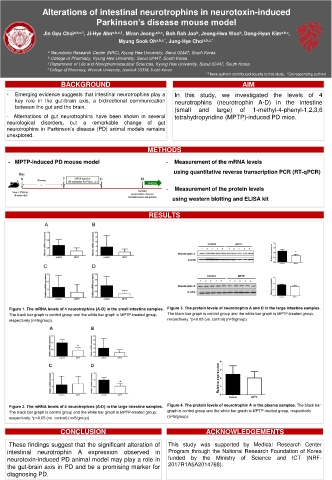
   -  Emerging evidence suggests that intestinal neurotrophins play a  In this study, we investigated the levels of 4
      key role in the gut-brain axis, a bidirectional communication  neurotrophins (neurotrophin A-D) in the intestine
      between the gut and the brain.                      (small  and  large)  of  1-methyl-4-phenyl-1,2,3,6
   - Alternations of gut neurotrophins have been shown in several  tetrahydropyridine (MPTP)-induced PD mice.
   neurological  disorders,  but  a  remarkable  change  of  gut
   neurotrophins in Parkinson’s disease (PD) animal models remains
   unexplored.

                                                 METHODS
    - MPTP-induced PD mouse model                      -  Measurement of the mRNA levels
                                                          using quantitative reverse transcription PCR (RT-qPCR)


                                                       -  Measurement of the protein levels
                                                         using western blotting and ELISA kit

                                                 RESULTS


                     CONCLUSION                                     ACKNOWLEDGEMENTS

    These findings suggest that the significant alteration of  This study was supported by Medical Research Center
   intestinal  neurotrophin  A  expression  observed  in  Program through the National Research Foundation of Korea
   neurotoxin-induced PD animal model may play a role in  funded  by  the  Ministry  of  Science  and  ICT  (NRF-
   the gut-brain axis in PD and be a promising marker for  2017R1A5A2014768).
   diagnosing PD.

