


Page 25 - Q. Neuroscience
P. 25
A Smart Delivery Of Drugs Into Neurons: A Novel Cell-Penetrating Peptide Enables
  Therapeutic Protein To Meet Intracellular Targets In The Interface Of Blood-Brain Barrier

   Youngjin Seo, Eunna Chung, Junghwan Jo, Seungwoo Lee, Soyoung Park, Kangin Choi, Jaeheon Choi, Youngsil Choi and Daewoong Jo
      Neurodegenerative Disease Drug Development Team, Cellivery R&D Institute, Cellivery Therapeutics, Inc., Seoul 03929, Korea

                              BACKGROUND                                                   AIM

    The  blood-brain  barrier  (BBB)  is  a  tightly-regulated  interface  between  neurons  and  blood   The  development  of  an  efficient
    vessels  to  control  the  neural  delivery  of  systemically-circulated  biomolecules  and  nutrients,   therapeutic  molecules  for  PD
    which is a huge challenge for the development of biotherapeutics for neuro-disorders such as   requires superior BBB-penetrating
    Parkinson’s disease (PD) due to lack of BBB penetrability.                  capability.

                                                 METHODS

    Brain pharmacokinetics (PK) studies have being performed in order to demonstrate neuronal delivery of cell-permeable (CP) proteins
    fused to a sequence-optimized advanced macromolecule transduction domain (aMTD). iCP-Parkin was detected in brain as assessed
    by immunofluorescence, flow cytometry, LC-MS/MS, western blot and enzyme-linked immunosorbent assay (ELISA) analysis.

                                                  RESULTS


 The  blood-brain  barrier  (BBB)  is  a  tightly-regulated  interface  between
 neurons  and  blood  vessels  to  control  the  neural  delivery  of  systemically-
 circulated  biomolecules  and  nutrients,  which  is  a  huge  challenge  for  the
 development  of  biotherapeutics  for  neuro-disorders  such  as  Parkinson’s
 disease  (PD)  due  to  lack  of  BBB  penetrability.  Effective  treatment  of
 therapeutic  molecules  for  PD  requires  superior  BBB-penetrating  capability.
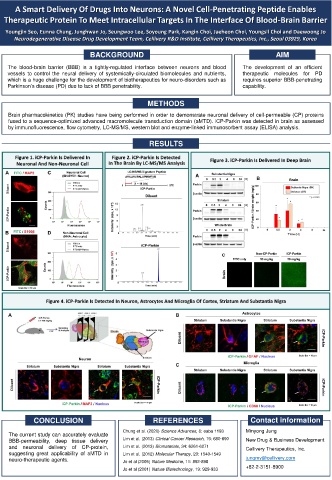
 Here, brain pharmacokinetics (PK) studies have being performed in order to
 demonstrate  neuronal  delivery  of  cell-permeable  (CP)  proteins  fused  to  a
 sequence-optimized advanced macromolecule transduction domain (aMTD).
 This  study  shows  that  the  tissue-permeability  of  aMTD-fused  Parkin  (iCP-
 Parkin)  was  significantly  promoted  in  6  major  organs  including  brain.  The
 quantitative analysis showed that iCP-Parkin was rapidly delivered into the
 deep brain (LC-MS/MS, 700 ng/g), and iCP-Parkin signals inside neurons were
 strongly detected by immunofluorescent analysis after intravenous injection
 (100  mg/kg),  which  is  currently  being  examined  by  using  immune
 magnetically isolated neurons from brain. In overall, the current study can   CONCLUSION   REFERENCES   Contact information
 accurately evaluate BBB-permeability and neuronal delivery of CP-proteins,
 suggesting great applicability of aMTD in neuro-therapeutics.   The current study can accurately evaluate   Chung et al. (2020) Science Advances, 6: eaba 1193   Minyong Jung
    BBB-permeability,  deep  tissue  delivery   Lim et al. (2013) Clinical Cancer Research, 19: 680-690   New Drug & Business Development
    and  neuronal  delivery  of  CP-protein,   Lim et al. (2013) Biomaterials, 34: 6261-6271   Cellivery Therapeutics, Inc.
    suggesting  great  applicability  of  aMTD  in   Lim et al. (2012) Molecular Therapy, 20: 1540-1549
    neuro-therapeutic agents.            Jo et al (2005) Nature Medicine, 11: 892-898   jungmy@cellivery.com
                                                                                 +82-2-3151-8900
                                         Jo et al (2001) Nature Biotechnology, 19: 929-933

