


Page 23 - Q. Neuroscience
P. 23
Replenishing Parkin Protects Neurons And Recovers Motor Function
                  From Neurotoxin (6-OHDA)-Mediated Cellular Stress
               Younseo Hwang, Youngjin Seo, Eunna Chung, Junghwan Jo, Seungwoo Lee, Soyoung Park and Daewoong Jo
                   Drug Development Team, Cellivery R&D Institute, Cellivery Therapeutics, Inc., Seoul 03929, Korea.

                   BACKGROUND                                                   AIM
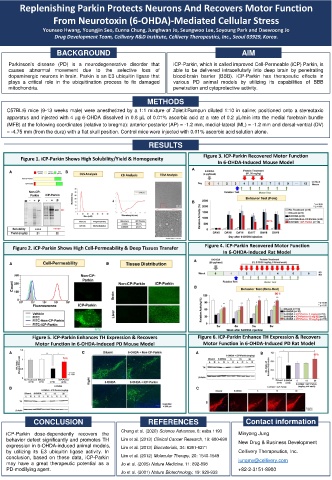
    Parkinson’s disease (PD) is a neurodegenerative disorder that  iCP-Parkin, which is called improved Cell-Permeable (iCP) Parkin, is
    causes  abnormal  movement  due  to  the  selective  loss  of  able to be delivered intracellularly into deep brain by penetrating
    dopaminergic neurons in brain. Parkin is an E3 ubiquitin ligase that  blood-brain barrier (BBB). iCP-Parkin has therapeutic effects in
    plays a critical role in the ubiquitination process to fix damaged  various PD animal models by utilizing its capabilities of BBB
    mitochondria.                                        penetration and cytoprotective activity.

                                                 METHODS
   C57BL/6 mice (9-13 weeks male) were anesthetized by a 1:1 mixture of Zoletil:Rumpun diluted 1:10 in saline; positioned onto a stereotaxic
   apparatus and injected with 4 µg 6-OHDA dissolved in 0.8 µL of 0.01% ascorbic acid at a rate of 0.2 µL/min into the medial forebrain bundle
   (MFB) at the following coordinates (relative to bregma): anterior-posterior (AP) = -1.2 mm, medial-lateral (ML) = -1.2 mm and dorsal-ventral (DV)
   = -4.75 mm (from the dura) with a flat skull position. Control mice were injected with 0.01% ascorbic acid solution alone.
                                                 RESULTS

                                                                   Figure 3. iCP-Parkin Recovered Motor Function
        Figure 1. iCP-Parkin Shows High Solubility/Yield & Homogeneity
                                                                        In 6-OHDA-Induced Mouse Model
    A                 B


     Figure 2. iCP-Parkin Shows High Cell-Permeability & Deep Tissues Transfer   Figure 4. iCP-Parkin Recovered Motor Function
                                                                          In 6-OHDA-Induced Rat Model
    A                               B


                                                                B


            Figure 5. iCP-Parkin Enhances TH Expression & Recovers   Figure 6. iCP-Parkin Enhance TH Expression & Recovers
            Motor Function in 6-OHDA-Induced PD Mouse Model        Motor Function in 6-OHDA-Induced PD Rat Model
    A                       C                                    A                    B


    B                                                            C


            CONCLUSION                           REFERENCES                      Contact information
   iCP-Parkin dose-dependently recovers the  Chung et al. (2020) Science Advances, 6: eaba 1193  Minyong Jung
   behavior defect significantly and promotes TH  Lim et al. (2013) Clinical Cancer Research, 19: 680-690  New Drug & Business Development
   expression in 6-OHDA-induced animal models,  Lim et al. (2013) Biomaterials, 34: 6261-6271
   by utilizing its E3 ubiquitin ligase activity. In                           Cellivery Therapeutics, Inc.
   conclusion, based on these data, iCP-Parkin  Lim et al. (2012) Molecular Therapy, 20: 1540-1549  jungmy@cellivery.com
   may have a great therapeutic potential as a  Jo et al. (2005) Nature Medicine, 11: 892-898
   PD-modifying agent.                                                         +82-2-3151-8900
                                        Jo et al. (2001) Nature Biotechnology, 19: 929-933

