


Page 25 - O. Microbiology
P. 25
Lycotoxin-Pa2a, A Novel Antibacterial and Antifungal Peptide
                  derived from the Venom of the Spider Pardosa astrigera
                                        1
                                                                                     2
                                                                                                      1
                                                        1
                                                                       1
                                                                 1
                                                                                           2
                                                   1
                                                                              1
                            Yunkyung Kim , Min Kyoung Shin , In-Wook Hwang , Seung-Tae Kim , and Jung-Suk Sung *   1
                                        Yunkyung Kim , Min Kyoung Shin , In-Wook Hwang , Seung-Tae Kim , and Jung-Suk Sung *
                            1 Department of Life Science, Dongguk University-Seoul, Goyang 10326, Republic of Korea
                                         1Department of Life Science, Dongguk University-Seoul, Goyang 10326, Republic of Korea
                            2 Life and Environment Research Institute, Konkuk University, Seoul 05029, Republic of Korea
                                      2Life and Environment Research Institute, Konkuk University, Seoul 05029, Republic of Korea
                   BACKGROUND                                                  AIM
   -  Venom  of  spiders  consists  of  various  bioactive  substances  including  ions,   -  To  secure  genetic  resources  for  Pardosa  astrigera,  a  domestic
      peptides, proteins. Among them, peptide substances (1-10 kDa) are known as   indigenous spider in Korea.
      a major component with cytolytic activity and neurotoxicity.    -  To identify the peptides expected to have physiological and biochemical
   -  Peptides  with  a  cationic,  α-helical  structure  are  usually  called  antimicrobial   function, and discover more toxic substances and their effects from the
      peptides  (AMPs)  due  to  its  cytolytic  activity,  and  found  in  venom  gland  of   venom of the Pardosa astrigera.
      venomous  species  such  as  spider  species  according  to  several  studies.   -  To explore the potential and industrial utility as biological and industrial
      However,  there  are  few  researches  on  venoms  and  toxin  peptides  derived   materials through functional analysis and further study on the mechanism
      from domestic native spiders in Korea.                 of action
                                               METHODS
   -  RNA sequencing and de novo assembly was performed to construct the venom-gland transcriptome of the spider Pardosa astrigera.
   -  Following homology search against known peptide toxins to select toxin-like sequences, structural characterization including cysteine patterns, disulfide bonds, a-
      helical conformation and net charge was conducted using several in silico analysis programs.
   -  Antibacterial  activity  of  Lycotoxin-Pa2a  against  gram  positive  bacteria  (B.  cereus  and  S.aureus)  and  gram  negative  bacteria  (E.  coli  and  E.cartovora)  was
      evaluated using colony forming unit assay. Also, antibacterial activity of the peptide against methicillin-resistant S.aureus was assessed thorugh detection of ATP.
   -  Antifungal activity of Lycotoxin-Pa2a against F.oxysporum and C. albicans was determined using colony forming unit assay.
                                                RESULTS
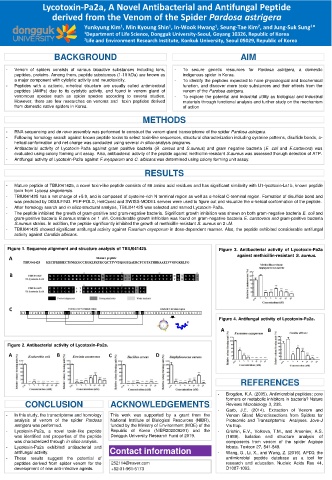
   -  Mature peptide of TBIU041425, a novel toxin-like peptide consists of 66 amino acid residues and has significant similarity with U1-lycotoxin-Ls1b, known peptide
      toxin from Lycosa singoriensis.
   -  TBIU041425 has a net charge of +5.9, and is composed of cysteine-rich N terminal region as well as α-helical C-terminal region. Formation of disulfide bond and
      was predicted by DISULFIND. PEP-POLD, HeliQuest and SWISS-MODEL servers were used to figure out and visualize the α-helical conformation of the peptide.
   -  After homology search and in silico structural analysis, TBIU041425 was selected and named Lycotoxin-Pa2a.
   -  The peptide inhibited the growth of gram-positive and gram-negative bacteria. Significant growth inhibition was shown on both gram-negative bacteria E. coli and
      gram-positive bacteria B.cereus strains on 1 uM. Considerable growth inhibition was found on gram-negative bacteria E. carotovora and gram-positive bacteria
      S.aureus strains. In addition, the peptide significantly inhibited the growth of methicillin-resistant S. aureus on 2 uM.
   -  TBIU041425 showed significant antifungal activity against Fusarium oxysporum in dose-dependent manner. Also, the peptide exhibited considerable antifungal
      activity against Candida albicans.

    Figure 1. Sequence alignment and structure analysis of TBIU041425.    Figure  3.  Antibacterial  activity  of  Lycotoxin-Pa2a
                                                                                       against methicillin-resistant S. aureus.
    A


    B


    C
                                                                         Figure 4. Antifungal activity of Lycotoxin-Pa2a.
                                                                         A              B


    Figure 2. Antibacterial activity of Lycotoxin-Pa2a.
    A               B               C               D


                                                                               REFERENCES

                                                                        -  Brogden, K.A. (2005). Antimicrobial peptides: pore
                                                                           formers or metabolic inhibitors in bacteria? Nature
         CONCLUSION                  ACKNOWLEDGEMENTS                      Reviews Microbiology 3, 238.
                                                                        -  Garb,  J.E.  (2014).  Extraction  of  Venom  and
   -  In this study, the transcriptome and homology   This  work  was  supported  by  a  grant  from  the   Venom  Gland  Microdissections  from  Spiders  for
      analysis  of  venom  of  the  spider  Pardosa   National  Institute  of  Biological  Resources  (NIBR),   Proteomic  and  Transcriptomic  Analyses.  Jove-J
      astrigera was performed.       funded by the Ministry of Environment (MOE) of the   Vis Exp.
   -  Lycotoxin-Pa2a,  a  novel  toxin-like  peptide   Republic  of  Korea  (NIBR202009201)  and  the   -  Grishin,  E.V.,  Volkova,  T.M.,  and  Arseniev,  A.S.
      was  identified  and  properties  of  the  peptide   Dongguk University Research Fund of 2019.   (1989).  Isolation  and  structure  analysis  of
      was characterized through in silico analysis.                        components  from  venom  of  the  spider  Argiope
   -  Lycotoxin-Pa2a  exhibited  antibacterial  and                        lobata. Toxicon 27, 541-549.
      antifungal activity.           Contact information                -  Wang, G., Li, X., and Wang, Z. (2016). APD3: the
   -  These  results  suggest  the  potential  of                          antimicrobial  peptide  database  as  a  tool  for
      peptides  derived  from  spider  venom  for  the    252114@naver.com   research  and  education.  Nucleic  Acids  Res  44,
      development of new anti-infective agents.    +82-31-961-5173         D1087-1093.

