


Page 45 - N. Metabolism and metabolic diseases
P. 45
Ginsenoside Compound K regulates adipogenesis
                                          in vitro and in vivo

                                        Sun Young Park 1,2  and Sungkun Chun 1,2
                                      2
                 1 Department of Physiology,  Brain Korea 21 plus Program, Jeonbuk National University Medical School,
                                          Jeonju-si, Jeollabuk-do 54907, Korea
                                                 Abstract
   Panax ginseng has been used as a natural medicine and their main component ginsenosides were reported that have many therapeutic effects
   for cancer, angiogenic disease, diabetes, obesity and neurological diseases. Recently, several studies showed that some types of ginsenosides
   have anti-obesity effects. However, ginsenoside Compound K’s effect on obesity or lipid metabolism was not reported yet. In this study, the effects
   of compound K on lipid metabolism were investigated through in vivo and in vitro assays. 3T3-L1 cells were differentiated with or without CK
   treatment and the related genes or proteins were examined. In addition, white adipose tissue (WAT) and brown adipose tissue (BAT) from
   C57BL/6 mice was used to confirm CK’s regulating effects on adipogenesis of both tissues. As a result, CK treatment regulated the differentiation
   of 3T3-L1 cells via concentration-dependent manner. Intraperitoneal CK injection (10mg/Kg, 10 days) increased expression of UCP-1 and PGC1-
   α mRNA levels in WAT as well as reduced the size of lipid droplets in WAT of CK-treated groups (n=5) compared to the vehicle-treated groups
   (n=5). In conclusion, these data suggest ginsenoside CK treatment can induce transition from white adipocytes to Brite (beige) adipocytes and
   have potential roles for treatment of obesity or lipid metabolic disorders.
                     Methods                                    Experimental scheme

                                                       In vitro


                                                       In vivo


                                                                                           Sacrifice

                                              Results
                 In vitro assays                                      In vivo assays
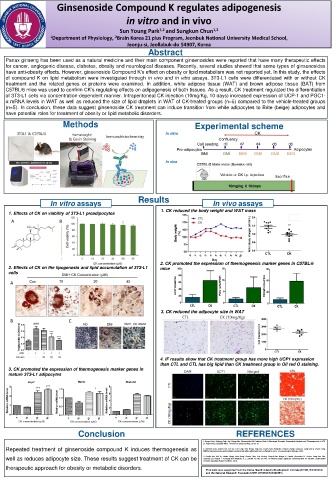
                                                     1. CK reduced the body weight and WAT mass
    1. Effects of CK on viability of 3T3-L1 preadipocytes
     A              B


                                                     2. CK promoted the expression of thermogenesis marker genes in C57BL/6
    2. Effects of CK on the lipogenesis and lipid accumulation of 3T3-L1  mice
    cells
    A


                                                     3. CK reduced the adipocyte size in WAT
    B                  C


                                                     4. IF results show that CK treatment group has more high UCP1 expression
                                                     than CTL and CTL has big lipid than CK treatment group in Oil red O staining.
    3. CK promoted the expression of thermogenesis marker genes in
    mature 3T3-L1 adipocytes


                          Conclusion                                          REFERENCES
                                                                   1.Seona Lim†, Jinbong Park, Jae-Young Um. Ginsenoside Rb1 Induces Beta 3 Adrenergic Receptor–Dependent Lipolysis and Thermogenesis in 3T3-
                                                                   L1 Adipocytesand db/db Mice. Fromtiers in pharmacology. 2019. 10
   Repeated treatment of ginsenoside compound K induces thermogenesis as  2. Shuwen Qian, Jiabao Pan, Yan Su, Yan Tang, Yina Wang, Ying Zou, Yaxin Zhao, Hong Ma, Youyou Zhang, Yang Liu, Liang Guo & Qi-qun Tang.
                                                                   BMPR2 promotes fatty acid oxidation and protects white adipocytes from cell death in mice. Communications biology. 2020.
   well as reduces adipocyte size. These results suggest treatment of CK can be  3. Heejin Jun, Hui Yu, Jianke Gong, Juan Jiang, Xiaona Qiao, Eric Perkey, Dong-il Kim, Margo P. Emont, Alexander G. Zestos, Jung-Sun Cho,
                                                                   Jianfeng Liu, Robert T. Kennedy,Ivan Maillard, X. Z. Shawn Xu and Jun Wu. An immune-beige adipocyte communication via nicotinic acetylcholine
                                                                   receptor signaling. Nature medicine. 2018.
   therapeutic approach for obesity or metabolic disorders.         This work was supported from the Korea Health Industry Development Institute (KHIDI, HI17C1510)
                                                                    and the National Research Foundation(NRF-2019M3C7A1032551).

