


Page 41 - N. Metabolism and metabolic diseases
P. 41
The regulation of steroid hormones in the placenta of
gestational diabetes mellitus (GDM)
Da Hee Kang¹, Sung-Min An¹, Min Jae Kim¹, Da Som Kim¹, So Young Kim¹ and Beum-Soo An¹*
¹Department of Biomaterials Science, College of Natural Resources & Life Science/Life and Industry Convergence Research Institute, Pusan National University, Korea
Abstract Results
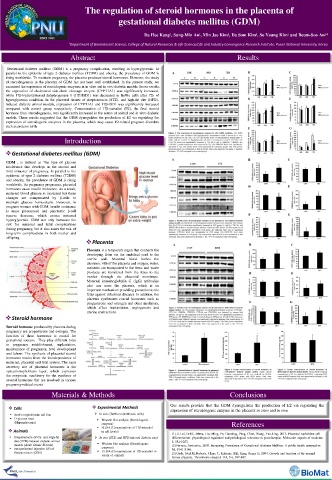
Gestational diabetes mellitus (GDM) is a pregnancy complication, resulting in hyperglycemia. In
parallel to the epidemic of type 2 diabetes mellitus (T2DM) and obesity, the prevalence of GDM is
rising worldwide. To maintain pregnancy, the placenta produces steroid hormones. However, the study
of steroidogenesis in the placenta of GDM has not been well established. In the present study, we
examined the expression of steroidogenic enzymes in in vitro and in vivo diabetic models. In our results,
the expression of cholesterol side-chain cleavage enzyme (CYP11A1) was significantly increased,
while 17β-hydroxysteroid dehydrogenase 1 (17βHSD1) was decreased in BeWo cells after 72h of
hyperglycemia condition. In the placental tissues of streptozotocin (STZ)- and high-fat diet (HFD)-
induced diabetic animal models, expression of CYP11A1 and 17βHSD1 was significantly increased
compared with control group respectively. Concentration of 17β-estradiol (E2), the final steroid
hormone from steroidogenesis, was significantly increased in the serum of animal and in vitro diabetic
models. These results suggested that the GDM dysregulates the production of E2 via regulating the
expression of steroidogenic enzymes in the placenta, which may cause E2-related pregnant disorders
such as preterm birth.
Introduction
Gestational diabetes mellitus (GDM)
GDM , is defined as “the type of glucose
intolerance that develops in the second and
third trimester of pregnancy. In parallel to the
epidemic of type 2 diabetes mellitus (T2DM)
and obesity, the prevalence of GDM is rising
worldwide. As pregnancy progresses, placental
hormones cause insulin resistance. As a result,
maternal blood glucose is increased but these
changes are compensated by β-cells to
maintain glucose homeostasis. However, in
pregnant women with GDM, insulin resistance
is more pronounced and pancreatic β-cell
reserve decrease, which causes maternal
hyperglycemia. GDM not only increases the
risk for maternal and fetal complications
during pregnancy, but it also raises the risk of
long-term complications in both mother and
offspring.
Placenta
Placenta is a temporary organ that connects the
developing fetus via the umbilical cord to the
uterine wall. Maternal blood bathes the
chorionic villi of the placenta and oxygen, water,
nutrients are transported to the fetus and waste
products are transfered from the fetus to the
mother through the placental membrane.
Maternal immunoglobulin G (IgG) antibodies
also can cross the placenta, which is an
important mechanism providing protection to the
fetus against infectious diseases. In addition, the
placenta synthesizes crucial hormones such as
progesterone and estrogen and other mediators,
which affect implantation, angiogenesis and
uterine contractions.
Steroid hormone
Steroid hormone produced by placenta during
pregnancy are progesterone and estrogen. The
function of these hormones is crucial for
gestational success. They play different roles
in pregnancy establishment, implantation,
maintenance of pregnancy, fetal development
and labour. The synthesis of placental steroid
hormones results from the interdependence of
maternal, placental and fetal system. The main
secretory site of placental hormones is the
syncytiotrophoblasts layer, which expresses
the enzymatic machinery for the synthesis of
several hormones that are involved in various
pregnancy-related events
Materials & Methods Conclusions
Cells Experimental Methods Our results provide that the GDM dysregulates the production of E2 via regulating the
expression of steroidogenic enzyme in the placenta in vitro and in vivo
BeWo trophoblastic cell line In vitro (BeWo trophoblastic cells)
D-glucose treat Western blot analysis (Steroidogenic
(Hyperglycemia) enzymes) References
ELISA (Concentrations of 17β-estradiol
Animals in cell lysate) [1] Ji, Lei, Brkić, Jelena, Liu, Ming, Fu, Guodong, Peng, Chun, Wang, Yan-Ling, 2013. Placental rophoblast cell
Streptozotocin (STZ)- and High-fat In vivo (STZ- and HFD-induced diabetic rats) differentiation: physiological regulation and pathological relevance to preeclampsia. Molecular aspects of medicine
diet (HFD)-induced diabetic animal 5, 981-1023.
models (Adult female SD rats) Western blot analysis (Steroidogenic [2] Ferrara, Assiamira, 2007. Increasing Prevalence of Gestational Diabetes Mellitus. A public health perspective
Intraperitoneal injection (IP) of enzymes) 30, S141-S146.
Streptozotocin (GD1) ELISA (Concentrations of 17β-estradiol in [3] Gude, Neil M, Roberts, Claire T, Kalionis, Bill, King, Roger G, 2004. Growth and function of the normal
serum of animal)
human placenta. Thrombosis research 114, 5-6, 397-407.

