


Page 37 - N. Metabolism and metabolic diseases
P. 37
Loss of the E3 ubiquitin ligase MKRN1 represses NAFLD
                     (Non-alcoholic fatty liver disease) through AMPK activation

                                                   Hyun-Ji Han*, Jaewhan Song
                                     Department of Biochemistry, College of Life science and Biotechnology,
                                                  Yonsei University, Seoul, Korea
                   BACKGROUND                                                  AIM

    Non-alcoholic fatty liver disease (NAFLD) is an important risk   MKRN1-depleted mice showed AMPK activation in the liver,
   factor for chronic metabolic syndrome. Makorin ring finger   resulting in the significant suppression of diet-induced
   protein 1 (MKRN1)  acts as an E3 ubiquitin ligase for the AMP-  metabolic syndrome. Moreover, we demonstrated the
   activated protein kinase (AMPK). AMPK is a master regulator of   therapeutic effect of MKRN1 using MKRN1-depleted high-
   energy metabolism in response to nutritional status. Here, we   nutrient-fed mice that reversed the non-alcoholic fatty liver
   report the identification of MKRN1 as a novel regulator to   disease. We suggest that MKRN1 repression could be a
   prevent NAFLD.                                         potential therapeutic strategy for metabolic disorders.

                                                METHODS
   MKRN1-null mice and their WT littermates (MKRN1+/+) were bred from MKRN1+/− mice and were randomly grouped for all the
   experiments. For HFD induced obesity experiments, male MKRN1+/+ and MKRN1−/− mice were placed on either an HFD (60%
   calories from fat; D12492, Research DIET Inc., NJ, USA) or a standard chow diet (17% calories from fat; 38057, Cargill Agri
   Purina  Inc.,  Republic  of  Korea)  for  20  weeks  starting  at  6–8  weeks  of  age.  For  HFHF  induced  NASH  experiments,  male
   MKRN1+/+ and MKRN1 -/- mice were placed on HFD with 30% High Froctose water for 20 weeks at 6-8 weeks of age. All the
   mice were maintained under temperature-controlled and light-controlled (standard 12-h light–dark cycles) conditions and provided
   with food and water ad libitum.
                                                RESULTS

   Figure 1                           Figure 2                           Figure 3
    a                                  a                                  a


    b                                  b          c           d           b


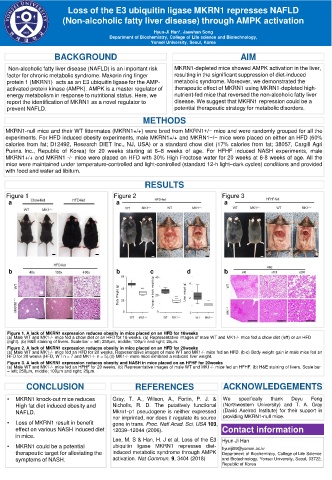
   Figure 1. A lack of MKRN1 expression reduces obesity in mice placed on an HFD for 16weeks
   (a) Male WT and MK1-/- mice fed a chow diet or an HFD for 16 weeks. (a) Representative images of male WT and MK1-/- mice fed a chow diet (left) or an HFD
   (right). (b) H&E staining of livers. Scale bar = left; 250µm, middle; 100µm and right; 25µm.

   Figure 2. A lack of MKRN1 expression reduces obesity in mice placed on an HFD for 20weeks
   (a) Male WT and MK1-/- mice fed an HFD for 20 weeks. Representative images of male WT and MK1-/- mice fed an HFD. (b-c) Body weight gain in male mice fed an
   HFD for 20 weeks (HFD, WT n = 7 and MK1-/- n = 5).(d) MK1-/- male mice exhibited a reduced liver weight.

   Figure 3. A lack of MKRN1 expression reduces obesity and NASH in mice placed on an HFHF for 20weeks
   (a) Male WT and MK1-/- mice fed an HFHF for 20 weeks. (b) Representative images of male WT and MK1-/- mice fed an HFHF. (b) H&E staining of livers. Scale bar
   = left; 250µm, middle; 100µm and right; 25µm.
          CONCLUSION                         REFERENCES                   ACKNOWLEDGEMENTS
   •  MKRN1 knock-out mice reduces    Gray,  T.  A.,  Wilson,  A.,  Fortin,  P.  J.  &   We   specifically   thank   Deyu   Feng
      High fat diet induced obesity and   Nicholls,  R.  D.  The  putatively  functional   (Northwestern  University)  and  T.  A.  Gray
      NAFLD.                          Mkrn1-p1 pseudogene is neither expressed   (David  Axelrod  Institute)  for  their  support  in
                                      nor imprinted, nor does it regulate its source   providing MKRN1-null mice.
   •  Loss of MKRN1 result in benefit   gene in trans. Proc. Natl Acad. Sci. USA 103,
      effect on various NASH induced diet   12039–12044 (2006).          Contact information
      in mice.
                                      Lee, M. S & Han, H. J et al. Loss of the E3  Hyun-Ji Han
   •  MKRN1 could be a potential      ubiquitin  ligase  MKRN1  represses  diet-    hyunji89@yonsei.ac.kr
      therapeutic target for alleviating the   induced metabolic syndrome through AMPK   Department of Biochemistry, College of Life Science
      symptoms of NASH.               activation. Nat Commun. 9, 3404 (2018)    and Biotechnology, Yonsei University, Seoul, 03722,
                                                                         Republic of Korea

