


Page 27 - M. Immunology
P. 27
Therapeutic and anti-inflammatory effect of Bleomycin induced Systemic
                                      sclerosis using W-peptide
  Gyu Tae Park*, Yang Woo Kwon, Young-cheol Song, Jae Ho Kim

  Medical Research Center for Ischemic Tissue Regeneration & Medical Research Institute, Department of Physiology, School of Medicine,
  Pusan National University, Yang san 626-870, Republic of Korea
                  BACKGROUND                                              METHODS

   Systemic sclerosis is an autoimmune disease that affects  For making of sclerosis model, Wild Type and FPR2
   multiple organs. It is caused by irregulated immune function  Knock  out mice were administrated bleomycin to
   and enlargement of connective tissue. Abnormal inflammatory  subcutaneous area for 3 weeks, and co-injected with W-
   activation is induce fibrosis, such as fibroblast activation, and  peptide for therapy of scleroderma. For check of fibrosis,
   collagen production. Formyl Peptide Receptor-2(FPR2) is a G-  We determined dermal thickness, and collagen density
   protein coupled receptor that expressed in Neutrophil, and  using Masson trichrome staining and hydroxyproline
   Monocyte. It is regulate inflammatory cell apoptosis, and  assay. For check of regulation of fibroblast activation,
   inflammatory cytokine expression. In previous reports was  mouse tissue were stained to alpha SMA, a myofibroblast
   conducted to investigate the effect of FPR2 activation in  marker, and Vimentin, a fibroblast number, and counted
   sclerosis.                                          α-sma positive and vimentin positive cell number. For
                         AIM                           check of inflammation, skin tissue were stained CD68, a
                                                       marker of inflammatory cell. And inflammatory cytokine
   we conducted an experiment to determine whether FPR2  level in mice sera was determinated through ELISA
   activation through W-peptide, a agonistic peptide of FPR2, has  assay.
   a therapeutic effect of Sclerosis disease.
                                                RESULTS
                      Figure 1                        Figure 2                        Figure 3


                      Figure 4                        Figure 5                        Figure 6


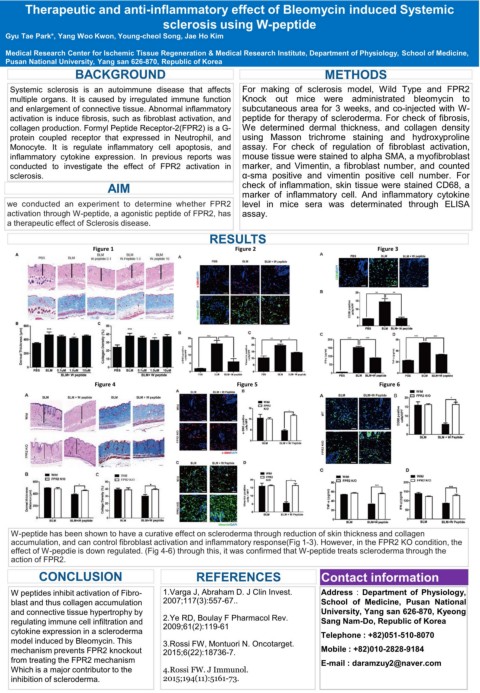
   W-peptide has been shown to have a curative effect on scleroderma through reduction of skin thickness and collagen
   accumulation, and can control fibroblast activation and inflammatory response(Fig 1-3). However, in the FPR2 KO condition, the
   effect of W-pepdie is down regulated. (Fig 4-6) through this, it was confirmed that W-peptide treats scleroderma through the
   action of FPR2.
          CONCLUSION                         REFERENCES                  Contact information

   W peptides inhibit activation of Fibro-  1.Varga J, Abraham D. J Clin Invest.   Address : Department of Physiology,
   blast and thus collagen accumulation   2007;117(3):557-67..           School of Medicine, Pusan National
   and connective tissue hypertrophy by                                  University, Yang san 626-870, Kyeong
   regulating immune cell infiltration and   2.Ye RD, Boulay F Pharmacol Rev.   Sang Nam-Do, Republic of Korea
   cytokine expression in a scleroderma   2009;61(2):119-61              Telephone : +82)051-510-8070
   model induced by Bleomycin. This   3.Rossi FW, Montuori N. Oncotarget.
   mechanism prevents FPR2 knockout   2015;6(22):18736-7.                Mobile : +82)010-2828-9184
   from treating the FPR2 mechanism                                      E-mail : daramzuy2@naver.com
   Which is a major contributor to the   4.Rossi FW. J Immunol.
   inhibition of scleroderma.         2015;194(11):5161-73.

