


Page 21 - M. Immunology
P. 21
Exclusive traits of neutrophils in NLRP3 inflammasome signaling

                              contribute to prolonged inflammation


                                      Seunghwan Son, Do-Wan Shim, Inhwa Hwang, Je-Wook Yu
              Department of Microbiology, BK 21 PLUS project for Medical Science, Yonsei University College of Medicine, Seoul, Korea


                         ABSTRACT                                A                       B

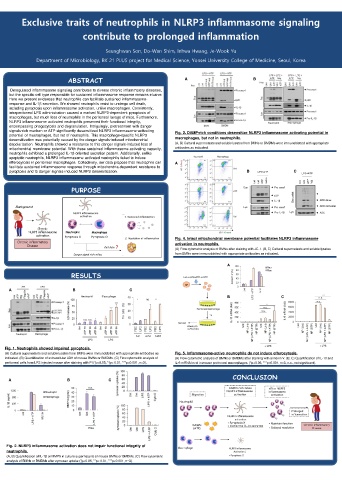
     Deregulated inflammasome signaling contributes to diverse chronic inflammatory diseases,
    but the specific cell type responsible for sustained inflammasome response remains elusive.
    Here we present evidences that neutrophils can facilitate sustained inflammasome-
    response and IL-1β secretion. We showed neutrophils resist to undergo cell death,
    including pyroptosis upon inflammasome activation, unlike macrophages. Consistently,
    intraperitoneal LPS administration caused a marked NLRP3-dependent pyroptosis of
    macrophages, but much less of neutrophils in the peritoneal lavage of mice. Furthermore,
    NLRP3 inflammasome activated neutrophils preserved their functional integrity,
    encompassing phagocytosis and degranulation. Intriguingly, pretreatment with danger
    signals-rich medium or ATP significantly desensitized NLRP3 inflammasome-activating   Fig. 3. DAMP-rich conditions desensitize NLRP3 inflammasome activating potential in
    potential of macrophages, but not of neutrophils. This macrophage-specific NLRP3
    desensitization was potentially caused by the danger signals-induced mitochondrial   macrophages, but not in neutrophils.
    depolarization. Neutrophils showed a resistance to this danger signals-induced loss of   (A, B) Cultural supernatants and soluble lysates from BMNs or BMDMs were immunoblotted with appropriate
    mitochondrial membrane potential. With these sustained inflammasome-activating capacity,   antibodies as indicated.
    neutrophils exhibited a prolonged IL-1β-oriented secretion pattern. Additionally, unlike
    apoptotic neutrophils, NLRP3 inflammasome activated neutrophils failed to induce
    efferocytosis in peritoneal macrophages. Collectively, our data propose that neutrophils can   A
    facilitate sustained inflammasome response through mitochondria-dependent resistance to
    pyroptosis and to danger signals-induced NLRP3 desensitization.                    B               C

                          PURPOSE


      Background


                                                              Fig. 4. Intact mitochondrial membrane potential facilitates NLRP3 inflammasome
                                                              activation in neutrophils.
                                                              (A) Flow cytometric analysis of BMNs after staining with JC-1. (B, C) Cultural supernatants and soluble lysates
                                                              from BMNs were immunoblotted with appropriate antibodies as indicated.
                                                                                A
                          RESULTS

    A                     B                   C
                                                                                B                  C
                                                                                            C           D


   Fig. 1. Neutrophils showed impaired pyroptosis.
   (A) Cultural supernatants and soluble lysates from BMNs were immunoblotted with appropriate antibodies as   Fig. 5. Inflammasome-active neutrophils do not induce efferocytosis.
   indicated. (B) Quantification of extracellular LDH of mouse BMNs or BMDMs. (C) Flow cytometric analysis of   (A) Flow cytometric analysis of BMNs or BMDMs after staining with annexin V. (B, C) Quantification of IL-10 and
   peritoneal cells from LPS injected mouse after staining with PI (*p<0.05, **p< 0.01, ***p<0.001, n=3).   IL-6 mRNA level in mouse peritoneal macrophages. (*p<0.05, ***p<0.001, n=3, n.s., not significant).

                                                                                  CONCLUSION
    A                   B              C


   Fig. 2. NLRP3 inflammasome activation does not impair functional integrity of
   neutrophils.
   (A, B) Quantification of IL-1β or MMP9 in culture supernatants of mouse BMNs or BMDMs. (C) Flow cytometric
   analysis of BMNs or BMDMs after zymosan uptake (*p<0.05, **p< 0.01, ***p<0.001, n=3).

