


Page 19 - M. Immunology
P. 19
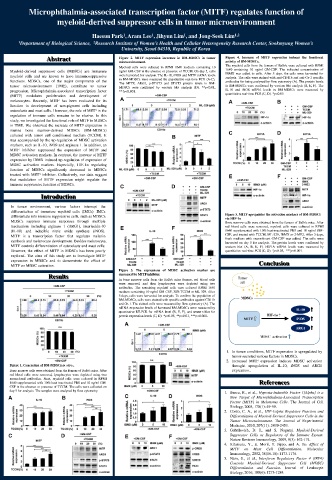
Microphthalmia-associated transcription factor (MITF) regulates function of
                    myeloid-derived suppressor cells in tumor microenvironment

                                         1
                               Haesun Park , Aram Lee , Jihyun Lim , and Jong-Seok Lim 1,2
                                                             1
                                                  1
                               2
       1 Department of Biological Science,   Research Institute of Women’s Health and Cellular Heterogeneity Research Center, Sookmyung Women’s
                                         University, Seoul 04310, Republic of Korea
                Abstract                Figure 2. MITF expression increases in BM-MDSCs in tumor  Figure 4. Increase of MITF expression induces the functional
                                        microenvironment.                 activity of BM-MDSCs.
                                        Myeloid cells were cultured in RPMI 1640 medium containing 10  The myeloid cells from the femurs of Balb/c were cultured with RPMI
    Myeloid-derived suppressor cells (MDSCs) are immature  ng/ml GM-CSF in the absence or presence of TCCM. On day 5, cells  1640 containing 10 ng/ml GM-CSF. The indicated concentration of
                                                                          IBMX was added to cells. After 5 days, the cells were harvested for
    myeloid cells and are known to have immunosuppressive  were harvested for analysis. The IL-10, iNOS and MITF mRNA levels  analysis. The cells were stained with anti-CD11b and anti-Gr-1 specific
    functions. MDSCs, one of the major components of the  in BM-MDSCs were measured by quantitative real-time PCR (A-C).  antibodies for being analyzed by flow cytometry (A). The protein levels
                                        The MITF, ARG1, p-STAT3 and STAT3 protein levels in BM-
    tumor microenvironment (TME), contribute to tumor  MDSCs were confirmed by western blot analysis (D). **p<0.01,  in BM-MDSCs were confirmed by western blot analysis (B, E, F). The
    progression. Microphthalmia-associated transcription factor  ***p<0.001.  IL-10 and iNOS mRNA levels in BM-MDSCs were measured by
                                                                          quantitative real-time PCR (C, D). *p<0.05
    (MITF)  modulates  proliferation  and  development  of
    melanocytes. Recently, MITF has been evaluated for its
    function in development of non-pigment cells including
    osteoclasts and mast cells. However, the role of MITF in the
    regulation of immune cells remains to be elusive. In this
    study, we investigated the functional role of MITF in MDSCs
    in TME. We observed the increase of MITF expression in
    murine  bone  marrow-derived  MDSCs  (BM-MDSCs)
    cultured with tumor cell conditioned medium (TCCM). It
    was accompanied by the up-regulation of MDSC activation
    markers, such as IL-10, iNOS and arginase 1. In addition, an
    MITF inhibitor suppressed the expression of MITF and
    MDSC activation markers. In contrast, the increase of MITF
    expression by IBMX induced up-regulation of expression of
    MDSC activation markers. Especially, HIF-1α regulating
    function of MDSCs significantly decreased in MDSCs
    treated with MITF inhibitor. Collectively, our data suggest
    that modulation of MITF expression might regulate the
    immune suppressive function of MDSCs.
              Introduction
     In tumor environment, various factors interrupt the
     differentiation of immature myeloid cells (IMCs). IMCs               Figure 5. MITF upregulates the activation markers of BM-MDSCs
     differentiate into immune suppressive cells, such as MDSCs.          via HIF-1α
     MDSCs suppress immune responses through multiple                     Bone marrow cells were obtained from the femurs of Balb/c mice. After
     mechanism including arginase 1 (ARG1), interleukin-10                red blood cells were removed, myeloid cells were cultured in RPMI
     (IL-10) and inducible nitric oxide synthase (iNOS).                  1640 supplemented with 10% heat-inactivated FBS and 10 ng/ml GM-
     MITF is a transcription factor that regulates melanin                CSF, and treated with TCCM, ML-329, IBMX or 2-ME2. After 3 days,
                                                                          fresh medium with recombinant GM-CSF was added. The cells were
     synthesis and melanocyte development. Besides melanocyte,            harvested on day 5 for analysis. The protein levels were confirmed by
     MITF controls differentiation of osteoclasts and mast cells.         western blot (A, B, E, F). HIF1A mRNA levels were measured by
     However, the effect of MITF in MDSCs has been poorly                 quantitative real-time PCR (C, D). *p<0.05, ***p<0.001.
     explored. The aims of this study are to investigate MITF
     expression in MDSCs and to demonstrate the effect of                            Conclusion
     MITF on MDSC activation.
                                        Figure 3. The expressions of MDSC activation marker are
                 Results                decreased by MITF inhibitor.
                                        In bone marrow cells from the Balb/c mice femurs, red blood cells
                                        were removed, and then lymphocytes were depleted using two
                                        antibodies. The remaining myeloid cells were cultured RPMI 1640
                                        medium containing 10 ng/ml GM-CSF, 30% TCCM or ML-329. After
                                        5 days, cells were harvested for analysis. To confirm the population of
                                        BM-MDSCs, cells were stained with specific antibodies against CD11b
                                        and Gr-1. The stained cells were measured by flow cytometry (A). The
                                        mRNA expression levels of harvested BM-MDSCs were measured by
                                        quantitative RT-PCR for mRNA level (B, E, F), and western blot for
                                        protein expression levels (C, D). *p<0.05, **p<0.01, ***p<0.001.
                                                                           1. In tumor conditions, MITF expression is upregulated by
                                                                            tumor-secreted various factors in MDSCs.
                                                                           2. Increased MITF expression induces MDSC activation
    Figure 1. Generation of BM-MDSCs in vitro..                             throught upregulation of IL-10, iNOS and ARG1
    Bone marrow cells were obtained from the femurs of Balb/c mice. After   expression..
    red blood cells were removed, lymphocytes were depleted using two
    monoclonal antibodies. Next, myeloid cells were cultured in RPMI
    1640 supplemented with 10% heat-inactivated FBS and 10 ng/ml GM-                 References
    CSF in the absence or presence of TCCM. The cells were collected on
    day 5 for analysis. The samples were analyzed by flow cytometry.      1. Busca, R., et al., Hypoxia-Inducible Factor 1{Alpha} is a
                                                                            New Target of Microphthalmia-Associated Transcription
                                                                            Factor (MITF) in Melanoma Cells. The Journal of Cell
                                                                            Biology, 2005, 170(1): 49-59.
                                                                          2. Corzo, C. A., et al., HIF-1alpha Regulates Function and
                                                                            Differentiation of Myeloid-Derived Suppressor Cells in the
                                                                            Tumor Microenvironment. The Journal of Experimental
                                                                            Medicine, 2010, 207(11): 2439-2453.
                                                                          3. Gabrilovich, D. I., and S. Nagaraj. Myeloid-Derived
                                                                            Suppressor Cells as Regulators of the Immune System.
                                                                            Nature Reviews Immunology, 2009, 9(3): 162-174.
                                                                          4. Kitamura, Y., E. Morii, T. Jippo, and A. Ito. Effect of
                                                                            MITF  on  Mast  Cell  Differentiation.  Molecular
                                                                            Immunology, 2002, 38(16-18): 1173-1176.
                                                                          5. Nam, S., et al., Interferon Regulatory Factor 4 (IRF4)
                                                                            Controls  Myeloid-Derived  Suppressor  Cell  (MDSC)
                                                                            Differentiation and Function. Journal of Leukocyte
                                                                            Biology, 2016, 100(6): 1273-1284.

