


Page 15 - M. Immunology
P. 15
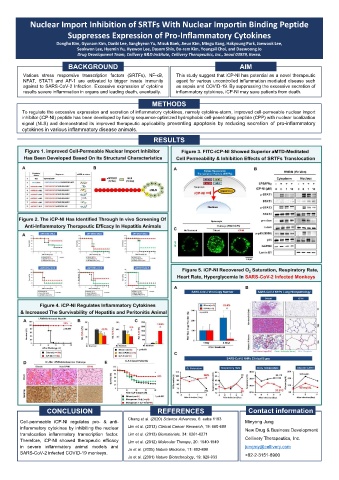
Nuclear Import Inhibition of SRTFs With Nuclear Importin Binding Peptide

                         Suppresses Expression of Pro-Inflammatory Cytokines
                     Dongho Kim, Gyunam Kim, Danbi Lee, Sanghyeon Yu, Misuk Baek, Jieun Kim, Mingu Kang, Hakyoung Park, Jaewook Lee,
                            Seokwon Lee, Hyemin Yu, Hyewon Lee, Dasom Shin, Bo-ram Kim, Youngsil Choi, and Daewoong Jo
                            Drug Development Team, Cellivery R&D Institute, Cellivery Therapeutics, Inc., Seoul 03929, Korea.
                         BACKGROUND                                                  AIM
         Various stress responsive transcription factors (SRTFs), NF-κB,  This study suggest that iCP-NI has potential as a novel therapeutic
         NFAT, STAT1 and AP-1 are activated to trigger innate immunity  agent for various uncontrolled inflammation mediated disease such
         against to SARS-CoV-2 Infection. Excessive expression of cytokine  as sepsis and COVID-19. By suppressing the excessive secretion of
         results severe inflammation in organs and leading death, eventually.  inflammatory cytokines, iCP-NI may save patients from death.
                                                      METHODS
         To regulate the excessive expression and secretion of inflammatory cytokines, namely cytokine-storm, improved cell-permeable nuclear import
         inhibitor (iCP-NI) peptide has been developed by fusing sequence-optimized hydrophobic cell-penetrating peptide (CPP) with nuclear localization
         signal (NLS) and demonstrated its improved therapeutic applicability preventing apoptosis by reducing secretion of pro-inflammatory
         cytokines in various inflammatory disease animals.
                                                       RESULTS


                 CONCLUSION                             REFERENCES                      Contact information
                                              Chung et al. (2020) Science Advances, 6: eaba 1193
        Cell-permeable iCP-NI regulates pro- & anti-                                   Minyong Jung
        inflammatory cytokines by inhibiting the nuclear  Lim et al. (2013) Clinical Cancer Research, 19: 680-690  New Drug & Business Development
        translocation inflammatory transcription factor.  Lim et al. (2013) Biomaterials, 34: 6261-6271
                                                                                       Cellivery Therapeutics, Inc.
        Therefore, iCP-NI showed therapeutic efficacy  Lim et al. (2012) Molecular Therapy, 20: 1540-1549
        in severe inflammatory animal models and                                       jungmy@cellivery.com
                                              Jo et al. (2005) Nature Medicine, 11: 892-898
        SARS-CoV-2 infected COVID-19 monkeys.
                                              Jo et al. (2001) Nature Biotechnology, 19: 929-933  +82-2-3151-8900

