


Page 25 - L. Genetics and genomics
P. 25
Improvement of target specificity of CRISPR-Cas12a
                         by using chimeric DNA-RNA guide.
                                 1,3
                         Hanseop Kim , Wi-jae Lee , Yeounsun Oh , Seung-Hun Kang ,Dong-Seok Lee , Sun-Uk Kim , Seung Hwan Lee 2
                                         1
                                                                      1
                                                                              1
                                                  1
                                                             3
                         1 Futuristic Animal Resource & Research Center (FARRC), Korea Researh Institute of Bioscience and Biotechnology(KRIBB), Cheongju, Korea
                         2 National Primate Research Center (NPRC), Korea Researh Institute of Bioscience and Biotechnology(KRIBB),Cheongju, Korea
                         3 Department of Functional Genomics, KRIBB School of Bioscience, Korea University of Science and Technology (UST), Daejeon, Korea
                         4 Department of Medicine, Graduate School, Kyung Hee University, Seoul 02447, Republic of Korea
                         5 School of Life Sciences and Biotechnology, BK21 Plus KNU Creative BioResearch Group, Kyungpook National University, Daegu, Republic of Korea
                         6 Department of Bioscience and Biotechnology, Konkuk University, Seoul 143-701, Korea
                         7 Department of Biotechnology, College of Life Sciences and Biotechnology, Korea University, Seoul 02841, Republic of Korea
    B a c k g r o un d                                   M e t h o ds
   The CRISPR–Cas system is a bacterial immune system, which and it is now
   widely used for target-specific genome editing in various organisms. One of
   the CRISPR systems, CRISPR–Cas9 RNA-guided endonuclease, is routinely
   used to specifically correct or control genes of interest based on its ability to
   cut double-stranded DNA. Another component of the CRISPR system,
   CRISPR–Cas12a (Cpf1)was recently reported and is a class II, typeVeffector
   nuclease that has a bi-lobed structure composed of nuclease and recognition
   domains, similar to Cas9. Cas12a binds the target DNA helix via a single-
   stranded (cr)RNA, forming a DNA–RNA hybrid duplex. Cas12a has attracted
   attention as an excellent genome-engineering tool as it overcomes certain
   limitations of Cas9. In contrast to Cas9, which recognizes guanine (G)-rich
   sequences, Cas12a recognizes specific thymine (T)-rich protospacer adjacent
   motif (PAM) sequences (TTTN or TTN) and can specifically induce double-
   strand DNA cleavage.
    A im
   The CRISPR–Cas12a is now broadly applicable for gene editing in various  Partial DNA replacement introduced to the guide RNA of CRISPR-Cas12a.
   organisms ranging from microorganisms to humans, and therefore, we  In vitro cleavage and in vivo genome editing experiments were performed
   investigated off-target cleavage by Cas12a and engineered the Cas12a  with these chimeric DNA-RNA guides.
   (cr)RNA to address the off-target cleavage issue.
                                                 R es ul t s


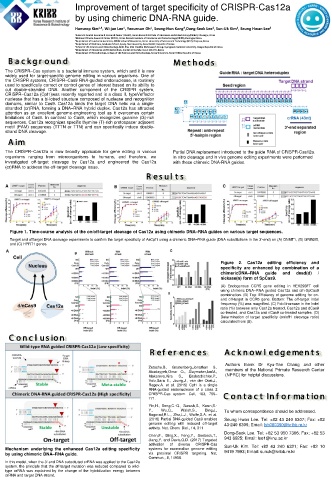
    Figure 1. Time-course analysis of the on/off-target cleavage of Cas12a using chimeric DNA–RNA guides on various target sequences.
    Target and offtarget DNA cleavage experiments to confirm the target specificity of AsCpf1 using a chimeric DNA–RNA guide (DNA substitutions in the 3’-end) on (A) DNMT1, (B) GRIN2B,
    and (C) HPRT1 genes.


                                                                         Figure  2.  Cas12a  editing  efficiency  and
                                                                         specificity are enhanced by combination of a
                                                                         chimericDNA–RNA  guide  and  dead(d)  /
                                                                         nickase(n) form of SpCas9.
                                                                         (A) Endogenous CCR5 gene editing in HEK293FT cell
                                                                         using chimeric DNA–RNA guided Cas12a and d/n-SpCas9
                                                                         combination. (B) Top: Efficiency of genome editing for on-
                                                                         and off-target in CCR5 gene. Bottom: The off-target indel
                                                                         frequency (%) was magnified. (C) Fold increase in the indel
                                                                         ratio (%) between only Cas12a treated, Cas12a and dCas9
                                                                         co-treated, and Cas12a and nCas9 co-treated samples. (D)
                                                                         Determination of target specificity (on/off1 cleavage ratio)
                                                                         calculated from (B).
    C o n c l us io n
                                                  R ef er en c es         A c k n ow l edg emen t s


                                                                          Authors thank Dr Kyu-Tae Chang and other
                                                 Zetsche,B.,  Gootenberg,Jonathan  S.,
                                                 Abudayyeh,Omar O., Slaymaker,IanM.,  members of the National Primate Research Center
                                                 Makarova,Kira  S.,  Essletzbichler,P.,  (NPRC) for helpful discussions.
                                                 Volz,Sara E., Joung,J., van der Oost,J.,
                                                 Regev,A. et al. (2015) Cpf1 is a single
                                                 RNA-guided endonuclease of a class 2
                                                 CRISPR-Cas system. Cell, 163, 759–  C o n t a c t  In f or ma t ion
                                                 771.
                                                 Yin,H., Song,C.-Q., Suresh,S., Kwan,S.-
                                                 Y.,  Wu,Q.,  Walsh,S.,  Ding,J.,  To whom correspondence should be addressed.
                                                 Bogorad,R.L., Zhu,L.J., Wolfe,S.A. et al.
                                                 (2018) Partial DNA-guided Cas9 enables  Seung Hwan Lee. Tel: +82 43 240 6307; Fax: +82
                                                 genome editing with reduced off-target  43-240 6309; Email: lsh080390@kribb.re.kr
                                                 activity. Nat. Chem. Biol., 14, 311
                                                                          Dong-Seok Lee. Tel: +82 53 950 7366; Fax: +82 53
                                                 Chen,F., Ding,X., Feng,Y., Seebeck,T.,
                                                 Jiang,Y. and Davis,G.D. (2017) Targeted  943 6925; Email: lee1@knu.ac.kr
                                                 activation  of  diverse  CRISPR-Cas
   Mechanism underlying the enhanced Cas12a editing specificity  systems for mammalian genome editing  Sun-Uk Kim. Tel: +82 43 240 6321; Fax: +82 10
                                                                          9419 7993; Email: sunuk@kribb.re.kr
   by using chimeric DNA–RNA guide.              via proximal CRISPR targeting. Nat.
                                                 Commun., 8, 14958.
   In this model, when the 3'-end DNA substituted crRNA was applied to the Cas12a
   system, the principle that the off-target mutation was reduced compared to wild-
   type crRNA was explained by the change of the hybridization energy between
   crRNA and target DNA strand.

