


Page 21 - L. Genetics and genomics
P. 21
Association of Genetic variants in long non-coding RNA SOX2OT with risk of
                                              gastric cancer
                                        Gang Min Hur , Jang Hee Hong 1,2
                                                     1
                                                                                                    2
   1 Department of Pharmacology, Chungnam National University College of Medicine, Daejeon, Republic of Korea,  Clinical
                   Trials Center, Chungnam National University Hospital, Daejeon, Republic of Korea.
                                         BACKGROUND & AIM

    Long non-coding RNAs (LncRNAs) have been suggested that are associated with cancer progression. In this study, we
    evaluated the association between polymorphism rs9839776 in lncRNA sex-determining region Y-box 2 overlapping transcript
    (SOX2OT) and the risk of gastric cancer (GC) and GC subgroups via a case-control study.

                                                METHODS

    We genotyped polymorphism rs9839776 in SOX2OT with 377 GC patients and 353 controls using TaqMan genotyping assay. χ 2
    tests were used to estimate the Hardy-Weinberg equilibrium of each SNP and the association between the GC and control.
    Binary logistic regression was conducted to estimate the GC risk by odds ratios (OR) and 95% confidence intervals (CI).
                                                 RESULTS


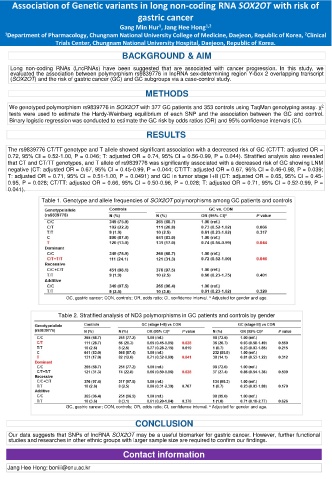
    The rs9839776 CT/TT genotype and T allele showed significant association with a decreased risk of GC (CT/TT: adjusted OR =
    0.72, 95% CI = 0.52-1.00, P = 0.046; T: adjusted OR = 0.74, 95% CI = 0.56-0.99, P = 0.044). Stratified analysis also revealed
    that CT and CT/TT genotypes, and T allele of rs9839776 was significantly associated with a decreased risk of GC showing LNM
    negative (CT: adjusted OR = 0.67, 95% CI = 0.45-0.99, P = 0.044; CT/TT: adjusted OR = 0.67, 95% CI = 0.46-0.98, P = 0.039;
    T: adjusted OR = 0.71, 95% CI = 0.51-1.00, P = 0.0491) and GC in tumor stage I+II (CT: adjusted OR = 0.65, 95% CI = 0.45-
    0.95, P = 0.028; CT/TT: adjusted OR = 0.66, 95% CI = 0.50-0.96, P = 0.028; T: adjusted OR = 0.71, 95% CI = 0.52-0.99, P =
    0.041).
               Table 1. Genotype and allele frequencies of SOX2OT polymorphisms among GC patients and controls


                                                                     a
                       GC, gastric cancer; CON, controls; OR, odds ratio; CI, confidence interval.  Adjusted for gender and age.
                    Table 2. Stratified analysis of ND3 polymorphisms in GC patients and controls by gender


                                                                     a
                       GC, gastric cancer; CON, controls; OR, odds ratio; CI, confidence interval.  Adjusted for gender and age.
                                             CONCLUSION

    Our data suggests that SNPs of lncRNA SOX2OT may be a useful biomarker for gastric cancer. However, further functional
    studies and researches in other ethnic groups with larger sample size are required to confirm our findings.
                                         Contact information

   Jang Hee Hong: boniii@cnu.ac.kr

