


Page 9 - I. Chemical biology and drug discovery
P. 9
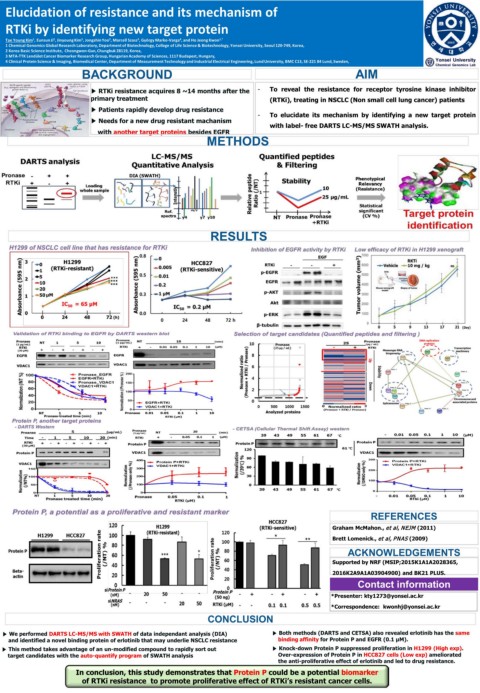
Elucidation of resistance and its mechanism of
  RTKi by identifying new target protein
  Tae Young Kim 1 , Eunsun Ji 2 , Jinyoung Kim 2 , Jongshin Yoo 2 , Marcell Szasz 3 , György Marko-Varga 4 , and Ho Jeong Kwon 1,*
  1 Chemical Genomics Global Research Laboratory, Department of Biotechnology, College of Life Science & Biotechnology, Yonsei University, Seoul 120-749, Korea,
  2 Korea Basic Science Institute,  Cheongwon-Gun, Chungbuk 28119, Korea,
  3 MTA-TTK Lendület Cancer Biomarker Research Group, Hungarian Academy of Sciences, 1117 Budapest, Hungary,
  4 Clinical Protein Science & Imaging, Biomedical Center, Department of Measurement Technology and Industrial Electrical Engineering, Lund University, BMC C13, SE-221 84 Lund, Sweden,
                   BACKGROUND                                                    AIM
                     ▶ RTKi resistance acquires 8 ~14 months after the   -  To reveal the resistance for receptor tyrosine kinase inhibitor
                     primary treatment                        (RTKi), treating in NSCLC (Non small cell lung cancer) patients
                     ▶ Patients rapidly develop drug resistance  -  To elucidate its mechanism by identifying a new target protein
                     ▶ Needs for a new drug resistant machanism  with label- free DARTS LC-MS/MS SWATH analysis.
                       with another target proteins besides EGFR
                                                METHODS


                                                RESULTS


                                                                                    REFERENCES
                                                                            Graham McMahon., et al, NEJM (2011)
                                                                            Brett Lomenick., et al, PNAS (2009)
                                                                               ACKNOWLEDGEMENTS
                                                                            Supported by NRF (MSIP;2015K1A1A2028365,
                                                                            2016K2A9A1A03904900) and BK21 PLUS.
                                                                                  Contact information
                                                                            *Presenter: kty1273@yonsei.ac.kr
                                                                            *Correspondence: kwonhj@yonsei.ac.kr
                                                CONCLUSION

  ▶ We performed DARTS LC-MS/MS with SWATH of data independant analysis (DIA)  ▶ Both methods (DARTS and CETSA) also revealed erlotinib has the same
   and identified a novel binding protein of erlotinib that may underlie NSCLC resistance  binding affinity for Protein P and EGFR (0.1 μM).
  ▶ This method takes advantage of an un-modified compound to rapidly sort out  ▶ Knock-down Protein P suppressed proliferation in H1299 (High exp).
   target candidates with the auto-quantify program of SWATH analysis  Over-expression of Protein P in HCC827 cells (Low exp) ameliorated
                                                                the anti-proliferative effect of erlotinib and led to drug resistance.
                  In conclusion, this study demonstrates that Protein P could be a potential biomarker
                   of RTKi resistance  to promote proliferative effect of RTKi’s resistant cancer cells.

