


Page 5 - I. Chemical biology and drug discovery
P. 5
Inhibition of fatty acid binding protein 4 ameliorates
                          impaired ciliogenesis in gastric cancer cells

                                                     1
                                               Yooju Jung , Jae-Ho Cheong , and Ho Jeong Kwon 1
                                                               2
                            1 Chemical Genomics Global Research Laboratory, Department of Biotechnology, College of Life Science & Biotechnology,
                                                   Yonsei University, Seoul 03722, Korea
                                     2 Department of Surgery, Yonsei University College of Medicine, Seoul, Republic of Korea
                     BACKGROUND                                                  AIM
  ▶ FABP4 (Fatty Acid Binding Protein 4) in cancer        ▶ Investigation on correlation between FABP4 and primary cilia in gastric
  • FABP4 is known as a carrier protein for fatty acids in adipocyte.  cancer
  • Recently, FABP4 has been reported as a cancer related protein in different kindsof cancer.  • Although FABP4 plays an important role in cancer cells, its mechanism still remains
  •FABP4 contributes to poor prognosis in ovarian cancer and could be a target for therapeutic  unclear in gastric cancer cell lines.
  intervention for cancer .                               • Microarray assay on gastric cancer patients tissue indicated those who express lower
                                                          amounts of FABP4 presented higher survival rate.
  ▶ Primary cilia as a cell cycleregulator in cancer      • Furthermore, Primary cilia has been recognized as a signaling center for tumorigenesis.
  •Primary cilium assembly begins at the G0/G1 phase of the cell cycle and starts to disassemble  • Accordingly, we hypothesize that there could be a correlation between FABP4 and
  when cells re-enter the cell cycle.                     primary cilia in gastriccancer.
  • Primary cilia is deficient in many cancer cells and their proliferation is upregulated. Restoring
  primary cilia in cancersis one of the novel therapeuticapproach.


                                                                              Methods
                                                          ▶ ICC (Immunocytochemistry)
                                                          ▶ TCGAanalysis
                                                          ▶ In silico docking analysis
                                                          ▶ Xenograft mouse model
                                                  RESULTS
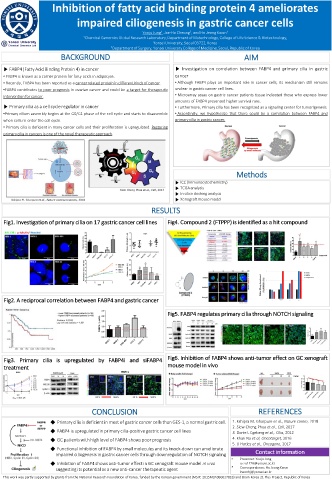
  Fig1. Investigation of primary cilia on 17 gastric cancer cell lines  Fig4. Compound 2 (FTPPP) is identified as a hit compound


  Fig2. A reciprocal correlation between FABP4 and gastric cancer

                                                        Fig5. FABP4 regulates primary cilia through NOTCH signaling


  Fig3. Primary cilia is upregulated by FABP4i and siFABP4  Fig6. Inhibition of FABP4 shows anti-tumor effect on GC xenograft
  treatment                                             mouse model in vivo


                               CONCLUSION                                            REFERENCES

                 ◆ Primary cilia is deficient in most of gastric cancer cells than GES-1, a normal gastric cell.  1. Kshipra M. Gharpure et al., Nature comm, 2018
                                                                             2. Siew Cheng Phua et al., Cell, 2017
                 ◆ FABP4 is upregulated in primary cilia-positive gastric cancer cell lines  3. Dorte L Egeberg et al., Cilia, 2012
                 ◆ GC patients with high level of FABP4 shows poor prognosis  4. Khan Na et al, Oncotarget, 2016
                                                                             5. U Harjes et al., Oncogene, 2017
                 ◆ Functional inhibition of FABP4 by small molecules and its knock-down can ameliorate  Contact information
                   impaired ciliogenesis in gastric cancer cells through downregulation of NOTCH signaling
                                                                            •  Presenter: YoojuJung
                 ◆ Inhibition of FABP4 shows anti-tumor effect in GC xenograft mouse model in vivo  uzzu1226@yonsei.ac.kr
                   suggesting its potential as a new anti-cancer therapeutic agent  *        Correspondence: Ho Jeong Kwon
                                                                               kwonhj@yonsei.ac.kr
  This work was partly supported by grants from the National Research Foundation of Korea, funded by the Korean government (MSIP; 2015M3A9B6027818) and Brain Korea 21 Plus Project, Republic of Korea

