


Page 13 - I. Chemical biology and drug discovery
P. 13
The Natural alkaloid compound E inhibits both stem cell and non-stem-cell populations
        in human cancer cells by targeting heat shock protein 70


         Seung Yeob Hyun¹, Huong Thuy Le¹, Hye Young Min¹, Honglan Pei¹, Yijae Lim¹, Injae Song¹, Yen T. Nguyen¹,
         Suckchang Hong¹, Byung Woo Han¹, Ho Young Lee¹ *
                                               ,
         ¹ College of Pharmacy, Seoul National University, Seoul 08826, Republic of Korea 151-742

                        Abstrac                                               MATERIAL & METHODS
                        t
                                                              1. Effect of Compound E on CSCs and non – CSCs are examined
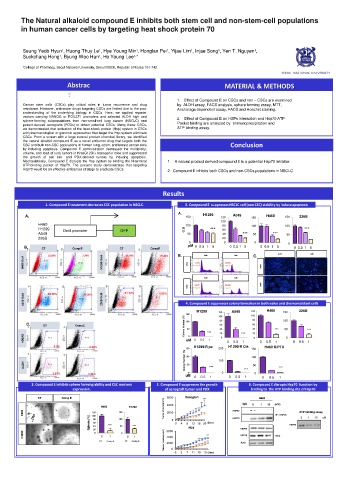
         Cancer stem cells (CSCs) play critical roles in tumor recurrence and drug  by  ALDH assay, FACS analysis, sphere forming assay, MTT,
         resistance. However, anticancer drugs targeting CSCs are limited due to the poor  Anchorage dependent assay, FACS and Hoechst staining.
         understanding of the underlying biology in CSCs. Here, we applied reporter
         vectors carrying NANOG or POUSF1 promoters and selected ALDH high and  2. Effect of Compound E on HSPs interaction and Hsp70 ATP
         sphere-forming subpopulations from non-small-cell lung cancer (NSCLC) and
         patient-derived xenografts (PDXs) to obtain potential CSCs. Using these CSCs,  Pocket binding are analyzed by  Immunoprecipitation and
         we demonstrated that activation of the heat shock protein (Hsp) system in CSCs  ATP binding assay.
         and pharmacological or genomic approaches that target the Hsp system eliminate
         CSCs. From a screen with a large natural product chemical library, we identified
         the natural alkaloid compound E as a novel antitumor drug that targets both the
         CSC and bulk non-CSC populations in human lung, colon, and breast cancer cells  Conclusion
         by inducing apoptosis. Compound E administration decreased the multiplicity,
         volume, and load of lung tumors in KrasG12D/+ transgenic mice and suppressed
         the growth of cell line- and PDX-derived tumors by inducing apoptosis.
         Mechanistically, Compound E disrupts the Hsp system by binding the N-terminal  1. A natural product derived compound E is a potential Hsp70 inhibitor.
         ATP-binding pocket of Hsp70. The present study demonstrates that targeting
         Hsp70 would be an effective anticancer strategy to eradicate CSCs.  2.  Compound E inhibits both CSCs and non-CSCs populations in NSCLC.
                                                         Results

                 1. Compound E treatment decreases CSC population in NSCLC.  3. Compound E  suppresses NSCLC cell (non CSC) viability by induce apoptosis
                                                              A.
          A.                                                     150   H1299   120  A549  150  H460  150  226B
                                                                             100
              H460                                               100         80        100         100
              H1299    Oct4 promoter      GFP                   O.D      ***  60                         ***
              A549                                               50          40     ***  50    ***  50
              226B                                                           20
                                                                  0           0         0           0
         B.    CT         Comp E          CT         CompE        μM 0 0.5 1  5  0 0.5 1 5  0 0.5 1  5  0 0.5 1 5
                 10.68%      7.76%          38.09%      26.42%  B.     0uM       1uM    C.      0uM        1uM
         H460 Oct4                  H1299 Oct4                   A549  1.07%  46.74%       A549


                                                                       0uM       1uM
                                                                 H460  3.61%  24.32%       H460
                                            17.13%
                                                        8.88%
         A549 Oct4  33.16%    20.26%  226B Oct4                  4. Compound E suppresses colony formation in both naïve and chemoresistant cells
                                                                    H1299   120  A549  120   H460  150  226B
                                                                 150        100        100
                                                                Colony Number (%)  50  40  40  ***  50    ***
          C.    CT         CompE                                 100        80 60       80        100
                                                                                        60
         +DEAB                                                   uM  0  0.5  ***  20 0  0  0.5  ***  20 0  0  0.5  1  0  0  0.5  1
                                                                  0
                                                                         1
                                                                                    1
                   0.3%         0.33%                            150  H1299/R pe  200  H1299/R Cis   150  H460 R/PTX
                                                                Colony Number (%)  100  100  100
         ALDH                                                    50      ***            50       ***
                   2.67%       1.44%                             uM 0  0  0.5  1  0  0  0.5  ***  0  0  0.5  1
                                                                                     1
            2. Compound E inhibits sphere forming ability and CSC markers   5. Compound E suppresses the growth   6. Compound E disrupts Hsp70  function by
                          expression.                     of xenograft tumor and PDX   binding to  the ATP binding site of Hsp70
              CT      Comp E                              6000   Xenograft  ***           H460
                                    H460     H1299       Tumor Volume(mm 3 )  4000  IgG  0  1  10  (uM)
         H460                    120      150             2000                   HSP90          IP : HSP70  ATP binding assay
                                 100
                                Sphere (%)  80 60 40  ***  100 50  ***  0  0  4  8 PDX              HSP70
                                                                                                        0        1       10       uM
                                                                                 HSP70
                                                                   12 16 20 (Days)
         H1299                   20 0  0  1  0  0  1      6000          ***        HSP90        WCL
                                                                                   HSP70
                                                          4000
                                   CT        Comp E  CT       Comp E  Tumor Volume(mm 3 )  2000  Actin
                                                            0
                                                             0  3  7  11 15 19 (Days)

