


Page 17 - I. Chemical biology and drug discovery
P. 17
Sophora flavescens extracts elicit therapeutic effects on overactive bladder syndrome by activating
  the large-conductance calcium-activated potassium channel
  Heeji Jo¹, Jisun Han¹, Narasaem Lee¹, Hyun Jun Lee², Sung Joo Jang³, Seunghwan Ryu³, Sang Hyun Moh³, Jae Hoon Cheong², and Chul-Seung Park¹
  ¹School of Life Sciences and Integrated Institute of Biomedical Research, Gwangju Institute of Science and Technology, Gwangju 61005, South Korea,
  ²Department of Pharmacy, Sahmyook University, Seoul 01795, South Korea,
  ³Anti-Aging Research Institute, BIO-FD&C Co., Ltd, Incheon 21990, South Korea
                                BACKGROUND                                                  AIM

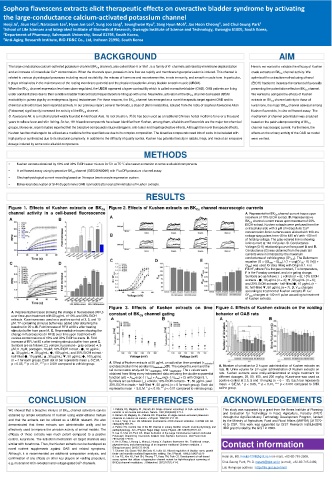
    The large-conductance calcium-activated potassium channel (BK Ca channel), also called Maxi-K or Slo1, is a family of K + channels activated by membrane depolarization   Herein, we wanted to validate the efficacy of Kushen
    and an increase of intracellular Ca 2+ concentration. When the channels open, potassium ions flow out rapidly and membrane hyperpolarization is induced. This channel is   crude extracts on BK Ca channel activity. We
    related to various physiological processes including neural excitability, the release of hormone and neurotransmitter, innate immunity, and smooth muscle tone. In particular,   optimized the extraction method using ethanol
    it plays critical roles in the maintenance of the resting membrane potential and the phasic relaxation in urinary bladder smooth muscle (UBSM).  (EtOH) fraction to increase the content of flavonoids
    When the BK Ca channel expression level was down-regulated, the UBSM appeared a hyper-contractility which is called overactive bladder (OAB). OAB patients are living   presenting the potentiation effect on BK Ca channel.
    under constant stress due to their sensitive bladder that contracts frequently before filling up with urine. Meanwhile, activation of the BK Ca channel decreased UBSM   We wanted to compare the effects of Kushen
    excitability in guinea pigs by an endogenous ligand, testosterone. For these reasons, the BK Ca channel has emerged as a novel therapeutic target against OAB and its   extracts on BK Ca channel activity to those of
    chemical activators have been reported actively. In our previous report, several flavonoids, a class of plant metabolites, isolated from the roots of Sophora flavescens Aiton  kurarinone, the major BK Ca channel activator among
    (Fabaceae) significantly increased the activity of the BK Ca channel.          Kushen flavonoids, in vitro cell-based assay. The
    S. flavescens Ait. is a medicinal plant widely founded in Northeast Asia. Its root (Kushen, 苦参) has been used as a traditional Chinese herbal medicine for over a thousand   mechanism of channel potentiation was analyzed
    years to relieve fever and skin-itching. So far, 181 bioactive compounds have been identified from Kushen, among them, alkaloids and flavonoids are the major two chemical   based on the patch-clamp recording of BK Ca
    groups. Moreover, recent studies reported that the bioactive compounds induce estrogenic, anti-tumor and hepatoprotective effects. Although the novel therapeutic effects,   channel macroscopic current. Furthermore, the
    Kushen has the challenge to be utilized as a medicine for the specified use due to its complex composition. The bioactive compounds need lots of costs to be isolated with   effects on the urinary activity of the OAB rat model
    high purity or synthesized due to its structural complexity. In addition to the difficulty of quality control, Kushen has potential toxicity in rabbits, frogs, and mice at an excessive   were verified.
    dosage induced by some toxic alkaloid components.
                                                METHODS

    •  Kushen extracts obtatined by 10% and 30% EtOH-water mixture for 5 h at 75 ℃ after water extraction to remove alkaloid components
    •  A cell-based assay using hyperactive BK Ca channel (G803D/N806K) with FluxOR potassium channel assay.
    •  Electrophysiological current recording based on Xenopus laevis oocyte expression system.
    •  Behavioral observation of SHR (hypertensive OAB rat model) after oral administration of Kushen extracts.
                                                RESULTS

    Figure 1. Effects of Kushen extracts on BK Ca Figure 2. Effects of Kushen extracts on BK Ca channel macroscopic currents
    channel activity in a cell-based fluorescence                                A. Representative BK Ca channel current traces upon
    assay                                                                        treatment of 10% EtOH extract. B. Representative
                                                                                 BK Ca channel current traces upon treatment of 30%
                                                                                 EtOH extract. Kushen extracts were perfused from the
                                                                                 extracellular side with 3 µM of intracellular Ca 2+
                                                                                 concentration. Ionic currents were elicited with 100-ms
                                                                                 voltage step pulses from -80 to 180 mV with -100 mV
                                                                                 of holding voltage. The gray-colored line is showing
                                                                                 ionic current at 140 mV pulse. C. Conductance-
                                                                                 Voltage (G-V) relationship curve from panel A and B.
                                                                                 Conductance (G) was obtained from the peak tail
                                                                                 currents were normalized by the maximum
                                                                                 conductance of vehicle group (G o max ). The Boltzmann
                                                                                 equation (G = {(G max – G min ) / (1 + exp[(V 1/2 - V) / k])} +
                                                                                 G min ) was used for data fitting with Origin 9.1. k is
                                                                                 RT/zF, where R is the gas constant, T is temperature,
                                                                                 F is the Faraday constant, and z is gating charge.
                                                                                 Symbols are as follows: □, vehicle (n = 6); 10% EtOH
                                                                                 extracts - ●, 10 µg/mL (n = 4); ▼, 50 µg/mL (n = 6);
                                                                                 and 30% EtOH extracts - half-filled ●, 10 µg/mL (n =
                                                                                 6); half-filled ▼, 50 µg/mL (n = 7). D. V 1/2 changes
                                                                                 according to treatment of Kushen extracts. E. G /
                                                                                 G o max changes at 140-mV pulse according to treatment
                                                                                 of Kushen extracts.
                                    Figure 3. Effects of Kushen extracts on time  Figure 4. Effects of Kushen extracts on the voiding
     A. Representative traces showing the change in fluorescence (RFU)   constant of BK Ca channel gating  behavior of OAB rats
     over time upon treatment with 50 µg/mL of 10% and 30% EtOH
     extracts. Kurarinone was used as a positive control at 3, 5, and 10   B
     µM. Tl + -containing stimulus buffer was added after obtaining the
     baseline for 20 s. B. Fold increase of RFU at 80 s after treating
     stimulus buffer from panel A. C. Representative traces showing the
     change in fluorescence (in RFU) over time upon treatment with
     various concentrations of 10% and 30% EtOH extracts. D. Fold
     increase of RFU at 80 s after treating stimulus buffer from panel C.
     Symbols are as follows: □, vehicle; Kurarinone - gray-colored ◄, 3
     µM; ►, 5µM; pentagon, 10 µM; 10% EtOH extract - ●, 10 µg/mL;
     ▲, 30 µg/mL; ▼, 50 µg/mL; ◆, 100 µg/mL; and 30% EtOH extract -
     half-filled ●, 10 µg/mL; ▲, 30 µg/mL; ▼, 50 µg/mL; ◆, 100 µg/mL
     (n = 4 for each group). Each dot or bar represents mean ± S.E.M. *
     p < 0.05, ** p < 0.01, *** p < 0.001 compared to vehicle group.  A. Effect of Kushen extracts at 50 µg/mL on activation time constant (τ activation )
                                     and deactivation time constant (τ deactivation )(B). The outward current and the   A. Number of urination for 3 h upon administration of Kushen extracts on
                                     tail current were analyzed for τ deactivation and τ deactivation . The τ values were   rats. B. Urine volume for 3 h upon administration of Kushen extracts on
                                     obtained from fitting every independent data set using the double exponential   rats. Kushen extracts were orally-administrated at single treatment for
                                     function (y(t) = A fast exp(- t / τ fast ) + A slow exp(- t / τ slow ) + C) with Origin 9.1.   different dosages, 25, 50, 100, and 200 mg/kg. Kurarinone was used as
                                     Symbols are as follows: □, vehicle; 10% EtOH extracts - ▼, 50 µg/mL; and   positive control at 2.5, 5 and 10 mg/kg (n = 6 ~ 12). Each bar represents
                                     30% EtOH extracts – half-filled ▼, 50 µg/mL (n = 6 for each group). Each dot   mean ± S.E.M. * p < 0.05, ** p < 0.01, *** p < 0.001 compared to SHR
                                     represents mean ± S.E.M. * p < 0.05, ** p < 0.01 compared to vehicle group.  saline group.
          CONCLUSION                         REFERENCES                   ACKNOWLEDGEMENTS
    We showed that a bioactive mixture of BK Ca channel activators can be  1. Pallotta BS, Magleby KL, Barrett JN. Single channel  recordings of Ca2+-activated K+   This study was supported by a grant from the Korea Institute of Planning
                                      currents in rat muscle cell culture. Nature. 1981;293(5832):471-4.
    obtained by simple extractions of Kushen using water-ethanol mixture  2. Barrett JN, Magleby KL, Pallotta BS. Properties of single calcium-activated potassium   and Evaluation for Technology in Food, Agriculture, Forestry (IPET)
                                                                          through the Agri-Bioindustry Technology Development Program, funded
    and that the extracts can be utilized as a UBSM relaxant. We also  channels in cultured rat muscle. J Physiol. 1982;331:211-30.  by the Ministry of Agriculture, Food and Rural Affairs (MAFRA) [317070-
                                      3. Cui J, Yang H, Lee US. Molecular mechanisms of BK channel  activation. Cell Mol Life Sci.
    demonstrated that these extracts can administrable orally and be  2009;66(5):852-75.  4] to CSP. This work was supported by GIST Research Institute(GRI)
                                      4. Petkov GV. Central role of the BK channel in urinary bladder smooth  muscle physiology  and
    effectively used to improve the urination activity of animal models. The  pathophysiology. Am J Physiol Regul Integr Comp Physiol. 2014;307(6):R571-84.  IIBR grant funded by the GIST in 2020.
    efficacy of these extracts was much potent compared to a positive  5. Lee S, Choi JS, Park CS. Direct Activation of the Large-Conductance Calcium-Activated
                                      Potassium  Channel by Flavonoids Isolated  from Sophora flavescens. Biol Pharm Bull.
    control, kurarinone. The activation mechanism on target channels was  2018;41(8):1295-8.
    similar with kurarinone. Thus, the Kushen extracts can be developed as  6. He X, Fang J, Huang L, Wang J, Huang X. Sophora flavescens Ait.: Traditional  usage,   Contact information
                                      phytochemistry and pharmacology  of an important traditional Chinese  medicine. J
    novel nutrient supplements against OAB and related symptoms.  Ethnopharmacol. 2015;172:10-29.
                                      7. Clemow DB, Steers WD, McCarty  R, Tuttle JB. Altered regulation  of bladder nerve  growth
    Although, it is recommended an additional composition analysis, and  factor and neurally mediated hyperactive  voiding.  Am J Physiol. 1998;275(4):R1279-
    confirmation of any effects on other key players on voiding procedure,  8. Lee BC, Kim HJ, Park SH, Phuong TT, Kang TM, Park CS. Development of cell-based   Heeji Jo, BS. heejijo1208@gist.ac.kr (e-mail), +82-62-715-2566,
                                      assay system that utilizes a hyperactive channel mutant  for high-throughput screening  of
    e.g. muscarinic ACh-receptors and voltage-gated Ca 2+ channels.  BK(Ca) channel  modulators. J Biotechnol. 2013;167(1):41-6.  Chul-Seung Park, Ph.D. cspark@gist.ac.kr (e-mail), +82-62-715-2489,
                                                                         Lab Hompage address : http://life.gist.ac.kr/mnl/

