


Page 15 - I. Chemical biology and drug discovery
P. 15
Identification of unanticipated human targets of antibiotics
                            Artesunate for anti-cancer drug repositioning.

                         Sung Min Cho , Sein Park , Michael P. Gotsbacher , Peter Karuso and Ho Jeong Kwon 1,*
                                     1
                                                                  2
                                                                              2
                                              1
                 1 Chemical Genomics Global Research Laboratory, Department of Biotechnology, College of Life Science & Biotechnology, Yonsei University, 50 Yonsei-ro,
                                        2
                 Seodaemun-gu, Seoul 120-749, Korea,  Department of Molecular Sciences, Macquarie University, Sydney, NSW 2109, Australia  * Corresponding author:
                                                       kwonhj@yonsei.ac.kr
                   BACKGROUND                                                  AIM
                             ▶ Drug repositioning?        ART is the most potent and safe antimalarial and antibacterial drug.
                             - Simple process to develop new approved drugs  Despite its clinical potential, no human target for ART are known.
                             - Less time and cost         In this study, unbiased interrogation of several human cDNA
                             -Tigecyclin (Tygacil): From Antibiotic for S.  libraries, displayed on bacteriophage T7, was applied to reveal a
                             aureus to Anti-cancer drug for Acute myeloid
                             leukemia.                    high affinity human target of them.
                             - Salinomycin: From Antibiotic for Methicillin-
                             resistant staphylococcus aureus to Anti-cancer
                             drug for Breast cancer stem cell.
                                                METHODS

                                      ▶ Phage display is a powerful method for
                                      identification of target proteins of a compound.
                                      ▶ Target proteins can be identified by an affinity
                                      selection method called biopanning.
                                      ▶ To identify target proteins, cDNA is amplified ▶ A new technology for target identification of non-labeled small molecules.
                                      by PCR and analyzed by DNA sequencing.  ▶ Target protein bound with drug has high stability against pronase.
                                      ▶ This method is not only easy and quick to ▶ Pronase can not easily degrade drug-bound proteins.
                                      identify target proteins, but also economically ▶ Proteins are detected by immunoblotting, and the difference of protein
                                      useful.                    bands means the possibility of drug’s target.
                                                RESULTS
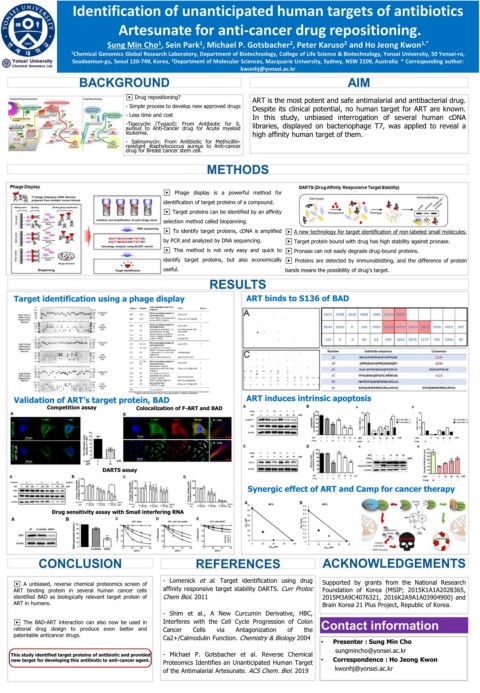
    Target identification using a phage display         ART binds to S136 of BAD


    Validation of ART’s target protein, BAD             ART induces intrinsic apoptosis
            Competition assay   Colocalization of F-ART and BAD


                        DARTS assay
                                                         Synergic effect of ART and Camp for cancer therapy


             Drug sensitivity assay with Small interfering RNA


          CONCLUSION                         REFERENCES                   ACKNOWLEDGEMENTS

                                      - Lomenick et al . Target identification using drug
    ▶ A unbiased, reverse chemical proteomics screen of                   Supported by grants from the National Research
    ART binding protein in several human cancer cells  affinity responsive target stability DARTS. Curr Protoc  Foundation of Korea (MSIP; 2015K1A1A2028365,
    identified BAD as biologically relevant target protein of  Chem Biol. 2011  2015M3A9C4076321, 2016K2A9A1A03904900) and
    ART in humans.                                                        Brain Korea 21 Plus Project, Republic of Korea.
                                      - Shim et al., A New Curcumin Derivative, HBC,
    ▶ The BAD-ART interaction can also now be used in  Interferes with the Cell Cycle Progression of Colon  Contact information
    rational drug design to produce even better and  Cancer  Cells  via  Antagonization  of  the
    patentable anticancer drugs.
                                      Ca2+/Calmodulin Function. Chemistry & Biology 2004
                                                                         •  Presenter : Sung Min Cho
                                                                            sungmincho@yonsei.ac.kr
   This study identified target proteins of antibiotic and provided   - Michael P. Gotsbacher et al. Reverse Chemical
   new target for developing this antibiotic to anti-cancer agent.  Proteomics Identifies an Unanticipated Human Target  •  Correspondence : Ho Jeong Kwon
                                      of the Antimalarial Artesunate. ACS Chem. Biol. 2019  kwonhj@yonsei.ac.kr

