


Page 11 - I. Chemical biology and drug discovery
P. 11
Development of G protein-biased agonists for human μ-opioid receptor
In Hee Jang 1,3 , Jae Hoon Jeong 2 , Jeong-Hoon Kim 1,4 , Sung Goo Park 1,4 , Byoung Chul Park 1,4 ,
Bi-oh Park 1 , Sung Young Kim 1,4 , Sang Kyum Kim 3 , Yong-Chul Kim 2 , Sunhong Kim 1,4
1 Disease Target Structure Research Center, Korea Research Institute of Bioscience & Biotechnology, Daejeon, 34141, Republic of Korea
2 Life sciences, Gwangju Institute of Science and Technology, Gwangju, 61005, Republic of Korea
3 College of pharmacy, Chungnam national university, Daejeon, 34134, Republic of Korea
4 Bioscience, Korea university of science and technology, Daejeon, 34113, Republic of Korea
BACKGROUND AIM
G-protein coupled receptor is a cell membrane receptor that forms a huge superfamily, and it is Several studies have reported that some of the side effects of μ-opioid receptors occur when the
known that there are about 1000 different types of GPCRs in the human cell membrane. About receptors transmit signals through β-arrestin. Therefore, in order to develop a drug that reduces
one-third of drugs currently on the market are targeting GPCR. Among these GPCRs, we the side effects of morphine, efforts are being made to create a biased ligand that transmits a
focused on ligands targeting opioid receptors. The opioid receptor is largely composed of μ, κ signal only toward the Gαi-protein, not the β-arrestin signaling pathway. As part of this effort,
and δ-opioid receptor. Among them, the μ-opioid receptor is well known as the target of Morphine. several compounds were produced through structure activity relationship based on PZM21,
Morphine is a drug that is still used as a painkiller. However, it is accompanied by serious side known as biased ligand. And we built an assay to detect the G protein pathway and the β-arrestin
effects such as tolerance, addiction, constipation and respiratory depression. pathway to see if the compound is a biased ligand.
METHODS RESULTS
A B A B
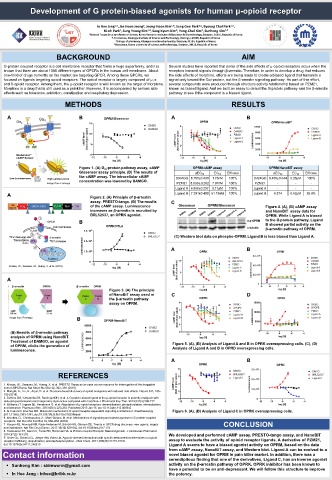
Figure 1. (A) G αi -protein pathway assay, cAMP OPRM cAMP assay OPRM NanoBiT assay
Glosensor assay principle. (B) The results of pEC 50 EC 50 Efficacy pEC 50 EC 50 Efficacy
the cAMP assay. The intracellular cAMP DAMGO 8.755±0.430 1.76nM 100% DAMGO 6.456±0.044 0.35µM 100%
concentration was lowered by DAMGO.
Image from Promega PZM21 8.099±0.262 7.97nM 100% PZM21 - - -
Ligand A 6.958±0.257 0.11µM 100% Ligand A - - -
A Figure 2. (A) Principle of β-arrestin Ligand B 7.291±0.489 51.19nM 100% Ligand B 6.374 0.42μM 25.8%
assay, PRESTO-tango. (B) The results C
of the cAMP assay. Luminescence Figure 4. (A), (B) cAMP assay
increases as β-arrestin is recruited by and NanoBiT assay data for
BRL52537, an OPRK agonist. OPRM. While Ligand A is biased
B to the G protein pathway, Ligand
B showed partial activity on the
β-arrestin pathway of OPRM.
(C) Western blot data on phospho-OPRM. Ligand B is less biased than Ligand A.
A B
Kroeze, W., Sassano, M., Huang, X. et al. (2015).
A
Figure 3. (A) The principle
of NanoBiT assay used in C D
the β-arrestin pathway
assay on OPRM.
Image from Promega B
(B) Results of β-arrestin pathway
analysis of OPRM using NanoBiT.
Treatment of DAMGO, an agonist
of OPRM, elicits the generation of Figure 5. (A), (B) Analysis of Ligand A and B in OPRK overexpressing cells. (C), (D)
luminescence. Analysis of Ligand A and B in OPRD overexpressing cells.
A B
REFERENCES
1. Kroeze, W., Sassano, M., Huang, X. et al. PRESTO-Tango as an open-source resource for interrogation of the druggable
human GPCRome. Nat Struct Mol Biol 22, 362–369 (2015).
2. Manglik, A., Lin, H., Aryal, D. et al. Structure-based discovery of opioid analgesics with reduced side effects. Nature 537, 185–
190 (2016).
3. DeWire SM, Yamashita DS, Rominger DH, et al. A G protein-biased ligand at the μ-opioid receptor is potently analgesic with
reduced gastrointestinal and respiratory dysfunction compared with morphine. J Pharmacol Exp Ther. 2013;344(3):708-717.
4. Williams JT, Ingram SL, Henderson G, et al. Regulation of μ-opioid receptors: desensitization, phosphorylation, internalization,
and tolerance. Pharmacol Rev. 2013;65(1):223-254. Published 2013 Jan 15. doi:10.1124/pr.112.005942
5. Al-Hasani R, Bruchas MR. Molecular mechanisms of opioid receptor-dependent signaling and behavior. Anesthesiology. Figure 6. (A), (B) Analysis of Ligand C in OPRK overexpressing cells.
2011;115(6):1363-1381. doi:10.1097/ALN.0b013e318238bba6
6. Wootten, D., Christopoulos, A., Marti-Solano, M. et al. Mechanisms of signalling and biased agonism in G protein-coupled
receptors. Nat Rev Mol Cell Biol 19, 638–653 (2018).
7. Hauser AS, Attwood MM, Rask-Andersen M, Schiöth HB, Gloriam DE. Trends in GPCR drug discovery: new agents, targets CONCLUSION
and indications. Nat Rev Drug Discov. 2017;16(12):829-842. doi:10.1038/nrd.2017.178
8. Hodavance SY, Gareri C, Torok RD, Rockman HA. G Protein-coupled Receptor Biased Agonism. J Cardiovasc Pharmacol.
2016;67(3):193-202. We developed and performed cAMP assay, PRESTO-tango assay, and NanoBiT
9. Groer CE, Schmid CL, Jaeger AM, Bohn LM. Agonist-directed interactions with specific beta-arrestins determine mu-opioid
receptor trafficking, ubiquitination, and dephosphorylation. J Biol Chem. 2011;286(36):31731-31741. assay to evaluate the activity of opioid receptor ligands. A derivative of PZM21,
doi:10.1074/jbc.M111.248310 Ligand A seems to have a biased agonist activity on OPRM, based on the data
Contact information from cAMP assay, NanoBiT assay, and Western blot. Ligand A can be evolved to a
novel biased agonist for OPRM in pain killer market. In addition, there was a
serendipitous finding that one of the derivatives, Ligand C, has an inverse agonist
Sunhong Kim : skimworm@gmail.com activity on the β-arrestin pathway of OPRK. OPRK inhibitor has been known to
have a potential to be an anti-depressant. We will follow this structure to improve
In Hee Jang : inhee@kribb.re.kr the potency.

