


Page 75 - I. Chemical biology and drug discovery
P. 75
Identification of a natural product inhibitor for src-homology phosphotyrosyl phosphatase
  2 and tyrosine-protein phosphatase non-receptor type 2
  Jae Kwan Kim, Sang J. Chung*
  School of Pharmacy, Sungkyunkwan University, Suwon 16419, Republic of Korea

                   BACKGROUND                                                  AIM

   cardiovascular disease, neuropathy, kidney damage, and so on. There are two types of  In order to identify a potential therapeutic compound for diabetes, 658
   diabetes: type 1 diabetes (T1D) and type 2 diabetes (T2D). Especially type 2 diabetes (T2D)  natural compounds were screened by enzyme kinetics and selected by
   is occurred by a disability of glucose uptake and is mainly related to insulin resistance. Src-  C2C12 cell viability test. SHP2 expression and purification proceeded for
   homology phosphotyrosyl phosphatase 2 (shp2) is one of the targets for type 2 diabetes  enzyme kinetics and IC50 and Ki were examined. Also, we confirm
   (T2D). It has been reported that overexpression of SHP2 causes various types of cancer:  whether SHP2 and PTPN2 is a target for diabetes by performing siRNA
   obesity and diabetes. Therefore, the Inhibition of SHP2 activity can improve type 2
   diabetes (T2D) by enhancing insulin sensitivity. Tyrosine-protein phosphatase non-  knockdown. These results implicate that JK102 could be a therapeutic
   receptor type 2 is also several diseases such as cancer, obesity and diabetes so on.  target for diabetes.
   Especially PTPN2 is known to regulate IR signaling and leptin signaling related to T2D.
                                                METHODS


                               Non-fluorescent                     fluorescent
                                 DiFMUP    JK102                    DiFMU
                                               PTPN2 or PTPN11
                   Scheme of phosphate assay. Activity of PTPN2 and PTPN11 was measured using DiFMUP for substrate. DiFMUP is a fluorogenic
                   substrate widely used for the detection of PTP activity and DiFMU has excitation/emission maxima of ~358/450 nm.

    The enzymatic activities of purified PTPN2 and PTPN11 were measured using 6,8-difluoro-4-methylumbelliferyl phosphate (DiFMUP)(100 μM). To determine the Km
    values, PTPN2 and PTPN11 were added to reaction buffer (20 mM Bis-tris pH 7.0, 150 mM NaCl, 2.5 mM dithiothreitol (DTT), 0.01% Triton X-100) containing
    DiFMUP(800, 400, 200, 100, 50, 25, 12.5, 6.25μM) to a final volume of 100μl in a 96 well-plate. Fluorescence intensities were measured continuously for 10 min
    (Excitation/Emission = 355/460 nm) using a Victor™X4multi label plate reader (Perkin Elmer, Waltham, MA, USA), and Km values were determined by Lineweaver-
    Burk plots.
    To measure IC50 values, JK102 was added solution with PTPN2 (50 μM, 25 μM, 12.5 μM, 6.25 μM, 3.125 μM, 1.5625 μM) and DiFMUP (2xKm) or PTPN11 (20 μM,
    15 μM, 11 μM, 10 μM, 9 μM, 7 μM, 5 μM) and DiFMUP (2xKm).
    Plus, We compared glucose uptake in C2C12 cell. When C2C12 cells were grown and the cells reached 100% confluence, the cell culture medium was changed to
    DMEM supplemented with 1% horse serum, and the cells were incubated for 4 days. For the 2-NBDG assay, confluent cells were incubated overnight in low-glucose,
    serum-free medium followed by a 24 h treatment in the absence or presence of 50 μM 2-NBDG. The cell medium was subsequently removed, and the fluorescence
    intensity was recorded at excitation and emission wavelengths of 485 and535 nm, respectively. Insulin and AICAR were treated for positive control and JK102 was
    treated concentration of 20 μM, 40 μM.
                                                RESULTS

    (A)                 (B)


              M:     Protein marker
              1:     Un-induced total
              2:     Un-induced soluble
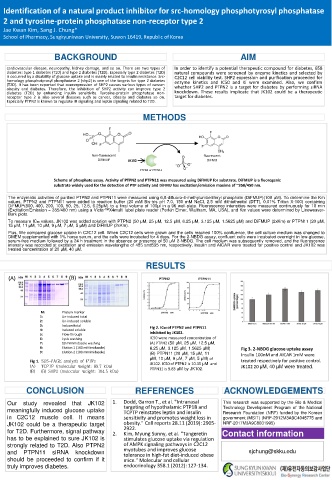
              3:     Inducedtotal                 Fig 2. IC50 of PTPN2 and PTPN11
              4:     Induced soluble
              5:     Flow-through                 inhibited by JK102.
              6:     Lysis washing                IC50 were measured concentration of
              7:     10 mMimidazole washing       (A) PTPN2 (50 μM, 25 μM, 12.5 μM,
              8:     Elution 1 (100 mMimidazole)  6.25 μM, 3.125 μM, 1.5625 μM)   Fig 3. 2-NBDG glucose uptake assay
              9:     Elution 2 (100 mMimidazole)  (B) PTPN11 (20 μM, 15 μM, 11  Insulin 100nM and AICAR 1mM were
                                                  μM, 10 μM, 9 μM, 7 μM, 5 μM) of
           Fig 1. SDS-PAGE analysis of PTPs       JK102. IC50 of PTPN2 is 10.35 μM and   treated respectively for positive control.
           (A)  TCPTP (molecular weight: 89.7 kDa)   PTPN11 is 9.83 μM by JK102.  JK102 20 μM, 40 μM were treated.
           (B)  (B) SHP2 (molecular weight: 104.5 kDa)
          CONCLUSION                         REFERENCES                   ACKNOWLEDGEMENTS

   Our   study  revealed  that  JK102  1.  Dodd, Garron T., et al. "Intranasal   This research was supported by the Bio & Medical
                                         targeting of hypothalamic PTP1B and
   meaningfully induced glucose uptake   TCPTP reinstates leptin and insulin   Technology Development Program of the National
                                                                          Research Foundation (NRF) funded by the Korean
   in C2C12 muscle cell. It means        sensitivity and promotes weight loss in   government (MSIT) (NRF-2012M3A9C4048775 and
   JK102 could be a therapeutic target   obesity." Cell reports 28.11 (2019): 2905-  NRF-2017M3A9C8031995)
   for T2D. Furthermore, signal pathway  2.  2922.                       Contact information
                                         Kim, Myung Sunny, et al. "Tangeretin
   has to be explained to sure JK102 is  stimulates glucose uptake via regulation
   strongly related to T2D. Also PTPN2   of AMPK signaling pathways in C2C12
   and   PTPN11   siRNA   knockdown      myotubes and improves glucose            sjchung@skku.edu
                                         tolerance in high-fat diet-induced obese
   should be proceeded to confirm if it  mice." Molecular and cellular
   truly improves diabetes.              endocrinology 358.1 (2012): 127-134.

