


Page 71 - I. Chemical biology and drug discovery
P. 71
Development of reversible covalent PPARγ

    antagonistic ligands based on a structure-

    based approach

    Hyunsoo Kim¹, Jun Young Jang², Byung Woo Han², Seung Bum Park¹*
                                                                                    ,
    ¹Department of Chemistry, Seoul National University, Seoul 08826, Republic of Korea,
    ²Research Institute of Pharmaceutical Sciences, Seoul National University, Seoul 08826,
    Republic of Korea

    ABSTRACT
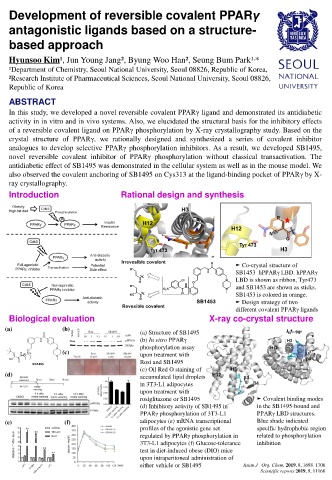
    In this study, we developed a novel reversible covalent PPARγ ligand and demonstrated its antidiabetic
    activity in in vitro and in vivo systems. Also, we elucidated the structural basis for the inhibitory effects
    of a reversible covalent ligand on PPARγ phosphorylation by X-ray crystallography study. Based on the
    crystal structure of PPARγ, we rationally designed and synthesized a series of covalent inhibitor
    analogues to develop selective PPARγ phosphorylation inhibitors. As a result, we developed SB1495,
    novel reversible covalent inhibitor of PPARγ phosphorylation without classical transactivation. The
    antidiabetic effect of SB1495 was demonstrated in the cellular system as well as in the mouse model. We
    also observed the covalent anchoring of SB1495 on Cys313 at the ligand-binding pocket of PPARγ by X-
    ray crystallography.
    Introduction                        Rational design and synthesis


                                                                              ► Co-crystal structure of
                                                                              SB1453–hPPARγ LBD. hPPARγ
                                                                              LBD is shown as ribbon, Tyr473
                                                                              and SB1453 are shown as sticks.
                                                                              SB1453 is colored in orange.
                                                                              ► Design strategy of two
                                                                              different covalent PPARγ ligands
    Biological evaluation                                            X-ray co-crystal structure
   (a)               (b)
                                               (a) Structure of SB1495
                                               (b) In vitro PPARγ
                                               phosphorylation assay
                     (c)                       upon treatment with
                                               Rosi and SB1495
                                               (c) Oil Red O staining of
   (d)                                         accumulated lipid droplets
                                               in 3T3-L1 adipocytes
                                               upon treatment with
                                               rosiglitazone or SB1495               ► Covalent binding modes
                                               (d) Inhibitory activity of SB1495 in   in the SB1495-bound and
                                               PPARγ phosphorylation of 3T3-L1       PPARγ LBD structures.
   (e)                (f)                      adipocytes (e) mRNA transcriptional   Blue shade indicated
                                               profiles of the agonistic gene set    specific hydrophobic region
                                               regulated by PPARγ phosphorylation in   related to phosphorylation
                                               3T3-L1 adipocytes (f) Glucose-tolerance   inhibition
                                               test in diet-induced obese (DIO) mice
                                               upon intraperitoneal administration of
                                               either vehicle or SB1495         Asian J . Org. Chem. 2019, 8, 1698–1706
                                                                                      Scientific reports 2019, 9, 11168

