


Page 21 - H. Cell signaling
P. 21
The Autophagy Regulator p62

  Controls PTEN-Dependent
  Cilia Assembly


  Minah Park, Eun Ji Lee and Jong Hoon Park*                                         Department of Biological Science, Sookmyung Women’s University,
                                                                                                      Seoul 140-742, Republic of Korea
                        BACKGROUND                                                     AIM

     Autophagy is an intracellular process that degrades non-functional/damaged proteins under  Autophagy is a catabolic process required for maintaining intracellular energy homeostasis. It
     serum starvation or stress conditions and maintains cellular homeostasis by eliminating harmful proteins   eliminates harmful proteins and recycles functional macromolecules back into the cell via cargo
     and recycling functional breakdown products. Among three types of autophagy, macroautophagy uses   breakdown. Autophagy is generally suppressed under fed conditions and induced by serum starvation;
     autophagosomes to sequester cargo proteins. The mature autophagosome encounters and fuses with the   therefore, it is considered to be a nutrient-sensing mechanism. Cilia, finger-like organelles harboring
     lysosome, thereby delivering cargo that is broken down by acidic lysosomal enzymes. Cilia are antenna-  multiple receptors along their surface, are energy-sensing structures that are also triggered by serum
     like organelles that extend from the surface of eukaryotic cells. Especially, non-motile cilia (hereafter   deprivation.
     referred to as primary cilia) function as cellular sensory antennae in response to external stimuli. Specific   Herein, we verified the effect of autophagy alterations on ciliogenesis and the specific underlying
     receptors are clustered within cilia; therefore, functional cilia defects can lead to human diseases known   mechanisms. Autophagy flux altered either by drugs or autophagy-targeting siRNAs strongly inhibited
     as ciliopathies. Both autophagy and ciliogenesis are concurrently triggered by serum deprivation; thus,   ciliogenesis, and this inhibition was affected by p62, an autophagy regulator, via Pten/Dvl2/AurKA
     are essential nutrient-sensing mechanisms for managing intracellular energy defects.   pathways.
                                                       METHOD

     Cell Culture & Drug Treatment                             Immunofluorescence Microscopy
     NIH/3T3 mouse embryonic fibroblasts were obtained from the Korean Cell Line Bank and cultured in DMEM (LM001-  Cells incubated on coverslips were fixed in 4% paraformaldehyde in PBS or cold methanol for 10 min, blocked and
     05, Welgene) supplemented with 10% FBS (fetal bovine serum; 26140-079, Gibco). To regulate autophagy in vitro,   permeabilized for 15 min, and incubated with the following primary antibodies at 4C overnight: anti-acetylated a
     cells were treated with 5 nM of rapamycin (R8781, Sigma-Aldrich) and 50 uM of chloroquine (CQ; C6628, Sigma-  tubulin (T6793, Sigma-Aldrich and #5335, Cell Signaling Technology), anti-g tubulin (T6557, Sigma-Aldrich) and
     Aldrich) for 4 h. Drugs were treated after 24 h serum starvation when it is necessary to induce ciliogenesis.  p62 (#5114 and #23214, Cell Signaling Technology). The following day, cells were stained with DAPI for 15 min
                                                               and incubated with FITC-conjugated rabbit anti-mouse IgG (sc-358916, Santa Cruz Biotechnology), goat anti-
                                                               mouse IgG Alexa 488 (A11029, Thermo Fisher Scientific), or goat anti-rabbit IgG Alexa 594 (A11037, Thermo
     Western Blot                                              Fisher Scientific) antibodies for 2 h at room temperature. Finally, the slides were mounted with mounting solution
     Proteins were isolated and concentration was calculated using the Bradford assay. The following primary antibodies   (S3023, Dako) and visualized by confocal microscopy (LSM-700, Carl Zeiss). For histological analysis, sections were
     were used in this study: Atg5 (#12294, Cell Signaling Technology), LC3 A/B (#12741, Cell Signaling Technology), p62   counter-stained with hematoxylin & eosin (H&E) and renal collecting duct was observed by staining with
     (#5114 and #23214, Cell Signaling Technology), Pten (#9552, CellSignaling Technology), pDVL (ab124933, Abcam),   rhodamine-conjugated DBA (Vector Laboratories).
     Dvl2 (#3224, Cell Signaling Technology), and b-actin (A300-491A, Bethyl Laboratories). Membranes were blocked   siRNA Transfection
     with 5% skimmed milk in PBST (1XPBS with 1% Tween-20), incubated with primary antibodies diluted in 1% skimmed   Cells were transfected with control small interfering RNA (siRNA; 5′-AUG AAC GUG AAU UGC UCA ATT-3′/5′-UUG
     milk with PBST overnight at 4C, washed with PBST, and incubated with secondary antibodies in 2% skimmed milk for   AGC AAU UCA CGU UCA UTT-3′, ST pharm and sc-37007, Santa Cruz Biotechnology) or siRNA targeting Atg5 (sc-
     1 h at room temperature.                                  41446), PTEN (sc-36326), and SQSTM1 (sc-29828) using Liopfectamine RNAiMAX Reagent (Invitrogen).
                                                        RESULT


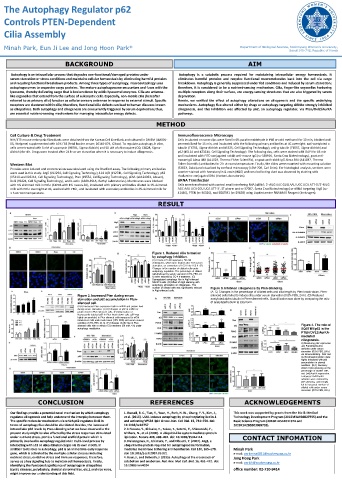
                                                      Figure 1. Reduced cilia formation
                                                      by autophagy inhibition.
                                                      (A) Effects of 5 nM rapamycin, 50 mM
                                                      chloroquine,  which were  treated after 24 h serum
                                                      starvation,  on conversion of LC3-I into LC3-II. (B)
                                                      Changes in the number of ciliated cells under
                                                      autophagy  regulation. The percentage of ciliated
                                                      cells(induced by serum starvation-0.5%  FBS, 24
                                                      h) were reduced by CQ 4 h treatment. (C)
                                                      Dysregulated autophagy flux in Atg5-silenced
                                                      NIH/3T3 cells. (D) Effect of Atg5 silencing with
                                                      autophagy  stimulation on ciliogenesis. The
                                                      number of ciliated cells was significantly reduced   Figure 3. Inhibited ciliogenesis by Pten-silencing.
                                                      in Atg5-silenced cells.   (A–C) Changes in the percentage of ciliated cells and cilia length by Pten knock-down. Pten-
                            Figure 2. Increased Pten during serum         silenced cells failed to induce cilia under serum starvation (0.5% FBS, 24 h). (D) Reduced
                            starvation and p62 accumulation in Pten-      acetylated alpha tubulin in Pten-silenced cells. Quantification was done by comparing the ratio
                            silenced cell.                                of acetylated tubulin to total form.
                            (A,B) Increased  Pten expression  both in mRNA and protein  level
                            during serum starvation.  (C,D) Changes of p62 at mRNA or
                            protein level  in Pten-silenced  cells. (E) Observation  of
                            fluorescently-labeled  p62 in Pten knock-down cells. p62 was
                            highly accumulated  in Pten-silenced  cells compared to siCtrl-
                            transfected cells under both basal (10% FBS) and serum starved
                            condition  (0.5% FBS, 24 h). (F) Changes of p62 flux in Pten-
                            silenced cells with or without CQ treatment  (50 mM, 4 h) under               Figure 4. The role of
                            autophagy  modulation.                                                        SQSTM1/p62 in the
                                                                                                          PTEN/DVL2/AurKA-
                                                                                                          mediated
                                                                                                          ciliogenesis.
                                                                                                          A) Monitoring p62 expression
                                                                                                          and Pten/Dvl2/AurKA
                                                                                                          activities under  serum
                                                                                                          starvation (0.5% FBS, 24 h)
                                                                                                          via immunoblotting. Dvl2 and
                                                                                                          AurKA phosphorylation were
                                                                                                          highly enhanced with p62
                                                                                                          accumulation in starved
                                                                                                          condition. (B,C) Recovery
                                                                                                          effect of p62-silencing on the
                                                                                                          percentage of ciliated cells
                                                                                                          and Dvl2/AurKA expression.
                                                                                                          Enhanced Dvl2/AurKA
                                                                                                          activities were  restored by
                                                                                                          p62-silencing,  and it finally
                                                                                                          led to increased  number  of
                                                                                                          ciliated  cells under serum
                                                                                                          starvation (0.5% FBS, 24 h).
              CONCLUSION                             REFERENCES                       ACKNOWLEDGEMENTS
     Our findings provide a potential novel mechanism by which autophagy   1. Russell, R. C., Tian, Y., Yuan, H., Park, H. W., Chang, Y. Y., Kim, J.,   This work was supported by grants from the Bio & Medical
     regulates ciliogenesis and help understand the interplay between them.   et al. (2013). ULK1 induces autophagy by phosphorylating Beclin-1   Technology Development Program (2015M3A9B6027555) and the
     The specific molecular mechanisms via which p62 regulates Dvl2 in   and activating VPS34 lipid kinase. Nat. Cell Biol. 15, 741–750. doi:   Basic Science Program (2016R1A5A1011974 and
     terms of autophagy flux should be elucidated. Besides, the increase of   10.1038/ncb2757  2019R1A2B5B03069738).
     intracellular p62 levels by Pten-silencing what we have observed in the   2. Ichimura, Y., Kirisako, T., Takao, T., Satomi, Y., Shimonishi, Y.,
     present study might be also affected by the stress responses stimulated   Ishihara, N., et al. (2000). A ubiquitin-like system mediates protein
     under nutrient stress. p62 is a functional scaffold protein which is   lipidation. Nature 408, 488–492. doi: 10.1038/35044114  CONTACT INFOMATION
     primarily involved in autophagy regulation in multi-level process by   3. Nakatogawa, H., Ichimura, Y., and Ohsumi, Y. (2007). Atg8, a
     interacting with LC3 or ubiquitinated cargos via its own motifs. In   ubiquitin-like protein required for autophagosome formation,
     addition to its roles in autophagy, p62 is an immediate-early response   mediates membrane tethering and hemifusion. Cell 130, 165–178.   Minah Park
     gene, which is activated by the multiple cellular stresses including   doi: 10.1016/j.cell.2007.05.021  e-mail: parkmina0821@sookmyung.ac.kr
     nutrient stress, oxidative stress and immune responses, therefore,   4. Kaur, J., and Debnath, J. (2015). Autophagy at the crossroads of   Jong Hoog Park
     serves as a key signaling hub to maintain cell homeostasis. Finally,   catabolism and anabolism. Nat. Rev. Mol. Cell. Biol. 16, 461–472. doi:   e-mail: parkjh@sookmyung.ac.kr
     identifying the functional significance of autophagy in ciliopathies   10.1038/nrm4024
     (cystic diseases, polydactyly, skeletal abnormalities, etc.), and vice versa,   office number: 02-710-9414
     might improve our understanding of this field.

