


Page 17 - H. Cell signaling
P. 17
HDM-induced chemokine CCL20 regulates Chronic Inflammation and
               Remodeling of Airway in Mouse Model of Bronchial Asthma

                      Shin-Young Park , Min-Jeong Kang , Yun Young Lee , So Young Lee , and Joong-Soo Han 1,2
                                  1
                                                                       2
                                               2
                                                            2
                        1 Biomedical Research Institute and Department of Biochemistry & Molecular Biology, College of Medicine,
               2  Department of Biomedical Sciences, Graduate School for Biomedical Science & Engineering, Hanyang University, Seoul, Republic of Korea
                   BACKGROUND                                                  AIM
   * Chronic inflammatory response in the airway in asthma
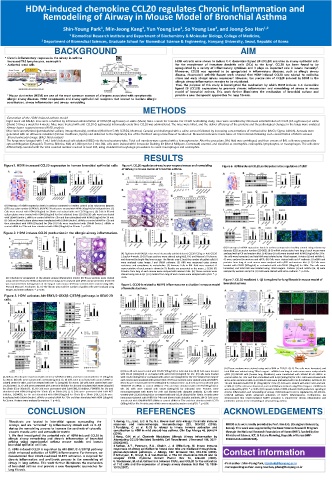
   - Increased Th2 lymphocytes, eosinophils               HDM extracts were shown to induce C-C chemokine ligand 20 (CCL20) secretion in airway epithelial cells
   - Activated mast cells                                 for the recruitment of immature dendritic cells (DCs) to the lung 4 . CCL20 has been found to be
                                                          upregulated by a variety of inflammatory cytokines and it plays an important role in innate immunity 5 .
                                                          Moreover, CCL20 was reported to be upregulated in inflammatory diseases, such as allergic airway
                                                          disease, rheumatoid arthritis . Recent work showed that HDM-induced CCL20 was related to oxidative
                                                          stress and early allergic airway responses 3 . However, the precise role of CCL20 induced by HDM in the
                                                          allergic airway inflammation remains to be elucidated.
                                                          Thus, the purpose of this study is investigated the mechanism by which HDM induces C-C chemokine
       Molecular Therapy - Nucleic Acids 2020 191000-1014  ligand 20 (CCL20) expressions to promote chronic inflammation and remodeling of airway in mouse
                                                          model of bronchial asthma. This work further illuminates the mechanism of bronchial asthma and
   * House dust mites (HDM) are one of the most common sources of allergens associated with symptomatic   provide a new therapeutic approaches for lung fibrosis.
   allergic airway diseases. HDM components and airway epithelial cell receptors that interact to mediate allergic
   sensitization, airway inflammation and airway remodeling
                                                METHODS
   Generation of the HDM-induced asthma model
   Eight-week-old BALB/c mice were sensitized by intranasal administration of HDM (30 ug/mouse) or saline (Sham) twice a week for 3 weeks. For CCL20 neutralizing study, mice were sensitized by intranasal administration of CCL20 (0.5 ug/mouse) or saline
   (Sham) 5 times a week for 4 weeks. Mice were treated with anti-CCL20 (5 ug/mouse) intranasally every time CCL20 was administered. The mice were killed, and the deliver efficiency of the proteins and the pathological changes in the lungs were analyzed.
   Airway hyper-responsiveness (AHR) analysis
   Mice were anesthetized (pentobarbital sodium, intraperitoneally), ventilated (flexiVent 5.1®; SCIREQ, Montreal, Canada) and challenged with a saline aerosol followed by increasing concentrations of methacholine (MeCh; Sigma-Aldrich). Aerosols were
   generated with an ultrasonic nebulizer (Omron Healthcare, Kyoto) and delivered to the inspiratory line of the flexiVent using a bias flow of medical air. Measurements were made twice at 1min intervals following each concentration of MeCh aerosol.
   Bronchoalveolar lavage (BAL) fluid analysis
   The lungs were lavaged with 1 mL Hank’s balanced salt solution (HBSS) via the tracheostomy tube. Total cell numbers were counted with a hemocytometer. After the procedure, BAL fluid was centrifuged, and then smears of BAL cells were prepared by
   cytocentrifugation (Cytospin3, Thermo, Billerica, MA) at 1,000 rpm for 3 min. BAL cells were stained with Hemacolor Staining Kit (Merck Millipore, Darmstadt) counted, and classified as neutrophils, eosinophils, lymphocytes, or macrophages. The cells were
   differentially counted until the total counted number reached at least 200, using standard hemocytologic procedures to count macrophages and eosinophils.
                                                RESULTS
  Figure1. HDM increased CCL20 expression in human bronchial epithelial cells  Figure 4. CCL20 regulates airway hyper-responsiveness and remodeling   Figure 6. HDM-induced CCL20 participatesin the regulation of EMT
                                         of airway in mouse model of bronchial asthma.
   (A) Heatmap of mRNA expression levels in asthma compared to healthy control using microarray datasets
   (GEO accession number GSE4302). (B) BEAS-2B cells were treated with HDM (10ug/ml) for indicated time. (C)
   Cells were treated with HDM (10ug/ml) for 30min and stained with anti-CCL20 (green). (D) Cells in 96-well
   culture plates were treated with HDM (10ug/ml) for the indicated times (E) BEAS-2B cells were transfected
   with 100nM Dentin-1 siRNAs or control siRNA for 72hr and then stimulated with HDM (10ug/ml) for 30 min.
   (F) Cells on 96-well culture plates were transfected with 100nM Dectin-1 siRNAs or control siRNA for 72h and
   then stimulated with HDM (10ug/ml) for 24hr (G) Cells were transfected with 100nM Dectin-1 siRNAs or
   control siRNA for 72hr and then stimulated with HDM (10ug/ml) for 30 min. *. p <0.05.
  Figure 2. HDM induces CCL20 production in the allergic airway inflammation.
                                                                          (A) Heatmap of mRNA expression levels in asthma compared to healthy control using microarray
                                                                          datasets (GEO accession number GSE4302). (B-D) mRNA and proteins from lung of each mouse were
                                        (A) Eight-week-old BALB/c mice were intranasally administratered CCL20 0.25ug or Anti-CCL20  analyzed with qPCR and western blot. (E-H) Beas-2B cells were treated with HDM (10ug/ml) for 24 hr.
                                        2.5ug for 4 weeks. (B-D) Tissue sections were stained using H&E, PAS and Masson’s Trichrome  The cells were harvested, and total RNA was isolated using TRIzol reagent. Proteins (E) and mRNAs (F,
                                        and observed by bright-filed microscopy. The fibrotic area (C) and the number of goblet cells (D)  G) were analyzed by western and qPCR. (H) Cells were stained with anti-E-cadherin. (I) mRNA and
                                        were analyzed using Image J and SABIA software. (E) AHR was measured using airway  proteins from lung of each mouse were analyzed with qPCR and western blot. (L-O) Cells were
                                        resistance and compliance to metacholine. (F) Immune Cells in BAL fluid were counted. A  treated with CCL20 (100ng/ml) or co-treated with anti-CCL20 (10ug/ml) for 24hr. The cells were
                                        representative of each group is shown (n=5). Results are presented as the mean ± S.E.M. (G)  harvested, and total RNA was isolated using TRIzol reagent. Proteins (L) and mRNAs (M, N) were
                                        Proteins from lung of each mouse were analyzed with western blot. (H) Tissue sections were  analyzed by western and qPCR. (O) Cells were stained with anti-E-cadherin. *. p <0.05.
                                        stained using anti-IL-1β. (I, K) mRNAs from lung of each mouse were analyzed with qPCR. *. p
   (A) Schedule for preparation of the allergic airway inflammation model. (B) Tissue sections were stained  <0.05.  Figure 7. CCL20-mediated IL-1β is required for lung fibrosis in mouse model of
   using anti-CCL20. (C, D) mRNA and proteins from lungs were analyzed with qPCR and western blot. (E) CCL20
   was measured from homogenates of the lung of each mouse. (F) Tissue sections were stained using H&E,  Figure 5. CCL20 is related to NLRP3 inflammasome activation in mouse model   bronchial asthma
   PAS and Masson’s Trichrome. (G, H) The fibrotic area and the number of goblet cells were analyzed using  of bronchial asthma.
   Image J and SABIA software. *. p <0.05.
  Figure 3. HDM activates Akt-ERK1/2-GSK3β-C/EBPβ pathways in BEAS-2B
  cells.


                                                                          (A) Tissue sections were stained using anti-α-SMA or TGF-β1. (B, C) The cells were harvested, and
                                        (A) Beas-2B cells were treated with CCL20 (100ng/ml) for indicated time (B-D) Cells were treated  total RNA was isolated using TRIzol reagent. mRNAs from lung of each mouse were analyzed with
                                        with CCL20 (100ng/ml) or co-treated with anti-CCL20 (10ug/ml) for 4hr. (E) Cells were treated  qPCR. (D) IMR-90 cells (human lung fibroblasts) were transfected with 100nM NF-κB siRNAs or
  (A, B) Beas-2B cells were transfected with vector or C/EBP β for 48hr, and then treated with Der f 2 (10ug/ml)  with CCL20 (100ng/ml) or co-treated with anti-CCL20 (10ug/ml) for 6hr (F) Proteins from lung of  control siRNA for 72hr and then stimulated with IL-1β (100ng/ml) for 24hr. Cells were stained with
  for 30min. (B) Cells were stained with anti-CCL20 (green). (C, D) Cells were transfected with control siRNA or  each mouse were analyzed with western blot. (H) Tissue sections were stained using anti-NLRP3.  anti-F-actin and anti-α-SMA. (E-H) IMR-90 cells were pretreated with TGF-β1 inhibitor, SB431542, for
  C/EBPβ siRNA for 48hr, and then treated with Der f 2 (10ug/ml) for 30min. (D) Cells were stained with anti-  (H) Cells were treated with CCL20 (100ng/ml) for indicated time. (I, J) Cells were transfected with  1hr and stimulated with TGF-β1 (50ug/ml) for 24 hr. (E) Cells were stained with anti-F-actin and anti-
  CCL20 (green). (E, F) Cells were pretreated with 1uM GSK-inhibitor for 1hr and stimulated with HDM (10ug/ml)  100nM NF-κB siRNAs or control siRNA for 72hr and then stimulated with CCL20 (100ng/ml) for  α-SMA. (F-H) The cells were harvested, and total RNA was isolated using TRIzol reagent. mRNA levels
  for 15min (E) or 30min (F). (G, H) Cells were pretreated with 2uM ERK1/2 inhibitor, PD98059, for 1hr and  6hr. (K) Cells were treated with CCL20 (100ng/ml) for indicated time. Proteins were  were analyzed by qPCR. *. p <0.05. (I) Proposed model of HDM-induced CCL20 production signaling in
  stimulated with HDM (10ug/ml) for 15min (G) or 30min (H). (I, J) Cells were pretreated with 1uM AKT  immunoprecipitate with NLRP3 for 24hr and blotted with ubiquitin antibody. (L) Cells were  chronic inflammation and remodeling of airway. HDM-induced CCL20 is regulated by Akt-ERK1/2-
  inhibitor, LY294002, for 1hr and stimulated with HDM (10ug/ml) for 15min (I) or 30min (J (K, L) Cells were  treated with CCL20 (100ng/ml) or co-treated with anti-CCL20 (10ug/ml) for 30min. Proteins were  C/EBP1β pathway which enhanced activation of NLRP3 inflammasome. Furthermore, we
  transfected with 100nM Dectin-1 siRNAs or control siRNA for 72hr and then stimulated with HDM (10ug/ml)  immunoprecipitated with NLRP3 for 24hr and blotted with ubiquitin antibody. (M-O) Cells were  demonstrated that CCL20-mediated NLRP3 activation is required for chronic inflammation and
  for 15 min. Proteins were analyzed by western. *. p <0.05.  transfected with 100nM NLRP3 siRNAs or control siRNA for 72hr and then stimulated with CCL20  profibrotic process in the remodeling of airway in lung asthma.
                                        (100ng/ml) for 6hr. Proteins and mRNAs were analyzed by western and qPCR. *. p <0.05.
          CONCLUSION                         REFERENCES                   ACKNOWLEDGEMENTS
    Fibroblasts are located in interstitial spaces surrounding the  1.Huang, F.L., Liao, E.C. & Yu, S.J. House dust mite allergy: Its innate immune
    airways, and are “activated” by inflammatory stimuli such as IL-1β  response  and  immunotherapy.  Immunobiology  223,  300-302  (2018).  IMR90 cells were kindly provided by Prof. Kim E.G. (ChungbukUniversity,
    during the remodeling process to increase the synthesis of cytosolic  2.Porsbjerg, C. et al. IL-33 is related to innate immune activation and  Korea). This work was supported by the Basic Science Research Program
                                      sensitization to HDM in mild steroid-free asthma. Clin Exp Allergy 46, 564-574
    smooth muscle actin and extracellular matrix .  (2016).               through the National Research Foundation of Korea (NRF), funded by the
    1. We first investigated the potential role of HDM-induced CCL20 in  3.Hong, G.H. et al. Clusterin Modulates Allergic Airway Inflammation by  Ministry of Science, ICT, & Future Planning, Republic of Korea (NRF-
    allergic airway remodeling and chronic inflammation of bronchial  Attenuating CCL20-Mediated Dendritic Cell Recruitment. J Immunol 196, 2021-  2018R1A1A1A05022185).
    asthma using experimental asthma mouse models and human  2030(2016).
    bronchial epithelial cell lines.  4.Nathan, A.T., Peterson, E.A., Chakir, J. & Wills-Karp, M. Innate immune
    2. HDM-induced CCL20 is regulated by Akt-ERK1/2-C/EBP1β pathway  responses of airway epithelium to house dust mite are mediated through beta-
                                      glucan-dependent pathways. J Allergy Clin Immunol 123, 612-618 (2009).
    which enhanced activation of NLRP3 inflammasome. Furthermore, we  5.Schutyser, E., Struyf, S. & Van Damme, J. The CC chemokine CCL20 and its Contact information
    demonstrated that CCL20-mediated NLRP3 activation is required for  receptor  CCR6.  Cytokine  Growth  Factor  Rev  14,  409-426  (2003).
    chronic inflammation and profibrotic process in the remodeling of  6. Weckmann, M. et al. Critical link between TRAIL and CCL20 for the activation
    airway in lung asthma. This work further illuminates the mechanism  of TH2 cells and the expression of allergic airway disease. Nat Med 13, 1308-  -First author : Shin-Young Park, ttokttoki@hanyang.ac.kr
    of bronchial asthma and provide a new therapeutic approaches for  1315 (2007).  -Corresponding author: Joong-Soo han, jshan@hanyang.ac.kr
    lung fibrosis.

