


Page 31 - G. Cell differentiation. division. and death
P. 31
MCR-P2 PEPTIDE IMPROVES THE THERAPEUTIC POTENTIAL OF
                                              MESENCHYMAL STEM CELLS

                        Soo Bin Lee , Ahmed Abdal Dayem and Ssang-Goo Cho 1,*
                                                 1,
                                1
                       1 Department of Stem Cell and Regenerative Biotechnology, Molecular & Cellular Reprogramming Center (MCR
                       C), Konkuk University, 120 Neungdong-ro, Gwangjin-gu, Seoul 05029, Republic of Korea


   •  Bone is a key element for the formation of body skeleton. The osteogenic differentiation capacity of  1.  To find a peptide that can improve the proliferation and differentiation ability of MSC.
      human embryonic stem cells (hESCs) and human mesenchymal stem cells (hMSCs) has been
      reported. There are many hurdles arouse form the application of hESCs, such as teratoma formation,  2.  To be useful in the field of cell-based tissue regeneration through promoting bone formation and c
      ethical issue, and immune reaction. Owing to self-renewal property as well as the multilineage  artilage formation.
      differentiation capacity of MSCs, they broadly applied in tissue engineering and regeneration.


    1.  Isolation and Expansion of stem cell from human Wharton's jelly, referred to as umbilical cord  3.  Cell proliferation assay
        matrix stromal cells
                                                              4.  Single-cell colony forming unit
    2.  Analysis of Mesenchymal Stem Cell (MSC) characterization of stem cell from human Wharton's
        jelly, referred to as umbilical cord matrix stromal cells  5.  Western blotting analysis
     2-1 Morphologic Analysis of MSCs                         6.  Reverse transcriptase polymerase chain reaction (RT-PCR)
                                                              7.  In vivo anti-arthritis mouse model.
     2-2 Colony Forming Unit assay
                                                                7-1 Collagenase II injection to cartilage
     2-3 Flow cytometry analysis
     2-4 Wound healing assay                                    7-2 MSC injection to cartilage
     2-5 3 lineage (bone, fat, cartilage) differentiation       7.3 Isolation of cartilage and sampling
     2-6 Alizarin Red S, Oil Red O and Alcian blue staining     7.4 Safranin O and Toluidine Blue staining


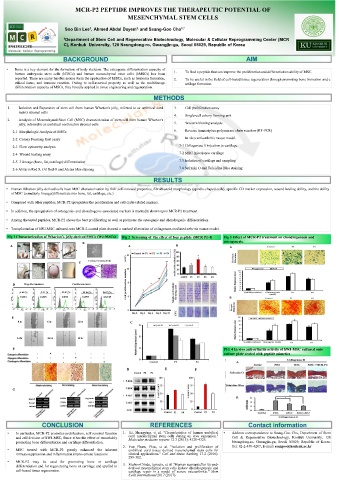
   • Human Wharton jelly-derived cells have MSC characterization by their self-renewal properties, fibroblastoid morphology (spindle-shaped cells), specific CD marker expression, wound healing ability, and the ability
     of MSC to multiply lineage(differentiate into bone, fat, cartilage, etc.)
   • Compared with other peptides, MCR-P2 upregulates the proliferation and cell cycle-related markers.
   • In addition, the upregulation of osteogenic- and chondrogenic-associated markers is markedly shown upon MCR-P2 treatment.
   • Among the tested peptides, MCR-P2 shows the best proliferating as well as promotes the osteogenic and chondrogenic differentiation.
   • Transplantation of hWJ-MSC cultured onto MCR-2-coated plate showed a marked alleviation of collagenase-mediated arthritis mouse model.
    Fig 1 Characterization of Wharton’s jelly-derived MSCs (WJ-MSCs)  Fig 2  Screening of  the effect of four peptide (MCR P1-4)  Fig 3 Effect of MCR-P2 treatment on chondrogenesis and
                                                                                osteogenesis.
                              B
     A                                        A                B                  A
                                                                      *
                                Colony Forming Unit
                             C


      D   Negative markers  Positive markers
        4.65 %  3.31 %  99.53 %  91.54 %  94.73 %
        CD34   CD45    CD73   CD90   CD105                                        B


     E
       0 hr       6 hr      12 hr              C


       24 hr      36 hr     48 hr
     F                                                                          FIG 4 In vivo anti-arthritis activity of hWJ-MSC cultured onto
                                                                                culture plate coated with peptide mimetics
                                                                                    A


     G
                                                                                    B


    •  In particular, MCR-P2 promotes proliferation, self renewal function  1.  Li, Shengying, et al. "Characteristics of human umbilical  •  Address correspondence to Ssang-Goo Cho, Department of Stem
                                              cord mesenchymal stem cells during ex vivo expansion."
       and cell division of hWJ-MSC, Since it has the effect of remarkably  Molecular medicine reports 12.3 (2015): 4320-4325.  Cell & Regenerative Biotechnology, Konkuk University, 120
       promoting bone differentiation and cartilage differentiation.              Neungdong-ro, Gwangjin-gu, Seoul, 05029, Republic of Korea.
                                            2. Van Pham, Phuc, et al. "Isolation and proliferation of  Tel: 82-2-450-4207, E-mail: ssangoo@konkuk.ac.kr
    •  MSC treated with MCR-P2 greatly enhanced the inherent  umbilical cord tissue derived mesenchymal stem cells for
       immunosuppression and inflammation improvement functions.  clinical applications." Cell and tissue banking 17.2 (2016):
                                              289-302.
    •  MCR-P2  may  be  used for promoting bone or cartilage
       differentiation and for regenerating bone or cartilage and applied to  3. Muñoz-Criado, Ignacio, et al. "Human suprapatellar fat pad-
                                              derived mesenchymal stem cells induce chondrogenesis and
       cell-based tissue regeneration.        cartilage repair in a model of severe osteoarthritis." Stem
                                              Cells International 2017 (2017).

