


Page 33 - G. Cell differentiation. division. and death
P. 33
Bioinformatics Approach for Identifying Novel Biomarkers and Their Signaling
  Pathways Involved in Interstitial Cystitis/Bladder Pain Syndrome
                                           1
                                                                                                 1
                            1
                                                                             1
                                                            1
  Subbroto Kumar Saha , Tak-Il Jeon  , Soo Bin Jang  , Se Jong Kim  , Kyung Min Lim  , Yu Jin
        1
                                             2,
                                                                       1,
  Choi  , Hyeong Gon Kim  , Aram Kim  * and Ssang-Goo Cho  *
                              2
                   BACKGROUND                                                  AIM
   Interstitial cystitis/bladder pain syndrome (IC/BPS) is a  The purpose of this study is to assess the potential of
   prevalent condition that presents with symptoms of     a genetic diagnosis of IC/BPS, since there is no single
   disrupted urine storage and pelvic pain. The syndrome
   lacks definitive diagnostic tests or markers and is defined  definition of IC/BPS that can identify all IC/BPS cases.
   by a collection of symptoms reported by patients, making  We conducted an extensive bioinformatic analysis to
   diagnosis subjective and clinician dependent. Under these  identify genes and transcriptional factors to determine
   circumstances, chronic inflammation has been reported to  whether these biomarkers meet the clinical criteria to
   have arisen after surgery in IC/BPS patients, which is
   frequently misdiagnosed. The purpose of this study is to  confirm  the  diagnosis  of  IC/BPS.  Thus,  we
   assess the potential of a genetic diagnosis of IC/BPS.  systematically predict the significant biomarkers.
                                               METHODS
   To identify Differentially Expressed Genes (DEGs) in IC/BPS, we utilized the Gene Expression Omnibus (GEO)
   datasets: GSE621, GSE11783, GSE28242, and GSE57560. The possible pathway and Gene Ontology of the
   common upregulated and downregulated DEGs were analyzed using Enrich web server. To construct the PPI
   network, we carried out the Cytoscape v3.7.2 software using common DEGs. We also constructed a hub gene and
   transcriptional factor network using the web-based tool NetworkAnalyst. We obtained IC/BPS patient-derived tissues
   from Konkuk University Medical Center and confirmed the gene expression via real-time qPCR.
                                                RESULTS

   Figure 1               Figure 2               Figure 3                Figure 4


         Figure 5               Figure 6               Figure 7                Figure 8


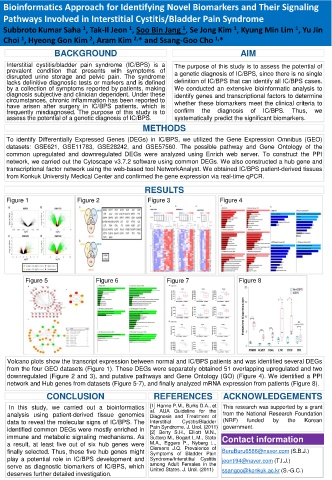
   Volcano plots show the transcript expression between normal and IC/BPS patients and was identified several DEGs
   from the four GEO datasets (Figure 1). These DEGs were separately obtained 51 overlapping upregulated and two
   downregulated (Figure 2 and 3), and putative pathways and Gene Ontology (GO) (Figure 4). We identified a PPI
   network and Hub genes from datasets (Figure 5-7), and finally analyzed mRNA expression from patients (Figure 8).
                CONCLUSION                         REFERENCES             ACKNOWLEDGEMENTS

    In this study, we carried out a bioinformatics  [1] Hanno P.M., Burks D.A., et  This research was supported by a grant
   analysis using patient-derived tissue genomics  al. AUA Guideline for the  from the National Research Foundation
                                                  Diagnosis and Treatment of
   data to reveal the molecular signs of IC/BPS. The  Interstitial  Cystitis/Bladder  (NRF)  funded  by  the  Korean
   identified common DEGs were mostly enriched in  Pain Syndrome. J. Urol. (2011)  government.
                                                  [2] Berry S.H., Elliott M.N.,
   immune and metabolic signaling mechanisms. As  Suttorp M., Bogart L.M., Stoto  Contact information
   a result, at least five out of six hub genes were  M.A., Eggers P., Nyberg L.,
   finally selected. Thus, these five hub genes might  Clemens J.Q. Prevalence of  BuruBuru6586@naver.com (S.B.J.)
                                                  Symptoms of Bladder Pain
   play a potential role in IC/BPS development and  Syndrome/Interstitial  Cystitis  jeonti94@naver.com (T.I.J.)
   serve as diagnostic biomarkers of IC/BPS, which  among Adult Females in the
                                                  United States. J. Urol. (2011)
   deserves further detailed investigation.                              ssangoo@konkuk.ac.kr (S.-G.C.)

