


Page 51 - F. Cell biology
P. 51
Cell Death according to Silica Nanoparticles manufactured by different methods

                                      Baek Jin Ee, Shin Jae Hoon, Lee Jong Seong
                                 Institute of Occupation & Environment, KCOMWEL, Incheon, Republic of korea

                        BACKGROUND                                                  AIM


   Silica nanoparticles can be roughly divided into two types: wet route base  The  purpose  of  this  study,  was  to  determine
   synthesis  method  and  thermal  route  base  (Pyrogenic)  synthesis  method.  the  difference  in  cytotoxicity  and  cell  death
   Differences in the silica production method may affect the physicochemical  mechanism  according  to  the  physicochemical
   properties  of  silica  nanoparticles,  and  may  cause  different  cytotoxicity  properties of silica nanoparticles by confirming
   results for silica nanoparticles. However, there have been few studies on the  the difference in cytotoxicity according to the
   cytotoxicity of silica nanoparticles made by other methods.     method of manufacturing silica nanoparticles.

                                                METHODS


    4  types  of  Silica  nanoparticles  (Table  1)  dispersed  in  a  culture   Table 1. Silica Nanoparticles (SiNPs)
    solution containing 10% FBS were diluted to a concentration of 0-  Method   Category   Properties   Size [nm]   Manufacturer
    5000 ug/ml, and then put into A549 cells and reacted for 24 hours.                           Sigma Aldrich
                                                                        Colloidal   Hydrophilic   20 - 30
    The  size  and  stability  of  the  dispersed  silica  nanoparticles  were   Wet - base      (Ludox Ⓡ TM)
    analyzed using an electron microscope and a zeta analyzer. CCK-8   Mesoporous   Hydrophilic   200   Sigma Aldrich
    reagent  was  used  to  confirm  proliferation,  and  LDH  assay  was   Fumed (602)   Hydrophilic   20 - 30   HW nanomaterial
                                                               pyrogenic
    performed. And the ROS generation of the cells was confirmed.
                                                                       Fumed (606)   Hydrophobic   20 - 30   HW nanomaterial
                                                RESULTS

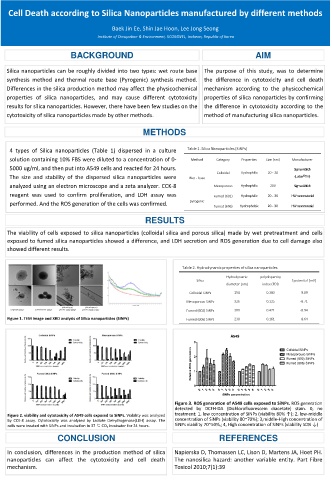
   The viability of cells exposed to silica nanoparticles (colloidal silica and porous silica) made by wet pretreatment and cells
   exposed to fumed silica nanoparticles showed a difference, and LDH secretion and ROS generation due to cell damage also
   showed different results.


                                                            Table 2. Hydrodynamic properties of silica nanoparticles

                                                                           Hydrodynamic   polydispersity
                                                                 Silica                         ζ-potential [mV]
                                                                           diameter [nm]   index (PDI)
                                                               Colloidal SiNPs   154    0.383      -9.09
                                                              Mesoporous SiNPs   326    0.125      -8.71
                                                              Fumed (602) SiNPs   309   0.471      -8.94

   Figure 1. TEM image and XRD analysis of Silica nanoparticles (SiNPs)    Fumed (606) SiNPs   230   0.161   -8.64


                                                                            A549
                                                                3

                                                                                              Colloidal SiNPs
                                                                                              Mesoporouse SiNPs
                                                                2                             Fumed (602) SiNPs
                                                               Relative ROS generation        Fumed (606) SiNPs

                                                                1


                                                                0
                                                                  0 1 2 3 4  0 1 2 3 4  0 1 2 3 4  0 1 2 3 4
                                                                         SiNPs concentration

                                                          Figure 3. ROS generation of A549 cells exposed to SiNPs. ROS generation
                                                          detected  by  DCFH-DA  (Dichlorofluorescein  diacetate)  stain.  0,  no
   Figure 2. viability and cytotoxicity of A549 cells exposed to SiNPs. Viability was analyzed   treatment; 1, low concentration of SiNPs (viability 80% ↑); 2, low-middle
   by  CCK-8  assay.  Cytotoxicity  was  analyzed  by  Lactate  Dehydrogenase(LDH)  assay.  The   concentration of SiNPs (viability 80~70%); 3,middle-High concentration of
   cells were treated with SiNPs and incubation in 37 ℃ CO 2  incubator for 24 hours.   SiNPs viability 70~50%,; 4, High concentration of SiNPs (viability 50% ↓)
                    CONCLUSION                                          REFERENCES

   In  conclusion,  differences  in  the  production  method  of  silica   Napierska D, Thomassen LC, Lison D, Martens JA, Hoet PH.
   nanoparticles  can  affect  the  cytotoxicity  and  cell  death   The  nanosilica  hazard:  another  variable  entity.  Part  Fibre
   mechanism.                                             Toxicol 2010;7(1):39

