


Page 47 - F. Cell biology
P. 47
Cortisone Increases Human Kv1.5 Channel Currents
Soobeen Hwang , Su-Hyun Jo 1,2
1
1 Interdisciplinary Graduate Program for BIT Medical Convergence, Kangwon National University, Chuncheon 200-701, Korea
2 Department of Physiology, School of Medicine, Kangwon National University, Chuncheon 200-701, Korea
ABSTRACT +50 A
-50 -60mV 1.4
Glucocorticoids are the primary hormones that
respond to stress and protect organisms from 1.3
dangerous situations. The glucocorticoids
hydrocortisone dormant form, cortisone, affect the
cardiovascular system with changes such as Current inhibition (%C) by cortisone after 10 min 1.2
increased blood pressure and cardio protection.
Kv1.5 channels are expressed in the heart and Control 100 νM Cortisone 10 µM Cortisone 1.1 Peak
peak
Steady-state
pancreatic beta-cells. The most studied is the human ss
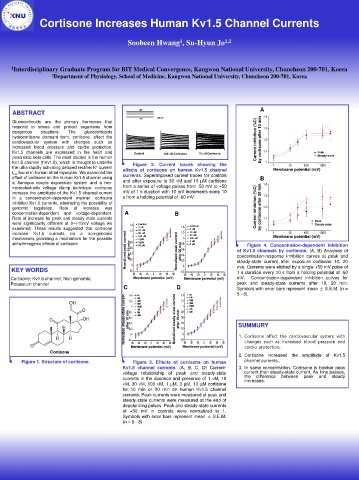
Kv1.5 channel (hKv1.5), which is thought to underlie Figure 2. Current traces showing the 1
the ultra-rapidly activating delayed rectifier K current effects of cortisone on human Kv1.5 channel 1 10 100 1000
+
Membrane potential (mV)
I kur found in human atrial myocytes. We examined the
effect of cortisone on the human Kv1.5 channel using currents. Superimposed current traces for controls B
a Xenopus oocyte expression system and a two- and after exposure to 30 νM and 10 µM cortisone 1.4
microelectrode voltage clamp technique. cortisone from a series of voltage pulses from -50 mV to +50
increase the amplitude of the Kv1.5 channel current mV of 1 s duration with 10 mV increments every 10
in a concentration-dependent manner. cortisone s from a holding potential of -60 mV. 1.3
inhibited Kv1.5 currents, eliminating the possibility of
genomic regulation. Rate of increase was Current inhibition (%C) by cortisone after 20 min 1.2
concentration-dependent and voltage-dependent. A B
Rate of increase for peak and steady state currents 1.1
Peak
were significantly different at 0~+10mV voltage we 1.4 con peak
ss
Steady-state
Control
Control
1 νM
examined. These results suggested that cortisone 1.2 1nM 1.4 con 1
1 νM
1nM
10nM
10 νM
10 νM
increase Kv1.5 currents via a non-genomic 30nM 1.2 10nM 1 10 100 1000
30 νM
30nM
30 νM
100
mechanism, providing a mechanism for the possible 1 100nMνM 1 100nMνM Membrane potential (mV)
100
1uM
1 µM
1 µM
after 10 min Nomalized peak current 0.6 Nomalized peak current after 20 min 0.6 of Kv1.5 channels by cortisone. (A, B) Analyses of
3 µM
arrhythmogenic effects of cortisone. 0.8 3uM 0.8 1uM Figure 4. Concentration-dependent inhibition
3uM
3 µM
10uM
10 µM
0.4
0.4
concentration-response inhibition curves at peak and
0.2
0 0.2 steady-state current after exposure cortisone 10, 20
0
min. Currents were elicited by a single +50 mV pulse of
KEY WORDS -0.2 -0.2
-60 -40 -20 0 20 40 60 -60 -40 -20 0 20 40 60 1 s duration every 10 s from a holding potential of -60
Cortisone; Kv1.5 channel; Non-genomic; Membrane potential (mV) Membrane potential (mV) mV. Concentration-dependent inhibition curves for
Potassium channel peak and steady-state currents after 10, 20 min.
C D Symbols with error bars represent mean ± S.E.M. (n =
1.4 con 1.4 con 5 - 8).
1nM 1nM
1.2 10nM 1.2 10nM
30nM 30nM
1 100nM 1 100nM
1uM 0.8 1uM
0.8
after 10 min Nomalized steady-state current 0.6 10uM Nomalized steady-state current after 20 min 0.6 SUMMURY
3uM
3uM
0.4
0.4
0.2
0
0 0.2 1. Cortisone affect the cardiovascular system with
-0.2 -0.2
-60 -40 -20 0 20 40 60 -60 -40 -20 0 20 40 60 changes such as increased blood pressure and
Membrane potential (mV) Membrane potential (mV) cardio protection.
Cortisone
2. Cortisone increased the amplitude of Kv1.5
Figure 1. Structure of cortisone. Figure 3. Effects of cortisone on human channel currents..
Kv1.5 channel currents. (A, B, C, D) Current- 3. In same concentration, Cortisone is blocker peak
voltage relationship of peak and steady-state current than steady-state current. As time passes,
currents in the absence and presence of 1 νM, 10 the difference between peak and steady
increases.
νM, 30 νM, 100 νM, 1 µM, 3 µM, 10 µM cortisone
for 10 min or 20 min on human Kv1.5 channel
currents. Peak currents were measured at peak and
steady-state currents were measured at the end of
depolarizing pulses. Peak and steady-state currents
of +50 mV in controls were normalized to 1.
Symbols with error bars represent mean ± S.E.M.
(n = 5 - 8).

