


Page 19 - F. Cell biology
P. 19
A novel peptide oligomer of bacitracin induces M1 macrophage polarization by facilitating
  Ca 2+   influx in macrophage-like RAW 264.7 cells
                                                               4
                                                                          5
                                                       3
                                             1,2
                     1,2
           1,2
                                  1,2
  Seon Yeong Ji , Hyesook Lee , Hyun Hwang-Bo , Su-Hyun Hong , Hee-Jae Cha , Cheol Park , Suhkmann Kim , Heui-Soo Kim , Yung Hyun Choi *
                                                                                               1,2
                                                                                    6
  1 Department of Biochemistry, Dong-eui University College of Korean Medicine, Busan 47227,  Anti-Aging Research Center, Dong-eui University, Busan 47340,
                                                            2
  3 Department of Parasitology and Genetics, Kosin University College of Medicine, Busan 49267,  Division of Basic Sciences, College of Liberal Studies, Dong‐eui
                                                              4
  University, Busan 47340, Departments of  Chemistry and  Biological Sciences, Pusan National University, Busan 46241, Republic of Korea
                                      6
                            5
                          BACKGROUND                                                   AIM
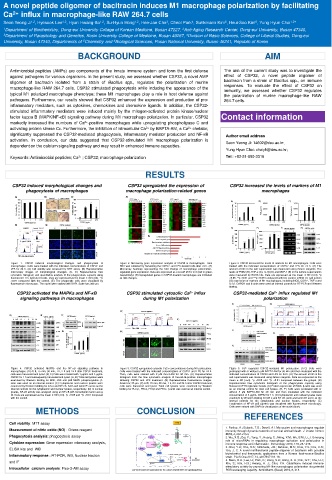
    Antimicrobial peptides (AMPs) are components of the innate immune system and form the first defense  The aim of the current study was to investigate the
    against pathogens for various organisms. In the present study, we assessed whether CSP32, a novel AMP  effect of CSP32, a novel peptide oligomer of
    oligomer of bacitracin isolated from a strain of Bacillus spp., regulates the polarization of murine  bacitracin from a strain of Bacillus spp., on immune
    macrophage-like RAW 264.7 cells. CSP32 stimulated phagocytosis while inducing the appearance of the  responses. To evaluate the effect of CSP32 on
                                                                          immunity, we assessed whether CSP32 regulates
    typical M1 polarized macrophage phenotype; these M1 macrophages play a role in host defense against  the polarization of murine macrophage-like RAW
    pathogens. Furthermore, our results showed that CSP32 enhanced the expression and production of pro-  264.7 cells.
    inflammatory mediators, such as cytokines, chemokines and chemokine ligands. In addition, the CSP32-
    stimulated inflammatory mediators were induced mainly by the mitogen-activated protein kinase/nuclear
    factor kappa B (MAPK/NF-κB) signaling pathway during M1 macrophage polarization. In particular, CSP32  Contact information
                             2+
    markedly increased the numbers of Ca -positive macrophages while upregulating phospholipase C and
    activating protein kinase Cε. Furthermore, the inhibition of intracellular Ca 2+  by BAPTA-AM, a Ca 2+  chelator,
    significantly suppressed the CSP32-mediated phagocytosis, inflammatory mediator production and NF-κB  Author email address
    activation. In conclusion, our data suggested that CSP32-stimulated M1 macrophage polarization is  Seon Yeong Ji: 14602@deu.ac.kr;
    dependent on the calcium signaling pathway and may result in enhanced immune capacities.
                                                                           Yung Hyun Choi: choiyh@deu.ac.kr;
                           2+
    Keywords: Antimicrobial peptides; Ca ; CSP32; macrophage polarization  Tel.: +82-51-890-3316
                                                RESULTS
     CSP32 induced morphological changes and   CSP32 upregulated the expression of   CSP32 increased the levels of markers of M1
         phagocytosis of macrophages      macrophage polarization-related genes       macrophages


     Figure  1.  CSP32  induced  morphological  changes  and  phagocytosis  of  Figure 2. Microarray gene expression analysis of CSP32 in macrophages. Total  Figure 3. CSP32 increased the levels of markers for M1 macrophages. Cells were
     macrophages. Cells were treated with the indicated concentrations of CSP32 and  RNA was collected by harvesting the CSP32- and LPS-treated cells after 24 h. (A)  treated with the indicated concentrations of CSP32 and LPS for 24 h. (A) The
     LPS for 24 h. (A) Cell viability was assessed by MTT assay. (B) Representative  Microarray heatmap representing the fold change of macrophage polarization-  amount of NO in the cell supernatant was measured using Griess reagents. The
     microscopy images of morphological changes. (C, D) Representative flow  regulated gene expression. Data are expressed as a cut-off of 0.5 to 2 (red to green,  levels of PGE2 (B), TNF-α (C), IL-1β (D) and MCP-1 (E) in the culture supernatants
     cytometric histogram and quantitative analysis of the phagocytosis capacity using  respectively). (B) Upregulated genes in CSP32-treated macrophages are indicated  were measured by ELISA kits. Data are expressed as the mean ± SD (n=4). *p
     fluorescent FITC-IgG latex beads. Data are expressed as the mean ± SD (n=4). **p  as fold changes.  <0.05, **p <0.01 and ***p <0.001 compared with the control. mRNA (F) and protein
     <0.01 compared with the control. (E) The phagocytic cells were visualized by  (G) expression of markers of M1 macrophages, including iNOS, COX-2, TNF-α and
     fluorescence microscopy. The nuclei were stained with DAPI. Scale bar; 200 μm.  IL-1β. GAPDH and β-actin were used as internal controls for RT-PCR and Western
                                                                            blotting.
      CSP32 activated the MAPKs and NF-κB  CSP32 stimulated cytosolic Ca 2+  influx   CSP32-mediated Ca 2+  influx regulated M1
        signaling pathways in macrophages       during M1 polarization                 polarization


     Figure 4. CSP32 activated MAPKs and the NF-κB signaling pathway in  Figure 5. CSP32 upregulated cytosolic Ca2+ concentrations during M1 polarization.  Figure 6. Ca 2+ regulated CSP32-mediated M1 polarization. (A-C) Cells were
     macrophages. (A) At 0, 15 min, 30 min, 1 h, 2 h and 24 h after CSP32 treatment,  Cells were treated with the indicated concentrations of CSP32 and LPS for 24 h.  pretreated with or without 5 μM BAPTA-AM for 30 min and then incubated with the
     cells were harvested and lysed. (B, C) Cells were treated with 1 μg/mL and 5 μg/mL  Then, cells were stained with 2 μM fluo-3-AM for 30 min. (A) Representative  indicated concentrations of CSP32 and LPS for 24 h. (A) The amount of NO in the
     CSP32 for 1 h and subsequently harvested and lysed. (A, B) Total cell lysates were  histogram from the flow cytometric analysis of fluo-3A-M-positive macrophages  cell supernatants was measured using Griess reagents. Data are expressed as the
     examined by Western blotting for ERK, JNK and p38 MAPK phosphorylation. β-  following CSP32 and LPS treatment. (B) Representative fluorescence images.  mean ± SD (n=4). *p <0.05 and **p <0.01 compared between the groups. (B)
     actin was used as an internal control. (C) Cytoplasmic and nuclear lysates were  Scale bar; 20 μm. (C) At 0, 15 min, 30 min, 1 h, 2 h and 24 h after CSP32 treatment,  Representative flow cytometric histogram of the phagocytosis capacity using
     examined by Western blotting for IκB-α and NF-κB. Actin and lamin B1 serve as the  cells were harvested and lysed. Total cell lysates were examined by Western  fluorescent FITC-IgG latex beads. (C) Protein expression of iNOS. β-actin was used
     internal controls for the cytoplasmic and nuclear lysates, respectively. (D) In nuclear  blotting for PLCγ1, PKCα, PKCβ and PKCε. β-actin was used as an internal control.  as an internal control for total cell lysates. (D, E) Cells were pretreated with or
     lysates, NF-κB activity was analyzed using an NF-κB p65 transcription factor assay  without 5 μM BAPTA-AM for 30 min and then incubated with the indicated
     kit. Data are expressed as the mean ± SD (n=4). *p <0.05 and **p <0.01 compared  concentration of 5 μg/mL CSP32 for 1 h. (D) Cytoplasmic and nuclear lysates were
     with the control.                                                      examined by Western blotting for IκB-α and NF-κB. Actin and lamin B1 serve as the
                                                                            internal controls for the cytoplasmic and nuclear lysates, respectively. (E)
                                                                            Localization of NF-κB p65 (green) was visualized with fluorescence microscopy.
                                                                            Cells were stained with DAPI for visualization of the nuclei (blue).
             METHODS                          CONCLUSION
                                                                                REFERENCES
    Cell viability: MTT assay
    Measurement of nitric oxide (NO) : Griess reagent                     1. Parihar, A.; Eubank, T.D.; Doseff, A.I. Monocytes and macrophages regulate
                                                                          immunity through dynamic networks of survival and cell death. J. Innate. Immun.
    Phagocytosis analysis: phagocytosis assay                             2010, 2, 204‐215.3
                                                                          2. Wu, X.Q.; Dai, Y.; Yang, Y.; Huang, C.; Meng, X.M.; Wu, B.M.; Li, J. Emerging
    Cytokine expression: Gene expression microarray analysis,             role of microRNAs in regulating macrophage activation and polarization in
                                                                          immune response and inflammation. Immunology 2016, 148, 237‐248.
    ELISA kits and  WB                                                    3. Choi, Y.H.; Cho, S.S.; Simkhada, J.R.; Rahman, M.S.; Choi, Y.S.; Kim, C.S.;
                                                                          Yoo, J. C. A novel multifunctional peptide oligomer of bacitracin with possible
    Inflammatory response : RT-PCR, WB, Nuclear fraction                  bioindustrial and therapeutic applications from a Korean food-source Bacillus
                                                                          strain. PLoS One 2017, 12, e017697118. 18.
    and IF                                                                4. Kwon, D.H.; Lee, H.; Park, C.; Hong, S.H.; Hong, S. H.; Kim, G.Y.; Cha, H.J.;
                                                                          Kim, S.; Kim, H.S.; Hwang, H. J.; Choi, Y.H. Glutathione induced immune-
    Intracellular  calcium analysis: Fluo-3-AM assay  CSP32 stimulates M1 polarization via the calcium-dependent NF-κB signaling pathway  stimulatory activity by promoting M1-like macrophages polarization via potential
                                                                          ROS scavenging capacity. Antioxidants (Basel) 2019, 8, 413.

