


Page 45 - D. Cancer biology
P. 45
D-32
BACKGROUNDS Metagenomics analysis A B
Comparison of alpha diversity in the CRC patients and
Colorectal cancer (CRC) is the most common type healthy controls revealed no significant differences
cancers in the world based on the Chao1 and Shannon indexes, as shown in
CRC occurs sporadically in the majority of cases, Figure 2A
indicating the predominant cause of the disease are Beta diversity at the phylum and genus levels was
environmental factors represented through PCoA (Figure 2B-C). A comparison
Diet-induced changes in gut-microbiome are recently of beta diversity at the genus level demonstrated a clear Figure 4. Distinct metabolic profiling between CRC patients and
supposed to contribute on epidemics of CRC separation between the groups compared to the healthy controls. A Score plot of the three-dimensional PCA and B
phylum-level clusters Loading plots of PC1 and PC2 from the PCA results of differentially
Three individual phyla were found; Firmicutes was accumulating metabolites from CRC patients versus healthy controls
AIM significantly increased in CRC patients, whereas the Table 1. List of metabolites significantly changed in CRC
level of Proteobacteria and Tenericutes was decreased
(Figure 3A,C-D) Metabolite Class Fold-change p-value
This study was aimed to investigate the association of For the genus level, 34 bacterial genera between the Leucine (CRC/Healthy control) 5.75E-03
(FDR-adjusted)
2.43
metagenomics and metabolomics in gut extracellular groups were significantly changed (Figure 3B, E-F) Isoleucine 2.19 5.23E-03
vesicles (EVs) of CRC and healthy subjects Alanine Amino acid 1.67 4.31E-02
A B C Lysine 1.44 1.48E-02
Tyramine 1.42 1.57E-22
Aminoisobutyric acid -1.12 6.66E-03
METHODS Ethanolamine Aromatic alcohol 1.38 4.56E-04
Amino alcohol
1.59
1.99E-12
Phenol
Furoic acid 1.42 1.31E-29
Succinic acid Carboxylic acid 3.15 4.46E-09
Study Population Oxalic acid 1.40 1.66E-03
Butanoic acid -1.30 2.26E-04
Hexanoic acid 1.30 9.38E-06
A total of 32 patients with colorectal cancer and 40 Palmitic acid Fatty acid 1.44 4.37E-25
healthy control individuals from Seoul National Oleic acid 1.32 3.09E-04
University Bundang Hospital, Chung-Ang University Figure 2. Alpha and beta diversity comparisons of microbiomes
Hospital and Haewoondae Baek Hospital participated in collected from CRC patients and healthy controls. A Chao1 and Diagnostic modeling
the present study between April 2016 and April 2018 Shannon indexes indicate alpha diversity. Principal coordinate
Patients were diagnosed for the first time according to analysis (PCoA) plots represent beta diversity at the B phylum and C A Pearson rank correlation analysis demonstrated a
the diagnostic criteria proposed by the International genus levels. Red circles represent healthy control individuals and close correlation between the gut microbiota and
blue circles represent CRC patients
Union Against Cancer and the American Joint certain metabolic products (Figure 5A)
Committee on Cancer in 2013 A B Ultimately, two metabolites (leucine and oxalic acid) and
Stool samples were collected prior to surgery or bowel 100% 100% g__Prevotella 9 two bacterial genera (Collinsella and Solanum
g__Faecalibacterium
90%
preparation and stored at -20 ℃ 90% g__Bacteroides melongena) were selected. Figure 5B-C shows the ROC
g__[Eubacterium]
80% p__Firmicutes 80% coprostanoligenes
p__Bacteroidetes g__Clostridium sensu stricto 1
70% p__Proteobacteria 70% g__Ruminococcus 1 of the logistic regression model to discriminate CRC-
p__Actinobacteria g__Escherichia-Shigella
Collection of Extracellular Vesicles 60% p__Tenericutes 60% g__Turicibacter positive patients from healthy controls
p__Verrucomicrobia
50% p__Fusobacteria 50% g__Lactobacillus
g__Peptoclostridium
Prior to separation of bacterial EVs from stool, a stool 40% p__Cyanobacteria 40% g__Terrisporobacter A
p__Saccharibacteria
sample (1 g) was mixed with 10 mL of phosphate- 30% p__Euryarchaeota 30% g__Pseudomonas
p__Acidobacteria
g__Enterococcus
buffered saline (PBS) followed by vibration for 24 h 20% Others 20% g__Subdoligranulum
Unassigned
g__Methylobacterium
The samples were then incubated to separate the EVs 10% 10% g__Ruminococcus 2
from human stool; EVs from the stool samples were 0% Healthy control CRC 0% Healthy control CRC g__Streptococcus
then isolated using centrifugation at 10,000 × g for 10 C D
min at 4 °C
Bacteria and foreign particles contained in the
supernatant were thoroughly eliminated by filtration
using a 0.22-μm pore size
Metagenomics and Metabolomics profiling
The workflow of metabolic profiling is shown in Figure 1
For the metagnomics profiling, The DNA was extracted Healthy control CRC B C
from bacterial Evs and V3-V4 regions of the 16S rDNA E F
gene was amplified
SILVA 128 database with UCLUST was used for the
classification of operational taxonomic units Metagenomics AUC 1.00 Metagenomics AUC 0.95
Metabolomics profiling was performed using GC-TOFMS Metabolite AUC 0.94 Metabolite AUC 0.92
Combined AUC
1.00
1.00
Combined AUC
The analyzed data were processed using Chroma TOF
and multivariate/univariate analyses were performed for Figure 5. Diagnostic model to discriminate CRC patients. A Heat map
the statistical comparison shows the association between metagenomic and metabolomic data.
All diagnostic models were calculated by logistic ROC curves in B training and C test sets using biomarkers (leucine,
regression based on Akaike information criterion Healthy control CRC oxalic acid, Collinsella and Solanum melongena) to discriminate CRC
Figure 3. Comparison of bacterial composition of EVs from CRC
RESULTS patients and healthy controls. A Relative taxon abundance plots for CONCLUSION
CRC patients and healthy controls at the A phylum and B genus levels.
Heat maps represent the relative abundance of microbes at the C
phylum and E genus levels. The total abundance is 1. Bar graphs Metagenomic profiling demonstrated that bacterial
represent microbial populations that were significantly different in phyla, particularly of Firmicutes and Proteobacteria,
abundance between CRC patients and healthy controls at the D
phylum and F genus levels were significantly altered in patients with colorectal
cancer
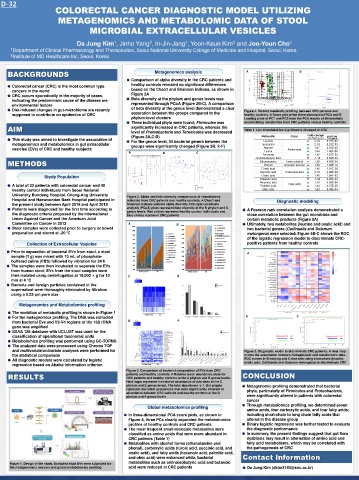
Global metabolomics profiling Through metabolomics profiling, we determined seven
amino acids, four carboxylic acids, and four fatty acids;
In three-dimensional PCA score plots, as shown in including short-chain to long chain fatty acids that
Figure 4, three PCs clearly separated the metabolomics altered in the disease group
profiles of healthy controls and CRC patients Binary logistic regression was further tested to evaluate
The most frequent small-molecule metabolites were the diagnostic performance
classified as amino acids that were more abundant in In summary, the present findings suggest that gut flora
CRC patients (Table 1) dysbiosis may result in alternation of amino acid and
Metabolites with alcohol forms (ethanolamine and fatty acid metabolisms, which may be correlated with
phenol), carboxylic acids (furoic acid, succinic acid, and the pathogenesis of CRC
oxalic acid), and fatty acids (hexanoic acid, palmitic acid,
and oleic acid) were enhanced while, bacterial Contact Information
Figure 1. Design of the study. Extracted stool EVs were subjected for metabolites such as aminoisobutyric acid and butanoic
the metagenomics analysis and global metabolomics profiling acid were reduced in CRC patients Da Jung Kim (dkim3193@snu.ac.kr)

