


Page 3 - D. Cancer biology
P. 3
Metastatic function of METTL18 in breast cancer
                              via actin methylation and Src

                             1
                                                                                       1
        Jieun Oh  , Han Gyung Kim  , Yo Han Hong  , Wooram Choi  , Deok Jeong , Chaoran Song  , Long You , and Jae Youl Cho 1
               1
                                                                1
                                                     1
                                                                             1
                                         1
                1 Department of Integrative Biotechnology, Sungkyunkwan University, Suwon, 16419, Republic of Korea
                   BACKGROUND                                                  AIM
   Breast cancer is the most common form of malignant tumor and  We examined methylation of histidine (His)-73 residue of actin by
   second leading cause of cancer-related deaths in women. Triple  METTL18 as a crucial component of metastatic responses of
                                                          breast tumor cells through modulation of the actin cytoskeleton and
   negative breast cancer (TNBC), accounts for 10 - 15 % of breast  Src phosphorylation.
   cancer and neither of approved drugs nor established
   chemotherapy targeting TNBC at present. METTL18 (histidine              METHODS
   methyltransferase 1 homolog) is considered a putative human
   homolog of YY110W (yeast histidine methyltransferase). B-actin,  Immunoblot and realtime PCR were used to detect METTL18
   S100A9, myosin, myosin kinase, and ribosomal protein RPL3  expression in cell lines and patient samples. Biological functions of
   were known to be methylated at histidine residues and may be  METTL18 were examined in vitro and in vivo. Via tumor xenografts,
   quite common in intracellular proteins in mammalian cells.  metastasis assay and PET/CT, effect of METTL18 in metastatic
   However, biological function and molecular characterization of  response  were  analyzed.  Immunoprecipitation  and  mass
   METTL18 have yet to be elucidated.                     spectrometry were conducted to determine the methylation of actin
                                                          histidine73 residue.
                                                RESULTS


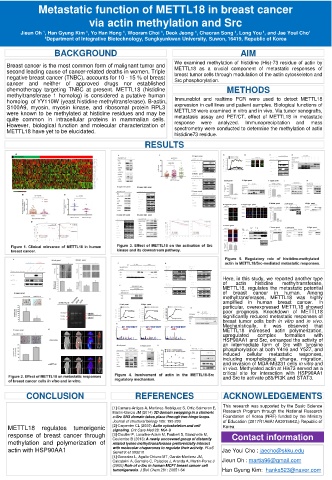
                                                                         Here, in this study, we reported another type
                                                                         of   actin  histidine  methyltransferase,
                                                                         METTL18, regulates the metastatic potential
                                                                         of  breast  cancer  in  human.  Among
                                                                         methyltransferases, METTL18 was highly
                                                                         amplified  in  human  breast  cancer.  In
                                                                         particular, overexpressed METTL18 showed
                                                                         poor prognosis. Knockdown of METTL18
                                                                         significantly reduced metastatic responses of
                                                                         breast tumor cells both in vitro and in vivo.
                                                                         Mechanistically,  it  was  observed  that
                                                                         METTL18 increased actin polymerization,
                                                                         upregulated  complex  formation  with
                                                                         HSP90AA1 and Src, enhanced the activity of
                                                                         an intermediate form of Src with tyrosine
                                                                         phosphorylation at both Y416 and Y527, and
                                                                          induced  cellular  metastatic  responses,
                                                                          including morphological change, migration,
                                                                          and invasion of MDA-MB231 cells in vitro and
                                                                          in vivo. Methylated actin at His73 served as a
                                                                          critical site for interaction with HSP90AA1
                                                                          and Src to activate p85/PI3K and STAT3.
          CONCLUSION                         REFERENCES                   ACKNOWLEDGEMENTS

                                                                          This research was supported by the Basic Science
                                      [1] Camara-Artigas A, Martinez-Rodriguez S, Ortiz-Salmeron E,
                                      Martin-Garcia JM (2014) 3D domain swapping in a chimeric   Research Program through the National Research
                                      c-Src SH3 domain takes place through two hinge loops.  Foundation of Korea (NRF) funded by the Ministry
                                      Journal of structural biology 186: 195-203  of Education (2017R1A6A1A03015642,) Republic of
    METTL18    regulates  tumorigenic  [2] Carpenter CL (2000) Actin cytoskeleton and cell   Korea
                                      signaling. Crit Care Med 28: N94-9
    response of breast cancer through  [3] Cloutier P, Lavallee-Adam M, Faubert D, Blanchette M,   Contact information
                                      Coulombe B (2013) A newly uncovered group of distantly
    methylation and polymerization of  related lysine methyltransferases preferentially interact
    actin with HSP90AA1               with molecular chaperones to regulate their activity. PLoS  Jae Youl Cho : jaecho@skku.edu
                                      Genet 9: e1003210
                                      [4] Gonzalez L, Agullo-Ortuno MT, Garcia-Martinez JM,
                                      Calcabrini A, Gamallo C, Palacios J, Aranda A, Martin-Perez J   Jieun Oh : martia96@gmail.com
                                      (2006) Role of c-Src in human MCF7 breast cancer cell
                                      tumorigenesis. J Biol Chem 281: 20851-64  Han Gyung Kim: hanks523@naver.com

