


Page 7 - D. Cancer biology
P. 7
FLT3-TAZ signaling induces drug resistance in leukemia
Ji Eun Shin and Hyun Woo Park
Department of Biochemistry, College of Life Science and Biochemistry, Yonsei University
SUMMARY Introduction
YAP/TAZ, the transcriptional co-activators of TEAD and major transducers of the Hippo A B C
pathway, has been studied only in solid tumors. Interestingly, YAP/TAZ are consistently
upregulated in adherent tumor cell lines, but hardly expressed in hematologic malignancies
including lymphoma and leukemia. However, we identified significant upregulation of TAZ in
specific leukemia mouse models driven by FLT3 (AML) or Bcr-Abl (blast crisis-CML; bc-
CML). We observed strong correlation between TAZ and FLT3 induction in bc-CML patients
as well as leukemia cells, which led us to investigate the role of FLT3-TAZ signaling in
imatinib-induced drug resistance in CML. FLT3 expression induced imatinib resistance (IR)
in K562 CML cells. In K562-IR cells, transcription of TAZ mRNA is significantly increased, but
not YAP. Our data shows that target gene induction by TAZ-TEAD interaction promotes Cancer Cell (2015)
imatinib resistance. Importantly, inhibition of FLT3-TAZ signaling re-sensitized K562-IR cell Nat Rev Cancer (2013) Nature medicine(2014)
to imatinib treatment and cause cell death. Therefore, we purpose that combination therapy
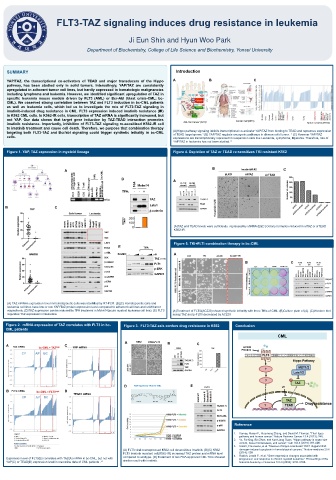
targeting both FLT3-TAZ and Bcr/abl signaling could trigger synthetic lethality in bc-CML (A)Hippo pathway signaling inhibits transcriptional co-activator YAP/TAZ from binding to TEAD and represses expression
1
of TEAD target genes. (B) YAP/TAZ regulate oncogenic pathways in diverse solid tumor . (C) However YAP/TAZ
2
cells. expressions are transcriptionally repressed in suspension cells like Leukemia, Lymphoma, Myeloma. Therefore, role of
YAP/TAZ in leukemia has not been studied. 3
Figure 1. YAP, TAZ expression in myeloid lineage Figure 4. Depletion of TAZ or TEAD re-sensitizes TKI resistant K562
B C
A
D A
10A! Molm14!
TPA:! -! -! +!
TAZ!
Lats1!
B C
β-catenin!
WWTR1 mRNA 200
100
0 (A)TAZ and TEAD levels were sufficiently repressed by shRNA.(B)(C) Colony formation reduced in siTAZ or siTEAD
K562-IR.
Figure 5. TKI+FLTi combination therapy in bc-CML
E TPA!
AC220:! -! -! nM! A
TAZ (T Ab)!
B C
FLT3!
p-ERK!
GAPDH!
AC220: 3,10nM / 12h
TPA: 10nM / 12h!
(A) TAZ mRNAs expression level in hematopoietic cells was identified by RT-PCR. (B)(C) Hematopoietic cells and
leukemia cell lines have low or non YAP/TAZ protein expression level compared to adherent cell lines and solid tumor
respectively. (D)TAZ expression can be induced by TPA treatment in Molm14(acute myeloid leukemia cell line). (E) FLT3 (A)Treatment of FLT3i(AC220) showed synthetic lethality with three TKIs of CML. (B)Culture plate of (A). (C)Western blot
regulates TAZ expression in leukemia. assay;TAZ and p-FLT3 decreased by AC220
Figure 2. mRNA expression of TAZ correlates with FLT3 in bc- Figure 3. FLT3-TAZ axis confers drug resistance in K562 Conclusion
CML patients
CML
A B C
A C
CP AP BC
D FDA-approved TKIs for CML E
B D
CP AP BC
Reference
1. Harvey, Kieran F., Xiaomeng Zhang, and David M. Thomas. "The Hippo
pathway and human cancer." Nature Reviews Cancer 13.4 (2013): 246.
2. Yu, Fa-Xing, Bin Zhao, and Kun-Liang Guan. "Hippo pathway in organ size
control, tissue homeostasis, and cancer." Cell 163.4 (2015): 811-828.
3. Cottini, Francesca, et al. "Rescue of Hippo coactivator YAP1 triggers DNA
(A) FLT3 viral overexpressed K562 cell desensitizes Imatinib. (B)(C) K562 damage–induced apoptosis in hematological cancers." Nature medicine 20.6
FLT3 Imatinib resistant cell(K562-IR) increased TAZ protein and mRNA level 4. (2014): 599
Radich, Jerald P., et al. "Gene expression changes associated with
Expression level of FLT3(B) correlates with TAZ(A) mRNA in bc-CML, but not with compared to wildtype. (D) Treatment of two FDA-approved CML TKIs showed progression and response in chronic myeloid leukemia." Proceedings of the
YAP(C) or TEAD(D) expression level in oncomine data of CML patients . 4 similar result with imatinib. National Academy of Sciences 103.8 (2006): 2794-2799.

